Medjini » Medinous
Powered by Medinous AI

Meet MedJini.

Your AI-led Clinical Assistant for Physicians

Meet the helping hand behind your clinical workflow. From patient histories and medications to investigation results and previous encounters, MedJini brings the information you're looking for into one view—just by asking.

Hello, I'm MedJini.

MedJiniConnecting to encounter…
0:00
Simulated voice session · fictional patient · no microphone used

10–12 Min

Saved on record preparation

Patient history is assembled before the consultation, reducing time spent manually reviewing multiple records.

40%

Faster access to clinical history

Investigations, discharge summaries, medications, and clinical notes are surfaced without navigating across multiple screens.

Zero Clicks

To prepare patient context

Diagnoses, medications, investigations, imaging, and visit history are organised automatically before the encounter begins.

The challenge

Why Physicians Need Faster Access to Patient Information

A patient's story is recorded across different parts of the Electronic Medical Record(EMR). In a structured OPD encounter, that can mean moving through 10–12 separate screens before a clinical decision is made. Across a clinic running 30–40 consultations per physician a day, the physician absorbs that navigation, and it rarely shows up on any operational report.

The gap
EMRs were built for documentation and compliance. Retrieval is manual and sequential, however simple the question.
The drain
Pre-consult navigation happens before clinical work begins, at every encounter on the list.
The cost
Fewer consultations per shift, more documentation load, and fatigue at the busiest points of the day.

MedJini makes that information easier to find, so physicians can spend less time searching and more attention on the consultation.

Clinical Consultation

How MedJini Supports AI-Powered Clinical Workflows

From reviewing patient histories before a consultation to retrieving clinical information during the encounter and analyzing patient trends, MedJini integrates AI-assisted clinical workflows directly into Medinous HMS. Physicians can access relevant patient information, explore clinical data, and make informed decisions without navigating multiple screens or applications.

AI Patient Summary

AI Patient Summaries for Faster Clinical Review

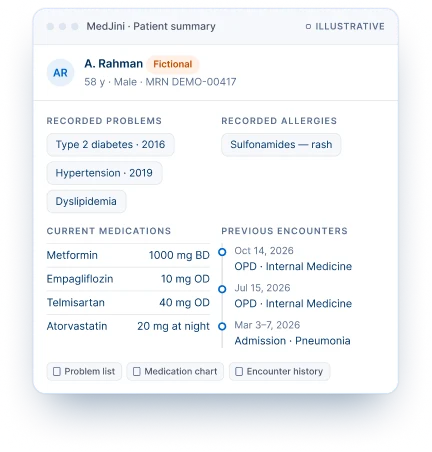
Before a consultation, there's often a history to review—diagnoses, medications, investigations, and previous encounters.

MedJini brings relevant details together in a structured patient summary, so physicians can review the patient's recorded history without searching through each section individually.

  • Brings the history together. Diagnoses, medications, investigations, and previous encounters in one structured summary.
  • Gets you familiar with the patient. Review relevant history before or during the consultation.
  • Keeps the details close. Explore the available recorded information when more context is needed.
Try asking Give me a summary of this patient's recent clinical history.
Explore Patient Summaries
AI Patient Summaries for Faster Clinical Review
Clinical Data Retrieval

Retrieve Patient Records with Natural-Language AI Queries

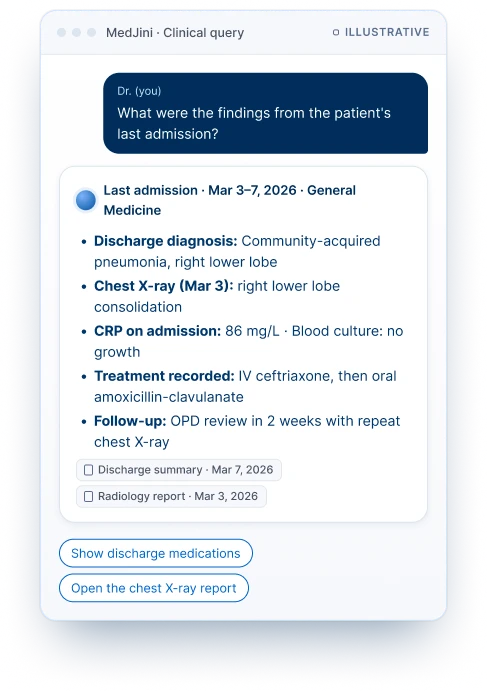
Need the latest HbA1c result? A previous discharge summary? The medications currently recorded?

Ask MedJini in natural clinical language. It retrieves relevant information from the available patient records, without requiring physicians to search through multiple EMR screens.

  • Ask naturally. Use familiar clinical language, without learning technical commands.
  • Find relevant information. Retrieve recorded investigations, medications, clinical notes, and previous encounters.
  • Keep exploring. Ask another question or review additional information from the patient record.
Try asking What were the findings from the patient's last admission?
Try a Clinical Query
Retrieve Patient Records with Natural-Language AI Queries
Patient Trends & History

Review Patient History and Clinical Trends with AI

A patient's clinical history develops across consultations, investigations, and previous encounters.

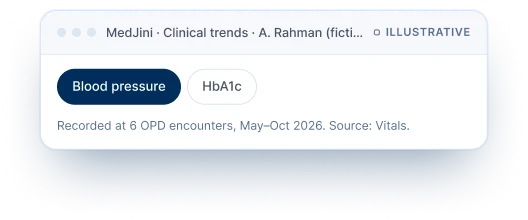
MedJini helps bring recorded clinical values together so physicians can review how those measurements have changed over time.

  • Look across encounters. Access available historical clinical measurements.
  • Bring the numbers together. Review recorded values through clear trend graphs.
  • Explore earlier results. Retrieve historical measurements and their recorded dates.
Try asking Show this patient's blood pressure readings over the last six months.
Explore Clinical Trends
Review Patient History and Clinical Trends with AI
Interactive Demo

Experience MedJini's AI Clinical Assistant in Action

Choose a specialty, then pick a question or type your own. MedJini answers only from what is recorded in the patient's chart.

Select specialty

Choose a question

MedJiniReady
Simulated demo
AR
A. Rahman Fictional patient
58 y · Male · MRN DEMO-00417 · Endocrinology OPD

What would you like to know?

Choose a question, or type your own below.

EMR Integration

AI Clinical Assistance Built into Medinous EMR

MedJini is designed to work within the Medinous Electronic Medical Record(EMR), so physicians can access relevant patient information without switching to a separate application.

Right where you work. Access MedJini within the clinical encounter.
Ask your way. Type a question, use voice input, or select a specialty-focused prompt.
Stay in control. MedJini supports information retrieval. Clinical interpretation and decisions remain with the physician.
See MedJini Inside Medinous
Privacy and clinical oversight.

MedJini works with patient information already held in your Medinous system. It does not diagnose, prescribe, or make treatment decisions. Access controls, data processing and audit arrangements are reviewed with your IT and compliance teams during evaluation.

Technical overview

Secure Clinical AI Integration and Data Governance

Benefits by Role

Benefits of AI Clinical Assistance for Physicians and Hospital Teams

MedJini is usually evaluated by more than one team. Choose a role to see what it means for each of them.

Less Navigation

Fewer screens to move through when retrieving patient information.

Clearer Context

Patient histories and relevant records brought together for review.

A Familiar Workflow

An AI companion within the existing Medinous clinical experience.

In your demo: Ask to see specialty-specific clinical questions configured as one-click prompts.

Resources

Clinical AI Resources and Insights for Healthcare Professionals

Go deeper on AI at the point of care, from the physician's consultation to the questions hospital leaders ask before adopting it.

The Intelligent Clinical Moment

How AI can help physicians make the most of every consultation.

Get the Guide

Managing the Clinical Moment: AI at the Point of Care

Watch the on-demand discussion on how healthcare organizations can introduce AI into the clinical workflow and give physicians faster access to relevant patient context.

Watch the Webinar

AI-led Doctor's Clinical Assistant

An overview of capabilities, how the assistant works inside Medinous HMS, and what a configured demo covers.

Download Brochure
Request a Demo

See MedJini's AI Clinical Assistant in Action

Discover how MedJini helps physicians access patient histories, retrieve clinical information, and review trends—all within their existing Medinous HMS workflow. What to expect in your personalized demo

  • See MedJini in action within the Medinous HMS consultation view.
  • Explore natural-language and voice queries using sample patient records.
  • Review clinical summaries, historical results, and patient trends relevant to your specialty.
Request a Demo

"*" indicates required fields

This field is for validation purposes and should be left unchanged.
Untitled*
FAQ

Frequently Asked Questions About MedJini AI Clinical Assistant

What does MedJini do?

MedJini lets physicians ask questions about a patient in natural clinical language and see relevant recorded information: summaries of history, specific results, medications, previous encounters, and trends in recorded values.

Does MedJini diagnose or recommend treatment?

No. MedJini retrieves and organizes information that is already recorded. Clinical interpretation, diagnosis, and treatment decisions remain with the physician.

Where does MedJini's information come from?

From the patient information available in your Medinous system, such as encounters, notes, medications, and investigation results. Responses point back to the source records so physicians can review them.

Do physicians need a separate app?

No. MedJini is designed to work within the Medinous clinical experience, so physicians stay in the encounter they are already working in.

Can physicians speak their questions?

Yes. Physicians can type a question, use voice input, or choose a quick prompt for commonly asked clinical questions.

How is patient data handled?

MedJini works with patient information held in your Medinous environment. Access controls, data processing and audit arrangements are reviewed with your IT and compliance teams during evaluation.

Does MedJini need a separate login or application?

No. It opens within the Medinous HMS encounter screen. Deployment requirements for your environment are confirmed with your IT team during implementation planning.

How are access permissions handled?

Information stays governed by the role-based access and security controls already configured in Medinous HMS. MedJini does not change who can see what.

Can prompts be set up for our specialties?

Yes. Each physician can have up to 20 specialty-configured query templates, triggered in one click. MedJini also brings forward the questions a physician asks most often.

Which care settings does it support?

MedJini is designed for OPD, IPD and emergency encounters, wherever physicians work in the Medinous HMS encounter screen.

What if the record is incomplete?

MedJini can only show what has been recorded. If information is missing or was never entered, it won’t appear, which is why source references are shown with each response.