
A hospital in Saudi Arabia operates through multiple departments, each playing an important role in patient care and hospital operations. From registration and consultation to billing and discharge, patients interact with different departments throughout their hospital journey. To deliver a seamless patient experience, these departments must work together with proper coordination and efficient communication. At the same time, hospitals must follow Saudi Arabia’s healthcare regulations to maintain compliance, protect patient data and manage financial operations effectively.
This blog explains how ZATCA, NPHIES, PDPL and AR DRG work and their role in strengthening a hospital management system in Saudi Arabia. It also explores how these frameworks support regulatory compliance, improve operational efficiency and help hospitals deliver better patient care.
Understanding Healthcare Regulations in Saudi Arabia
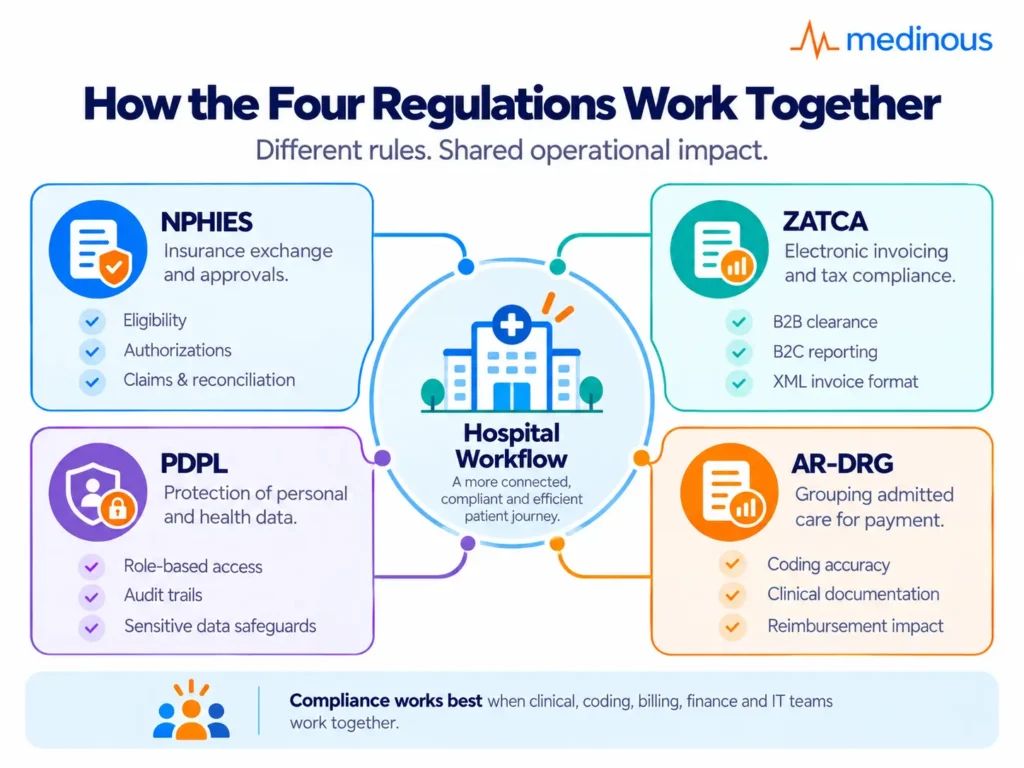
Here are four requirements that matter most for healthcare compliance today:
- NPHIES for insurance claims and approvals
- ZATCA for electronic tax invoices
- PDPL for personal data protection
- AR DRG for grouping admitted care for payment
Each has its own data format, deadlines and checks, so hospital compliance works best when billing, clinical and IT teams plan together. Start by knowing who owns each rule in your organization.
Think of the four requirements as layers. Clinical teams create the record, coders turn it into codes, billing turns codes into claims and invoices, and IT protects every step.
Why These Regulations Should Not Be Managed Separately
Although NPHIES, ZATCA, PDPL and AR DRG address different requirements, hospitals experience them as part of the same operational workflow.
A patient’s clinical encounter may generate documentation, diagnosis and procedure codes, insurance transactions, billing information, tax invoices and sensitive personal data. This means a problem created in one part of the workflow can affect several downstream processes.
For example:
- Incomplete clinical documentation can affect coding and the resulting AR DRG group.
- Incorrect coding can affect the information submitted in an insurance claim.
- A difference between the final billed amount and the tax invoice can create reconciliation issues.
- Excessive access to patient or insurance information can create a PDPL risk.
Compliance therefore works best as an end-to-end operating model rather than four separate projects owned by four separate teams.
For hospital leaders, the more useful question is not simply, “Are we compliant with each regulation?” It is, “Does information move correctly and securely from the clinical encounter through coding, claims, invoicing and settlement?”
What Is NPHIES and How Does It Support Healthcare Providers?
NPHIES is the national platform for health information exchange services. The official implementation guide calls it acentralized, validating, standards-based gateway that connects providers and payers across the Kingdom. The guide reports more than 6,419 provider facilities, 25 insurers and a 98% market share of claims, with 96% of authorizations adjudicated within 30 minutes.
NPHIES validates and delivers messages, but it does not adjudicate claims. Insurers still decide payment. Activity is growing fast. The guide reports 143 million transactions in 2023 and 292 million in 2024. The platform also keeps copies of exchanges to help regulators such as CHI with disputes and market oversight.
NPHIES Integration and Its Role in Healthcare Operations
NPHIES integration lets your system exchange messages directly instead of staff typing into portals. Common transactions that can be made include:
- Eligibility checks before the visit
- Prior authorization for services needing approval
- Claims after the visit
- Payment reconciliation
A connected medical billing system helps teams send clean claims the first time.Experts recommend separate test and live credentials, and testing in the staging environment first. A clinic system never talks to an insurer directly, because everything goes through NPHIES.
What a Good NPHIES Workflow Looks Like
NPHIES compliance is not only about successfully connecting an application to the national platform. Hospitals also need a reliable operational workflow around that connection.
A typical insured patient journey may involve:
- Eligibility : Confirm the patient’s insurance eligibility before services are provided.
- Authorization: Identify services that require approval and submit the required information before treatment where applicable.
- Clinical documentation: Ensure that the diagnosis, procedures and supporting clinical information required for the claim are captured
accurately. - Claim preparation: Convert completed clinical and billing information into the appropriate claim transaction.
- Validation and submission: Validate required identifiers, coding and transaction data before submitting through NPHIES.
- Response and correction: Capture payer or platform responses and route rejected or incomplete transactions to the appropriate team.
- Payment reconciliation:Reconcile accepted claims and payments against the hospital’s billing records. The objective is not simply to submit more claims. It is to increase the proportion that moves through the process without unnecessary rework.
How ZATCA Requirements Affect Healthcare Providers
Insured services appear on both the NPHIES claim and the tax invoice, so the figures must match. Build both from the same invoice to avoid month-end mismatches. Research rules sit in the integration phase of electronic invoicing, which started on 1 January 2023 and is rolled out to taxpayers in groups.
As rollout happens in groups, ask your finance team or ZATCA which group your facility belongs to and when your integration deadline falls. Start early, because testing always takes extra time.
ZATCA Compliance and Digital Invoicing in Healthcare
ZATCA compliance in the integration phase works in two ways:
- Clearance: standard B2B invoices go to the Fatoora platform for stamping before the buyer receives them.
- Reporting: simplified B2C invoices are issued with a QR code and reported within 24 hours. Invoices must use XML format through ZATCA interfaces.
Compare the totals on claims and invoices before month-end. Small mismatches are easier to fix early
Why NPHIES and ZATCA Reconciliation Matters
For insured care, the financial workflow does not end when a claim is submitted. The hospital also needs
confidence that the amount represented in the insurance workflow aligns with the amount represented in its financial and tax records.
This makes reconciliation an important compliance control.
Hospitals should be able to trace the journey from:
Clinical service → charge → insurance claim → payer response → final invoice → payment → financial record
If these stages are managed in disconnected applications or spreadsheets, finance and billing teams may spend significant time investigating differences at month-end.
A connected hospital management system can reduce this risk by allowing clinical charges, insurance transactions, invoices and financial information to originate from the same underlying workflow.
Understanding PDPL and Healthcare Data Protection
The Personal Data Protection Law is fully enforceable since 14 September 2024, with SDAIA as the regulator. Health data counts as sensitive data, and fines can reach SAR 5,000,000. The sensitive data needs stricter access controls, encryption and documented risk assessments. Strong healthcare data security is therefore a legal duty, not only good practice.
Explore Medinous healthcare data security capabilities for controlled access and auditability.
The law reaches foreign organizations that process the data of people in Saudi Arabia, that transfer data outside the Kingdom need safeguards, and that breaches must be notified to SDAIA and affected individuals on time.
What PDPL Means Inside the Hospital Workflow
PDPL is sometimes approached as an IT or cybersecurity requirement. In practice, data protection touches almost every hospital department. Sensitive information can pass through:
- Registration
- Appointments
- Insurance
- Clinical documentation
- Laboratory and radiology
- Pharmacy
- Billing
- Patient portals
- Reporting and analytics
Hospitals therefore need to consider not only whether patient data is encrypted, but also who can see it, why they can see it, what they can do with it and whether those actions can be traced.
Useful controls include:
- Role-based access
- User authentication
- Audit trails
- Controlled sharing of information
- Documented permissions
- Appropriate retention and disposal practices
- Controls around data transfers
- Incident and breach-response procedures
A receptionist, physician, coder, billing executive and hospital administrator do not require identical access to patient information. Good compliance therefore starts with aligning system access to real operational responsibilities.
What Is AR-DRG and How Does It Affect Healthcare Providers?
AR-DRG is the Australian Refined system for grouping admitted care. The Council of Health Insurance introduced it as a payment mechanism, and providers group admitted and day-care encounters on Version 9.0. Payment then depends on the coded record, not the length of the bill. Coders use ICD-10-AM for diagnoses, ACHI for procedures and ACS rules, which differ from ICD-10-CM with CPT.
Internationally, IHACPA approved Version 12.0 in April 2025. Yet, Saudi providers are measured on Version 9.0 today, so avoid mixing versions. Documentation must also record the comorbidities actually treated, because complexity that is not written down is not paid.
Insurers still decide payment, so a clean claim remains your job.
Why AR-DRG Makes Clinical Documentation a Financial Issue
Under activity-based payment models, the quality of clinical documentation can directly affect reimbursement.
The workflow is closely connected:
Clinical documentation → Coding → DRG assignment → Claim → Reimbursement
If relevant diagnoses, procedures or complexity are not accurately documented, the coding team cannot simply assume that they occurred.
This makes documentation quality a shared responsibility between clinicians, coding teams and revenue-cycle teams.
Hospitals preparing for DRG-based payment should therefore look beyond coder training alone. They should also assess:
- Whether physicians capture the required clinical detail
- Whether coders can easily access the complete patient record
- Whether diagnoses and procedures are consistently coded
- Whether incomplete records are identified quickly
- Whether coding and billing teams can review exceptions before claims are submitted
- Whether hospital leaders can monitor DRG patterns and documentation gaps
The more connected these processes are, the easier it becomes to identify revenue leakage before the claim leaves the hospital.
How These Requirements Influence Hospital Compliance
They connect in daily work:
- Clinical notes drive codes, and codes drive AR DRG groups.
- Groups and prices feed NPHIES claims.
- Final amounts must match ZATCA invoices.
- Every step must protect personal data under PDPL.
- One weak link, such as poor documentation, can ripple through the others.
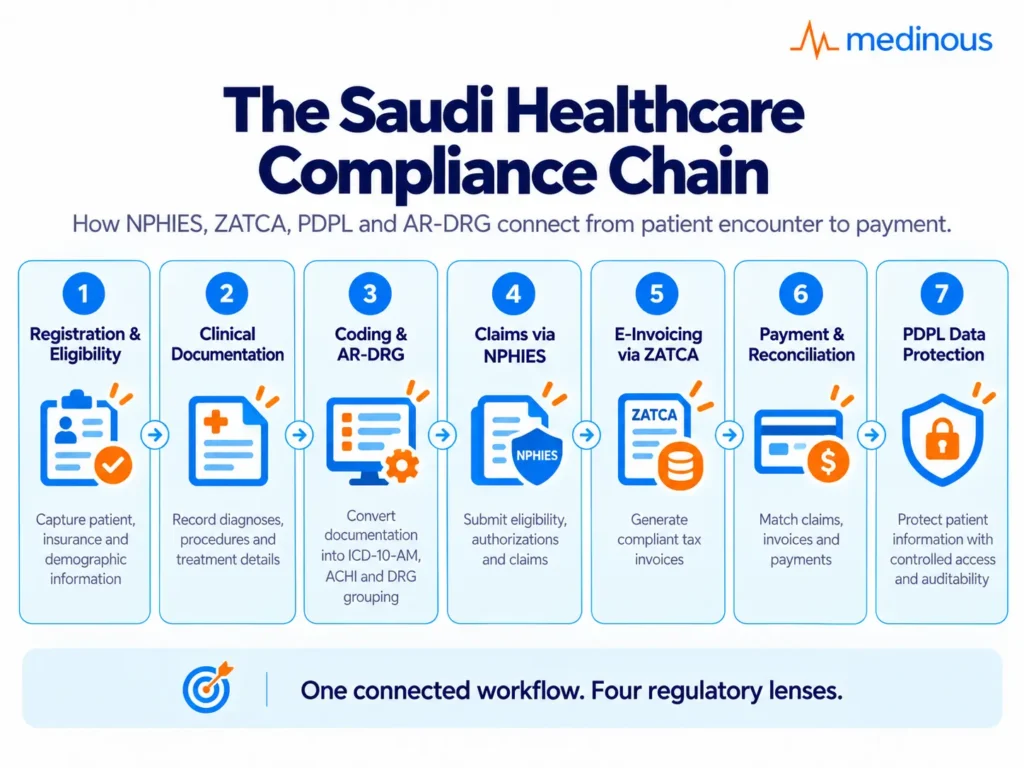
The Compliance Chain: From Patient Encounter to Payment
Hospitals can think about Saudi healthcare compliance as one connected chain rather than four separate
regulatory obligations.
- Capture
Registration and clinical teams capture accurate patient, insurance and clinical information. - Protect
PDPL controls determine how sensitive information is accessed and handled throughout the workflow. - Code
Clinical documentation is translated into diagnoses and procedures required for AR DRG and claims. - Claim
NPHIES enables the required insurance transactions between the provider and payer. - Invoice
ZATCA requirements govern electronic invoicing and tax-related transaction requirements. - Reconcile
Hospitals reconcile claims, invoices and payments so operational and financial records remain aligned. When these processes run on disconnected systems, compliance becomes a reconciliation exercise. When they are connected, compliance can become part of the normal hospital workflow.
Challenges of Managing Healthcare Compliance
Here are a few of the challenges in managing healthcare compliance:
- Overlapping rules from several regulators with separate formats and deadlines.
- Payer-specific quirks that break generic integrations.
- Missing payer identifiers, which cause unknown payer rejections.
- Coder training for ICD 10 AM and ACHI.
- Disconnected systems that force double entry.
- Time pressure when deadlines for different regulators overlap.
Where Compliance Problems Commonly Begin
Many compliance issues are not caused by a failure to understand the regulation. They begin earlier in everyday workflows.
For example:
- Incorrect patient or payer information captured during registration
- Authorization requirements identified too late
- Incomplete physician documentation
- Coding completed without enough supporting information
- Claims built independently from billing records
- Invoices generated in a separate financial workflow
- Users given broader access than their role requires
- Rejections handled manually without identifying recurring root causes
Hospitals should therefore monitor the points where information is created and handed from one team to another. These handoffs are often where compliance risk becomes operational risk.
How Healthcare Technology Can Support Compliance
Software should be able to carry the load. Look for the following so that the healthcare technology can support compliance:
- Insurance workflows that cover eligibility, approval and claims.
- Strong healthcare interoperability so billing and clinical data move without retyping, using healthcare interoperability standards.
- Clinical modules that capture diagnoses cleanly for coding.
- Access controls and audit logs for healthcare data security, supported by application setup options. Medinous provides billing, insurance and clinical modules that work on one platform. Choose tools that update as rules change, and ask vendors how they track new releases.
- Keep up with updates, as the regulators change standards, circulars and deadlines often.
What Hospitals Should Ask Their HMS Vendor About Saudi Compliance
Compliance capability should be evaluated as part of the hospital management system itself, not treated as a separate checklist after implementation.
Useful questions for technology vendors include:
- How does the platform support NPHIES eligibility, authorization, claims and reconciliation workflows?
- How are rejected transactions identified and corrected?
- Can clinical documentation flow directly into coding and billing workflows?
- How does the system support ICD-10-AM and procedure coding requirements?
- How are invoice and insurance values reconciled?
- How does the platform support ZATCA electronic invoicing workflows?
- Can access be configured by user role?
- Are important user and data activities auditable?
- How are regulatory updates incorporated into the product?
- Can dashboards help management identify rejections, pending approvals, coding gaps or financial exceptions?
The right technology should reduce the amount of compliance work happening outside the system in spreadsheets, emails and manual reconciliation processes.
A Practical Saudi Healthcare Compliance Dashboard
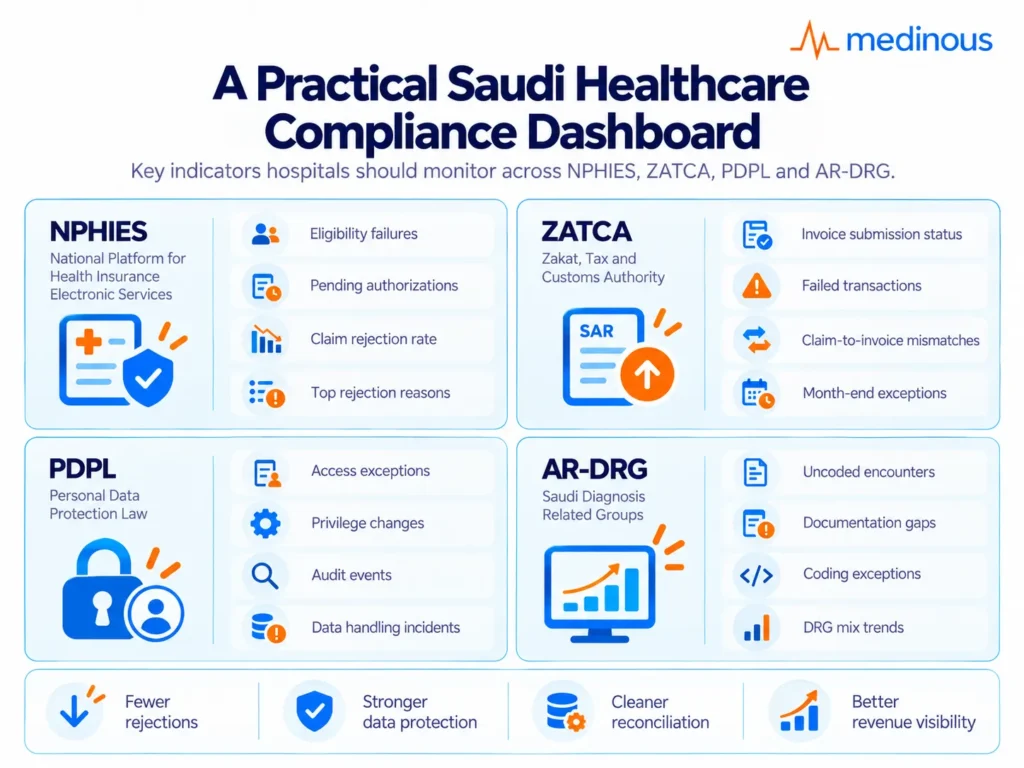
Hospital leadership should not have to wait until month-end to discover that something is wrong. A useful compliance dashboard can bring together operational indicators from across these workflows.
Examples include:
NPHIES
- Eligibility failures
- Pending authorizations
- Claim acceptance and rejection rates
- Top rejection reasons
- Outstanding payer responses
AR DRG
- Uncoded encounters
- Incomplete clinical documentation
- DRG distribution
- Coding exceptions
ZATCA
- Invoice submission status
- Failed transactions
- Claim-to-invoice reconciliation differences
PDPL
- User access activity
- Privilege changes
- Audit events
- Data access exceptions
This gives management an early-warning system rather than treating compliance as a periodic audit exercise.
Best Practices for Maintaining Healthcare Compliance in Saudi Arabia
Here are a few of the best practices to be followed for maintaining healthcare compliance in Saudi Arabia:
- Check eligibility before every insured visit.
- Track prior authorizations and their validity dates.
- Close visits with coded diagnoses the same day.
- Run shadow billing for AR DRG before payment rules change.
- Reconcile payments quickly and chase short payments.
- Review PDPL duties and risk assessments for sensitive data.
- Confirm current rules with the regulator, because standards change often.
Add two habits on top. Give each regulation one clear owner and hold a short monthly review across billing, clinical and IT teams so problems surface early.
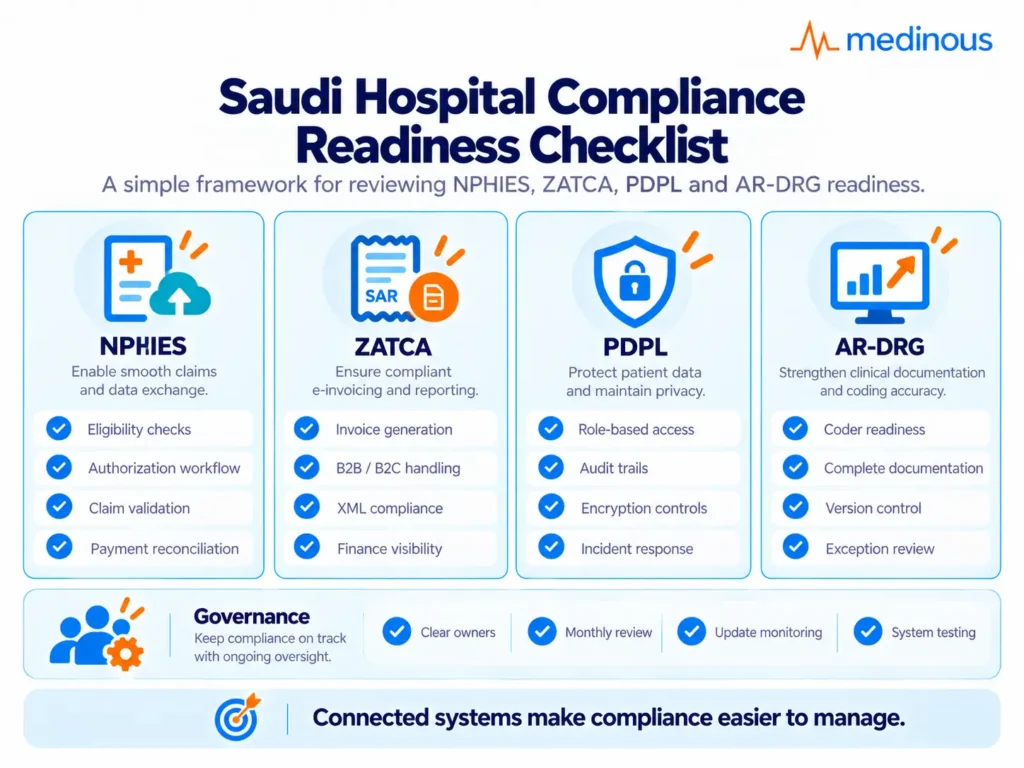
A Practical Compliance Readiness Checklist for Saudi Hospitals
Hospitals can use the following checklist to identify gaps before they become rejected claims, reconciliation issues or compliance incidents.
NPHIES
- Eligibility is checked consistently
- Authorization workflows have clear owners
- Claims are validated before submission
- Rejection reasons are tracked and analysed
- Payments are reconciled against claims
AR DRG
- Clinical documentation supports coding
- Coders are trained on the applicable standards
- Incomplete encounters are identified before billing
- Coding exceptions are reviewed
- DRG performance is monitored
ZATCA
- Invoices originate from reliable billing information
- Required transactions are connected to the invoicing workflow
- Failed submissions are visible to the finance team
- Claims and invoice totals can be reconciled
PDPL
- Sensitive information is protected
- Access is based on user responsibility
- Audit trails are available
- Data-sharing processes are governed
- Incident and escalation procedures are documented
Governance
- Each requirement has a named owner
- Clinical, finance, billing and IT teams review issues together
- Regulatory changes are monitored
- Technology updates are tested before production use
- Recurring compliance problems are tracked to their root cause
How Medinous Can Support a Connected Compliance Workflow
The strongest compliance model is one where regulatory requirements are embedded into the hospital’s everyday operational workflows.
Medinous connects clinical, patient administration, insurance, billing, diagnostics and other hospital processes within an integrated healthcare platform.
For Saudi healthcare organisations, this connected approach can help reduce the gaps between the point where clinical information is created and the point where that information is used for coding, insurance, billing and reporting.
Relevant capabilities include:
- Registration and appointment workflows
- Electronic medical records and clinical documentation
- Billing and insurance workflows
- NPHIES-related transactions
- Clinical coding support
- Financial and invoicing processes
- Role-based access and auditability
- Operational reporting
The advantage of an integrated approach is not simply having individual compliance features. It is having clinical and financial workflows share the same underlying patient and encounter information.
This can reduce duplicate entry, help teams identify exceptions earlier and create a clearer audit trail across the patient journey.
For hospitals in Saudi Arabia, compliance should increasingly become part of the operating system of the hospital rather than a separate activity performed after care has been delivered.
FAQs
What is NPHIES?
It is Saudi Arabia’s national platform for exchanging health and insurance information between providers and payers.
Does NPHIES approve claims?
No, NPHIES validates and delivers messages, while insurers adjudicate.
What is ZATCA clearance?
It is the stamping of B2B invoices by ZATCA before they reach the buyer.
Is health data sensitive under PDPL?
Yes, health data is sensitive under PDPL, as it needs stronger safeguards.
What is AR DRG?
AR DRG is a system that groups admitted care for payment, based on coded diagnoses and procedures.
Which AR DRG version applies in Saudi Arabia?
Reports say Version 9.0 is applied for SR DRG in Saudi Arabia.
What is the relationship between NPHIES and AR DRG?
AR DRG determines how eligible admitted care is grouped based on clinical coding, while NPHIES supports the insurance transaction workflow between healthcare providers and payers. Accurate clinical documentation and coding therefore affect the information that ultimately supports the claim.
Why should hospitals integrate ZATCA and NPHIES workflows?
Insurance claims and financial invoices are connected to the same healthcare services. Building them from consistent billing information can reduce discrepancies between claims, invoices and financial records and simplify reconciliation.
How does PDPL affect hospital management systems?
Hospital management systems process sensitive patient information across clinical and administrative workflows. Hospitals therefore need controls such as role-based access, audit trails and appropriate data protection practices so users only access information required for their responsibilities.
How can hospitals reduce NPHIES claim rejections?
Hospitals can reduce avoidable rejections by validating patient and payer information early, checking eligibility, managing authorization requirements, improving clinical documentation and coding, validating claims before submission and analysing recurring rejection reasons.
How should hospitals prepare for AR DRG?
Preparation should include both coding and clinical workflows. Hospitals need trained coding teams, complete clinical documentation, consistent diagnosis and procedure capture, processes for identifying incomplete records and visibility into coding and DRG exceptions before claims are submitted.
Can one hospital management system support NPHIES, ZATCA, PDPL and AR DRG compliance?
An integrated hospital management system can support the workflows and controls required across these areas by connecting clinical documentation, coding, insurance, billing, invoicing and data-access processes. Regulatory responsibility still remains with the healthcare organisation, so hospitals should also maintain governance,
training and regular compliance reviews.