

A crowded waiting room is more torturous than the disease itself. The unclear wait is clearly frustrating, and for hospitals, this is an inconvenience. Waiting time will directly impact patient satisfaction, staff workload and the reputation of the hospital. The straight solution to this issue is a well-designed “Hospital Management System”. A hospital queue management system addresses this problem directly by organizing how patients move through outpatient departments from check-in to consultation.
At Medinous, we work with hospitals and clinics that want to modernize outpatient operations without being complex for the staff. This blog looks at why outpatient flow matters, the challenges most facilities face, and how digital queue management can turn a chaotic waiting room into a predictable, patient-friendly process.
Why Outpatient Flow Matters for Hospital Efficiency
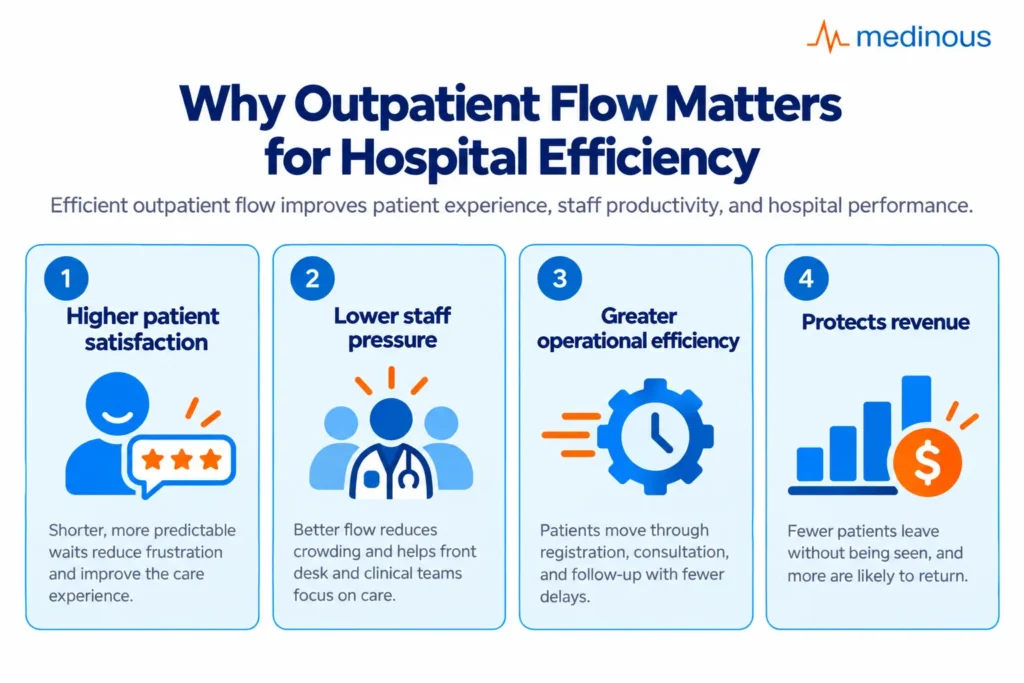
Outpatient departments are often the busiest and most visible part of a hospital. Long waits do more than frustrate patients; they lower satisfaction scores, add pressure on staff, and increase the chance that patients leave before being seen at all.
When flow is managed well, patients move through registration and consultation. Any follow-up steps are completed with far less confusion, and clinical staff can focus on care rather than managing a crowded room.
Smooth outpatient flow also protects revenue. Patients who leave without being seen, or who have a poor experience because of long unexplained waits, are less likely to return or recommend the facility to others.
For hospital leaders, reducing patient waiting time in hospitals has become as much a financial priority as a service one, since every patient who walks out unseen represents lost care and revenue.
Common Challenges in Outpatient Queue Management
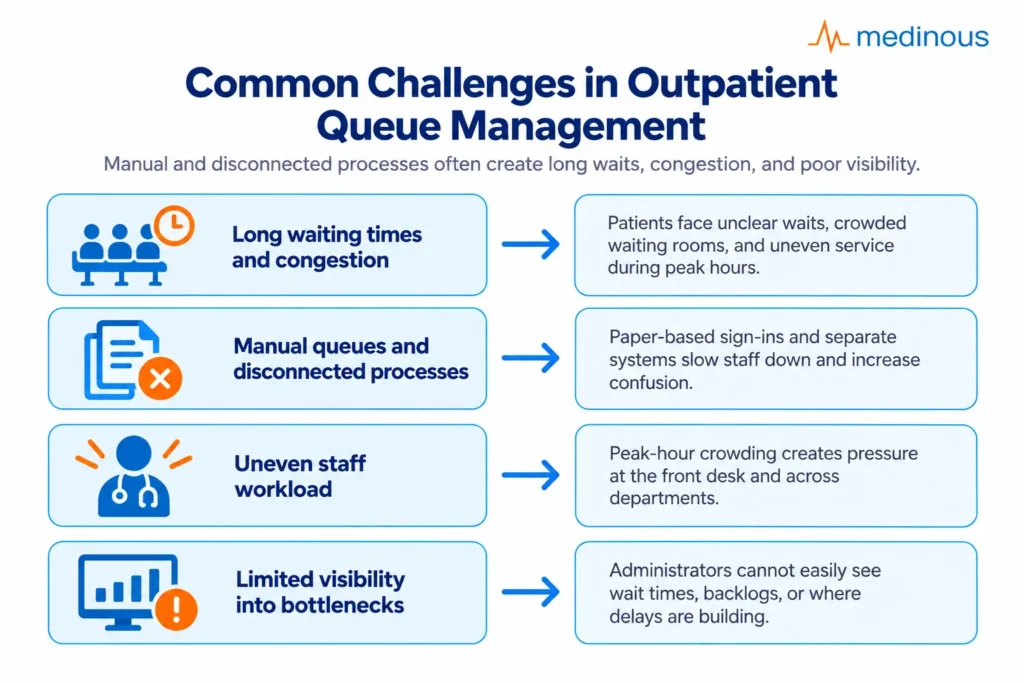
You will encounter a lot of challenges in outpatient queue management. The most common challenges are mentioned below:
Long Waiting Times and Patient Congestion
Many outpatient departments still rely on first-come, first-served lines with little visibility into how long a wait will actually take. This creates congestion at peak hours, uneven staff workloads throughout the day, and anxious patients who have no idea whether they are next or forgotten.
Emergency and outpatient settings alike face this pressure, with some facilities reporting waits that stretch well beyond patient expectations during busy periods.
Manual Queues and Disconnected Processes
When registration, appointment scheduling, and department queues are not connected, staff end up managing the same patient information in multiple places. This slows everything down and increases the risk of errors, such as calling the wrong patient or losing track of who has already checked in. A manual, paper-based queue also gives administrators very little insight into where bottlenecks are actually happening across departments.
How a Hospital Queue Management System Improves Patient Flow
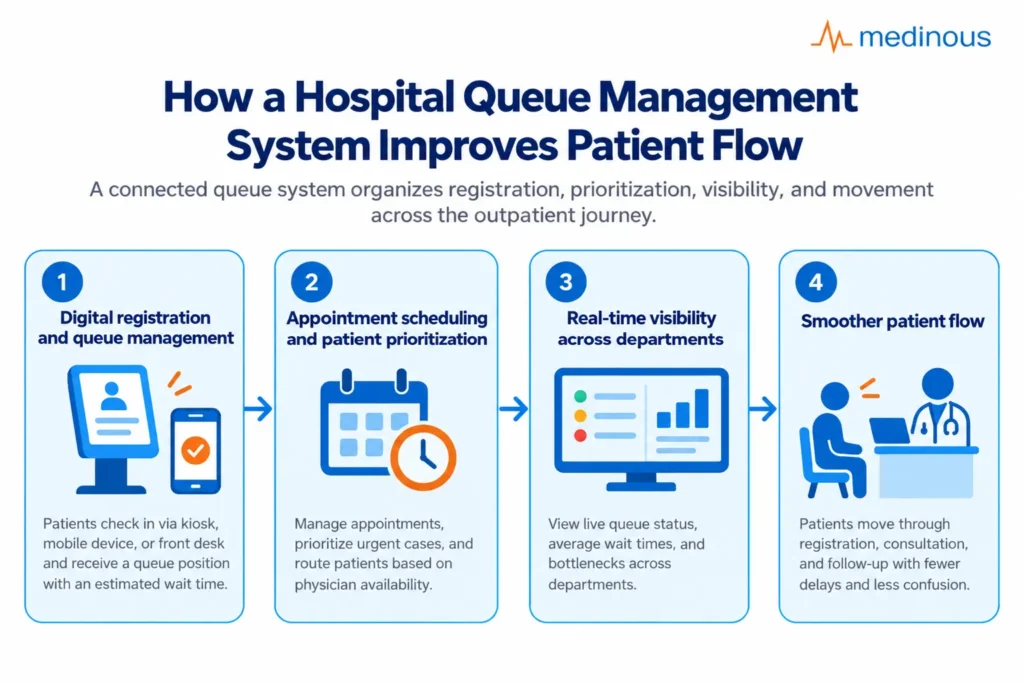
Here is a process in which a hospital queue management system improves patient flow:
Digital Registration and Queue Management
Replacing a physical line with a digital system allows patients to check in through a kiosk, mobile device, or front desk terminal, and immediately receive a position in the queue along with a realistic wait estimate. This kind of digital queueing system reduces confusion, keeps everyone in order, and lets staff focus on the patients in front of them rather than managing the flow of the waiting room manually.
Appointment Scheduling and Patient Prioritization
A strong queue system does more than track order of arrival. It allows staff to prioritize based on urgency, appointment type, or physician availability, so that patients with scheduled appointments are not stuck waiting behind unscheduled walk-ins, and urgent cases can be moved forward without disrupting the flow for everyone else. This kind of smart prioritization is far more difficult to manage consistently with a manual sign-in sheet.
Real-Time Visibility Across Departments
Perhaps the biggest advantage of a digital system is visibility. Administrators can see exactly how many patients are waiting in each department, how long the average wait has been, and where bottlenecks are forming in real time. This turns outpatient management from a reactive, day-to-day scramble into something hospital leaders can actively monitor and improve.
Key Benefits for Hospitals and Patients
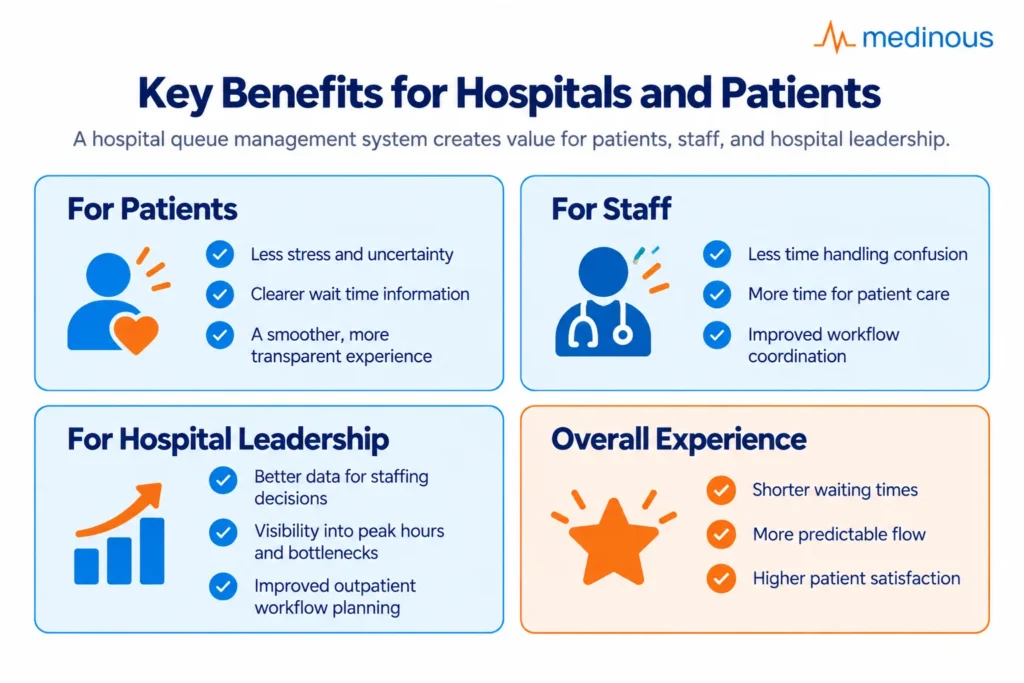
Here are the benefits for hospitals and patients:
- Patients: Experience less stress and greater transparency because they have a better idea of when they will be seen instead of having to guess.
- Staff: Spend less time handling confusion at the front desk and more time focusing on patient care.
- Hospital leadership: Gain useful data to plan staffing more accurately, identify peak hours, and improve outpatient management software workflows based on actual patterns rather than guesswork.
- Overall experience: A well-managed queue can create a smoother and more predictable experience for everyone involved.
What to Look for in a Hospital Queue Management System?
Not every queue solution is built for the complexity of a hospital environment. Look for a system that integrates directly with your clinic management software and existing outpatient management tools, rather than operating as a disconnected add-on that requires staff to work across separate screens.
Real-time dashboards, automated patient notifications, and the ability to route patients to the correct department or physician automatically are all features worth prioritizing. It is also worth checking whether the system supports analytics over time, since long-term trend data is what allows administrators to make lasting improvements rather than one-off fixes.
Best Practices for Improving Outpatient Flow
Here is a list of the best practices for improving the outpatient flow:
- Combine technology with clear communication: A queue management system works best when supported by clear signage and communication, helping patients understand the process from the moment they arrive.
- Review wait time data regularly: Monitor queue data to identify patterns and adjust staffing during predictable peak periods instead of waiting for congestion to build up.
- Train front desk and clinical staff together: Ensure everyone understands how the digital queue fits into their existing workflow, rather than creating an additional or disconnected task.
- Use queue data for continuous improvement: Treat queue data as an ongoing improvement tool. Small adjustments to routing or scheduling can gradually reduce patient waiting times without requiring a complete operational overhaul.
- Improve outpatient department visibility: A connected queue system does more than move patients through a line faster. It gives hospitals greater visibility and control over outpatient departments while keeping the patient experience at the centre of decisions.
- Focus on more than speed: Fast-moving queues do not automatically create a better experience. Patients also need to know where to go next and feel confident that they have not been overlooked.
- Keep patients informed: The most effective systems combine predictable waiting times with clear communication at every stage, particularly during busy periods.
- Make outpatient flow an ongoing priority: Hospitals that continuously monitor and improve outpatient flow can work towards lasting improvements in patient satisfaction and staff efficiency over time.
Medinous supports this kind of connected outpatient workflow through practice management software built to bring registration, scheduling, and queueing into a single system, giving hospital administrators the tools to plan rather than constantly react to a crowded waiting room.