
Managing a hospital today requires timely, accurate, and actionable information. Every day, hospitals generate large volumes of data across outpatient departments, inpatient wards, emergency care, pharmacy, laboratory, radiology, billing, insurance, collections, and discharge workflows. However, in many healthcare organizations, this information is still reviewed through delayed reports, spreadsheet exports, and department-wise summaries.
The shift toward healthcare analytics reflects a larger industry movement. According to Grand View Research, the global healthcare analytics market was estimated at USD 65.6 billion in 2025 and is projected to reach USD 198.8 billion by 2033, growing at a CAGR of 13.5% from 2026 to 2033. This growth reflects the increasing need for hospitals to make operational, financial, and clinical data more visible, usable, and decision-ready.
The challenge is not the absence of data. The real challenge is the ability to convert hospital data into timely decisions. The new Medinous AI Analytics Dashboard is designed to address this gap. Built as an intelligent hospital analytics dashboard, it brings together AI-powered search, real-time KPI monitoring, operational analytics, automated PDF reporting, pinned charts, WhatsApp-based queries, and proactive alerts in one connected view.
Why Hospitals Need a Smarter Analytics Dashboard
Traditional hospital reporting plays an important role in performance reviews. However, static dashboards and monthly MIS summaries are often not sufficient for hospitals that need faster operational and financial visibility. Revenue may appear strong while collections remain low. Patient volumes may increase while revenue per patient declines. Insurance receivables may continue to build without timely escalation. Pharmacy prescriptions may be issued but not completed. Radiology appointments may be scheduled but not converted into actual visits.
A modern hospital performance dashboard must therefore do more than present historical data. It must help leaders ask direct questions, compare performance across departments, identify exceptions, and act before operational or financial risks increase. The Medinous AI Analytics Dashboard provides CEOs, CFOs, COOs, administrators, and department leaders with a faster and more structured way to monitor hospital performance.
1. AI Search for Faster Hospital Data Insights
One of the key capabilities of the Medinous AI Analytics Dashboard is the AI Search Bar. It allows authorized users to ask questions in natural language and receive visual responses. Instead of navigating multiple reports or waiting for data teams to prepare custom summaries, hospital leaders can ask questions such as: “What are the top revenue departments in Q2?”, “What is the current month cash collection rate?”, “Which wards have the highest WIP revenue?”, or “How much insurance AR is pending?”
The dashboard returns relevant results with rendered charts, making insights easier to interpret, review, and share. The last five queries are also displayed as quick-access shortcuts, supporting recurring leadership reviews around revenue, collections, patient count, insurance AR, department performance, and alerts.
2. Unified Filters for Consistent Performance Review
Hospital data becomes more meaningful when it can be viewed in context. Revenue must be reviewed by period, department, patient type, billing category, doctor, or location. Patient volumes must be assessed alongside financial and operational indicators.
The dashboard includes a floating slicer bar that controls all charts and KPI cards simultaneously. Users can filter data by Year, Quarter, Month, Department, Area, Patient Type, Billing Type, Doctor, and custom date range. This creates one consistent view of hospital performance and reduces confusion caused by different reporting periods, extracts, or filter logic.
3. KPI Cards for Revenue, AR, and Patient Volume Monitoring
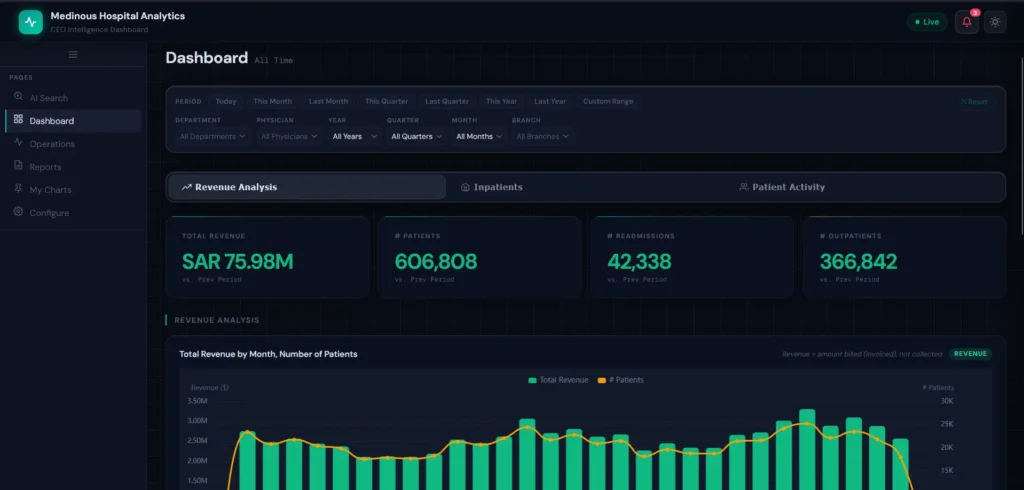
A hospital KPI dashboard should present the most important performance indicators clearly. The Medinous AI Analytics Dashboard highlights Total Revenue, Cash Collection Rate, Insurance AR Pending, Outstanding AR, Total Patients, Inpatients, Outpatients, and Revenue per Patient.
Total Revenue shows invoiced revenue for the selected period. Cash Collection Rate helps leaders assess how effectively billed amounts are converting into collections. Insurance AR Pending shows outstanding amounts owed by insurance sponsors. Outstanding AR provides a broader view of uncollected revenue across billing types. Patient-related indicators help leadership monitor movement across IP and OP channels, while Revenue per Patient connects operational volume with financial performance.
4. Revenue Visibility for Better Financial Control
Hospital revenue management is not limited to billing. It requires a clear understanding of invoiced revenue, collections, outstanding receivables, insurance AR, WIP revenue, and revenue per patient.
A hospital may generate strong billed revenue and still experience cash flow pressure if collections are delayed. This is especially relevant in insurance-heavy environments where denial rates and payer delays can directly affect cash flow. Business Wire reported that the initial denial rate for medical insurance claims increased to 11.81% in 2024, showing why hospitals need closer visibility into claims, receivables, and payer follow-up.
The dashboard helps leadership track these indicators systematically. It provides visibility into total invoiced revenue, cash collection rate, insurance AR pending, outstanding AR, OP/IP revenue split, WIP revenue, and revenue per patient. Year-on-year comparisons also allow leadership teams to assess whether performance is improving or declining over time.
5. Operations Analytics Across OP, IP, Pharmacy, Laboratory, Radiology, and Wards
Hospital financial performance is closely linked to operational activity. Every outpatient visit, emergency encounter, inpatient admission, pharmacy prescription, laboratory request, radiology appointment, and discharge workflow contributes to overall performance.
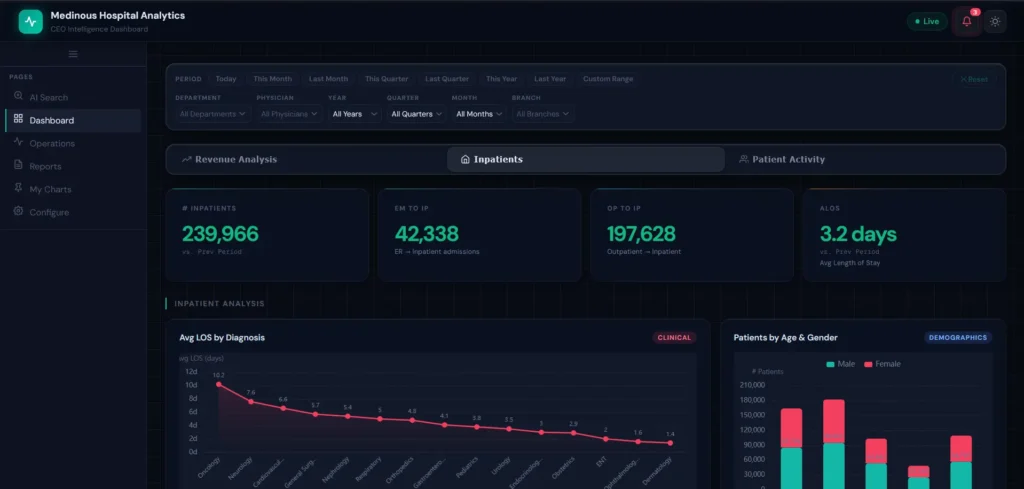
The Operations Page connects these activities with financial outcomes. The Total Earnings view shows revenue split across Outpatient, Inpatient, Total, and WIP. The Outpatients section separates ER and OP channels, showing visit counts and revenue. The Pharmacy section shows prescriptions issued, prescriptions completed, and pharmacy revenue. The Inpatients by Ward view shows admissions, discharges, active inpatient count, and WIP revenue for each ward.
The Laboratory section tracks requests received, samples collected, and revenue. The Radiology section provides modality-wise visibility across X-ray, CT, MRI, and other imaging services, including scheduled appointments, actual visits, and revenue. This gives hospital leaders a more complete view of how operational performance affects revenue, utilization, and departmental efficiency.
6. Automated PDF Reports for Management Reviews
Hospitals require formal reports for management meetings, board reviews, finance discussions, audits, and department-level performance reviews. Report preparation often requires teams to extract data, prepare charts, format tables, validate numbers, and circulate revised versions before a report is ready.
The Medinous AI Analytics Dashboard addresses this through automated PDF reporting. The Flash Report Button generates a hospital-branded PDF based on current dashboard filters. The Reports Page allows users to select predefined templates, choose the reporting month and year, and immediately download a formatted PDF. The Custom Report Tab adds flexibility by allowing users to define the report title, apply filters, preview the report, and schedule automated delivery.
7. Pinned AI Charts and WhatsApp-Based Analytics
Different hospital leaders monitor different indicators. A CEO may focus on revenue, patient movement, alerts, and department performance. A CFO may track collections, AR, WIP, and revenue per patient. A COO may monitor OP, IP, pharmacy, laboratory, radiology, and ward activity. The My Charts Page allows users to pin AI-generated charts and return to them later, creating a more personalized hospital analytics experience.
The dashboard also includes a two-way WhatsApp chatbot that allows authorized users to query hospital performance directly from their phone. Typing “revenue” returns today’s invoiced revenue split into IP and OP, along with patient count. Typing “collection” returns the current month’s billed amount, collected amount, and cash collection rate. Typing “alerts” shows active alerts and the most critical one. This makes real-time hospital analytics accessible without depending on dashboard availability at that moment.
8. Real-Time Alerts for Proactive Hospital Performance Monitoring
Most dashboards require users to open them before problems become visible. In a hospital environment, this can delay intervention. The alert system in the Medinous AI Analytics Dashboard monitors hospital data automatically and notifies leadership when defined thresholds are breached. These alerts can appear inside the dashboard UI and through WhatsApp.
Alerts may be configured for scenarios such as insurance AR crossing a defined limit, cash collection rate dropping below target, outstanding AR rising sharply, WIP exceeding expected thresholds, patient volumes declining, radiology utilization falling, or pharmacy completion rates reducing. This shifts analytics from passive reporting to proactive monitoring.
What the Medinous AI Analytics Dashboard Solves for Hospitals
The Medinous AI Analytics Dashboard gives hospitals a structured way to monitor performance across revenue, collections, AR, patient volumes, operations, reports, alerts, and AI-powered search. For CEOs, it provides faster visibility into hospital performance. For CFOs, it improves control over revenue, receivables, WIP, and payer exposure. For COOs and administrators, it connects operational activity with financial outcomes.
This is not only a dashboard enhancement. It is a more advanced way for hospital leadership to access, question, and act on performance data. Modern hospitals need more than reports that explain what happened. They need real-time hospital intelligence that shows what is happening, where attention is required, and how performance is changing.
Conclusion
The new Medinous AI Analytics Dashboard helps hospitals move from delayed reporting to real-time performance intelligence. With natural-language AI search, unified filters, executive KPI cards, operations analytics, automated PDF reporting, pinned AI charts, WhatsApp-based queries, and proactive alerts, it provides hospital leaders with a clearer and faster way to manage performance.
For hospitals that want stronger control over revenue, collections, patient movement, department performance, and operational risk, real-time hospital analytics is becoming essential. The Medinous AI Analytics Dashboard brings financial, operational, and leadership insights into one connected view, helping hospitals make faster, more informed, and more confident decisions.
Frequently Asked Questions:
What is an AI analytics dashboard for hospitals?
An AI analytics dashboard for hospitals is a digital decision-support tool that uses artificial intelligence, KPI cards, filters, charts, automated reports, and alerts to help hospital leaders monitor revenue, operations, patient volumes, collections, and performance in real time.
How does the Medinous AI Analytics Dashboard support hospital leadership?
It helps hospital leaders track revenue, cash collections, insurance AR, outstanding receivables, patient volumes, OP/IP performance, pharmacy, laboratory, radiology, ward activity, PDF reports, and alerts from one connected dashboard.
What KPIs can hospitals track?
Hospitals can track Total Revenue, Cash Collection Rate, Insurance AR Pending, Outstanding AR, Total Patients, Inpatients, Outpatients, and Revenue per Patient.
Does the dashboard support WhatsApp alerts?
Yes. Authorized users can query hospital data through WhatsApp and receive alerts when defined thresholds are breached.
Request a Demo
See how the Medinous AI Analytics Dashboard can help your hospital move from delayed reporting to real-time performance intelligence. Request a demo to explore AI-powered search, KPI monitoring, operations analytics, automated PDF reports, WhatsApp-based queries, and proactive alerts in action.
Request a demo