
Introduction: Why Modern Hospitals Need Smarter Systems
A hospital management system (HMS) is software that connects a hospital’s clinical and administrative functions registration, scheduling, medical records, diagnostics, pharmacy, billing, and reporting into one platform, so every department works from the same patient and operational data instead of separate, disconnected records.
Doctors, nurses, lab technicians, pharmacists, billing staff, and hospital administrators all use it, each through a view suited to their role. When a patient’s information is entered once at registration, every department that needs it next to the consultation room, the lab, the pharmacy, the billing counter can access it without re-entering data or chasing paper files.
Solutions like Medinous illustrate how HMS platforms have evolved beyond basic record-keeping to enable real-time coordination across departments, improve compliance readiness, and reduce administrative overhead. Unlike piecemeal solutions that function in isolation separate billing modules, standalone EMRs, or disconnected diagnostic logs an integrated HMS provides a consolidated environment where every department operates from a synchronized, validated data source.
At the same time, regulatory expectations are advancing. In the Gulf Cooperation Council (GCC), adherence to HL7 and interoperability standards is essential it is required for integration with national health platforms like NPHIES. Meanwhile, African markets have attracted over $3.8 billion in digital health investments, with a strong emphasis on scalable, standards-based platforms. These trends signal a decisive shift toward unified data architecture, real-time interoperability in healthcare IT, and policy-driven integration.
This guide is a rigorous exploration of the Hospital Management System from its architectural framework and modular components to its integration capabilities and administrative impact. We contrast it with legacy electronic record tools such as EMRs and EHRs, and offer implementation insights that will equip hospital administrators, CIOs, and operations leaders with a practical lens for selecting the HMS that fits their healthcare facilities.
How Does a Hospital Management System Work?
An HMS is built around the patient’s journey through the hospital. A typical flow looks like this:
- Registration A patient’s demographic and contact details are captured once, either at the front desk or through a patient portal, and stored in a central record.
- Appointment The patient is scheduled with the relevant department or doctor, and that slot is visible to both staff and the patient.
- Consultation The doctor pulls up the patient’s history, records the visit’s notes and diagnosis, and places orders directly in the system.
- Diagnostics Lab or radiology orders generated during consultation flow straight to the relevant department, and results attach back to the patient’s record once ready.
- Pharmacy Prescriptions are sent electronically to the pharmacy, which checks stock and dispenses medication.
- Billing/Insurance Charges from consultations, tests, and medication accumulate automatically, and insurance or TPA claims are processed against the same record.
- Admission/Discharge For inpatients, bed allocation, nursing notes, and discharge summaries are tracked within the same system.
- Reporting Data from every step feeds into operational and clinical reports for hospital management.
Without an integrated HMS, each department tends to keep its own records, which leads to duplicate data entry, delays in retrieving information, and a higher chance of errors of a doctor prescribing a drug without visibility into a lab result that hasn’t been shared yet, for example. An integrated system closes those gaps by keeping everyone on the same, current information.

HMS vs EMR vs EHR: Functional, Operational, and Strategic Differences
Understanding the distinction between Hospital Management Systems (HMS), Electronic Medical Records (EMR), and Electronic Health Records (EHR) is critical when evaluating digital infrastructure for healthcare delivery. While these systems may appear to overlap, their scope, functionality, and institutional value differ significantly.
| Dimension | Electronic Medical Record (EMR) | Electronic Health Record (EHR) | Hospital Management System (HMS) |
| Primary Focus | Patient data within a single provider | Patient records across multiple providers | End-to-end hospital operations across all departments and care levels. |
| Core Function | Documentation of visits, diagnoses, and treatment plans. | Coordination of care via data sharing and patient history. | Institutional governance: clinical, operational, financial, and compliance workflows. |
| Modules Included | Medical history, diagnosis, prescriptions | Shared patient summaries, allergy alerts, chronic care plans. | Full clinical + support systems: EMR, OT, LIS, RIS, pharmacy, billing, HR, BI, inventory. |
| Compliance Management | Basic documentation and privacy safeguards. | Patient data security protocols. | Full regulatory suite: CCHI, NPHIES, ICD-10, JCI, NABH, real-time compliance monitoring. |
An HMS like Medinous offers a more comprehensive, standards-based infrastructure compared to traditional EMR and EHR systems by integrating KPIs, compliance modules, and cost center visibility all within one interoperable platform.
What Are the Main Components of a Hospital Management System?

Before getting into individual modules, it helps to see the four functional layers an HMS is generally organized around:
- Patient-facing layer : registration, appointment scheduling, and patient portal access.
- Clinical layer : EMR, doctor’s workbench, nursing, OT, and specialty-specific documentation.
- Ancillary services layer : laboratory, radiology, pharmacy, blood bank, and CSSD.
- Back-office layer : billing and insurance, inventory, finance, quality and compliance, and reporting.
These layers aren’t isolated; a lab result generated in the ancillary layer surfaces automatically in the doctor’s clinical view, and a discharge in the clinical layer triggers a final bill in the back office. That handoff between layers, without anyone re-entering data, is what distinguishes an integrated HMS from a set of standalone tools performing similar jobs in isolation. The sections below go through the modules within each layer in detail.
Key Features of a Hospital Management System
Beyond the module list, a few core capabilities determine how well an HMS actually functions day to day.
Patient registration and appointment scheduling form the entry point; patient details are captured once and reused across every department, while staff and, in many systems, patients themselves can book, reschedule, or view available slots across doctors and departments.
At the clinical center is the EMR, which keeps a patient’s diagnoses, treatment history, allergies, and prescriptions in one place, so any doctor treating the patient works from the full picture instead of fragments from separate visits. OPD and IPD management are typically handled as distinct workflows, since outpatient care is built around quick throughput while inpatient care involves bed assignment, ongoing monitoring, and eventual discharge.
On the diagnostics side, laboratory management tracks a test from the initial order through sample collection to the final result, with the result linking straight back to the patient’s chart. Radiology management works the same way for imaging orders, scheduling, and reports tied to the same record. Pharmacy management checks prescriptions against real-time stock levels, helping catch shortages before they become a problem at the dispensing counter.
Billing and insurance management pulls charges from consultations, tests, procedures, and medication into a single bill automatically, and extends to claim submission and tracking with insurers or third-party administrators, a significant factor in markets where most patients aren’t paying out of pocket.
A few features sit behind the scenes but matter just as much: inventory management tracks consumables and equipment to avoid both stockouts and overstocking; bed management gives a live view of occupancy that speeds up admission decisions; and reporting and analytics turns data from every department into dashboards covering patient volumes, revenue, and operational performance without manual compilation.
Security features round this out. Role-based access means a receptionist and a doctor see very different parts of a patient’s record, matched to what their job requires. Audit controls log who accessed or changed a record and when important both for data protection and for meeting healthcare compliance requirements. And interoperability lets the HMS exchange data with systems outside itself, whether an insurance platform, a government health database, or diagnostic equipment from a different vendor.
Top Modules of Medinous Hospital Management System
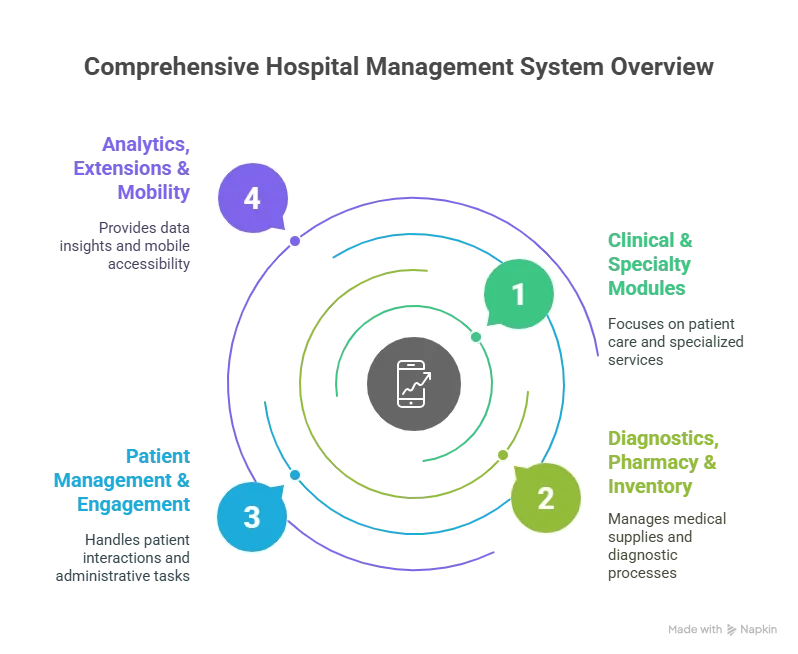
Clinical & Specialty Modules
Specialty-wise EMR: Customizable electronic records tailored to specific medical disciplines for accurate clinical documentation.
Doctor’s Workbench (CPOE): A unified interface for physicians to place orders, record notes, and manage treatment plans.
Nursing & Operation Theatre (OT): Manages nursing tasks, OT scheduling, surgical documentation, and perioperative workflows.
Clinical Model of Care & Order Sets: Provides predefined, evidence-based care pathways and standard order bundles.
Emergency Management: Streamlines triage, stabilization, and emergency care documentation in real-time.
Dental Module: Supports dental charting, treatment planning, and inventory of dental consumables.
Physiotherapy: Manages session scheduling, therapy plans, and patient progress tracking.
Dietary Management: Coordinates patient-specific meal planning based on clinical and nutritional requirements.
Home Care: Enables scheduling, documentation, and monitoring of care delivered outside the hospital.
Wellness Programs: Tracks preventive health check-ups, lifestyle interventions, and chronic disease screenings.
Ancillary Services: Covers additional services like audiology, optometry, and rehabilitation under a single system.
Diagnostics, Pharmacy & Inventory
Laboratory Module: Automates test requisitions, sample tracking, analyzer interfacing, and result reporting.
Radiology Module: Manages imaging orders, DICOM integration, and structured radiologist reporting.
Pharmacy Management: Handles drug dispensing, stock control, expiry alerts, and drug interaction checks.
General Stores & Inventory: Tracks the movement of medical supplies and consumables with real-time inventory status.
Central Sterile Supply Department (CSSD): Manages sterilization workflows, equipment lifecycle, and regulatory traceability.
Blood Bank: Supports donor tracking, compatibility testing, storage, and regulated release of blood products.
Patient Management & Engagement
Patient Care Coordination: Unifies treatment records, nursing notes, and care plans across departments.
Registration & Appointment Scheduling: Digitizes patient onboarding and manages specialty-wise time slots and queues.
Outpatient Management (OPD): Streamlines consultations, prescriptions, diagnostics, and billing in a single flow.
Inpatient Management (IPD) & ADT: Oversees bed allocation, transfers, discharges, and inpatient records.
Patient Portal Access: Allows patients to securely view reports, prescriptions, bills, and appointments online.
Administrative & Operational Support
Back-office Administration: Standardizes administrative workflows like records archiving, document management, and clerical support.
Billing & Insurance Claims: Automates multi-payer billing, insurance pre-authorizations, and claims reconciliation.
Housekeeping & Sanitation: Schedules cleaning rounds and tracks hygiene-related tasks for infection control.
Machine Maintenance & Biomedical Equipment Tracking: Monitors asset uptime, AMC contracts, and service requests.
Application Setup & Role Management: Configures user roles, permissions, tax logic, and localization settings.
Finance & Governance
Finance & Budgeting: Manages general ledger, cost centers, and financial planning with audit-ready records.
Fixed Asset Management: Tracks acquisition, depreciation, servicing, and disposal of physical assets.
Quality & Infection Control: Logs quality metrics, monitors hospital-acquired infections, and supports accreditation.
Incident Reporting & Risk Management: Enables real-time reporting of adverse events with root cause tracking.
Analytics, Extensions & Mobility
Analytics Engine: Delivers real-time insights through customized dashboards and performance KPIs.
MIS Dashboards: Provides executive-level summaries for financials, clinical throughput, and departmental efficiency.
Mobility Access for Clinicians & Staff: Enables mobile-based access to patient data, tasks, and decision support tools.
Types of Hospital Management Systems
Hospitals can choose from a few different deployment types, each suited to different needs:
Cloud-based HMS. Hosted on the vendor’s servers and accessed through the internet. Hospitals avoid maintaining their own servers, and updates are handled centrally well suited to hospitals wanting lower upfront infrastructure costs and access from multiple locations.
On-premise HMS. Installed and run on the hospital’s own servers and infrastructure, giving hospitals more direct control over their data, a common preference for compliance or internal policy reasons, though it requires in-house IT resources to maintain.
Hybrid HMS. Combines both approaches, some modules or data hosted on-premise, others in the cloud. Common for hospitals transitioning from on-premise systems or needing to keep specific data local while using cloud infrastructure elsewhere.
Integrated HMS. A system where all modules clinical, administrative, billing, inventory are built to work together natively, rather than being separate tools stitched together through custom integration work.
Modular HMS. Lets hospitals implement only the modules they currently need registration and billing first, for example and add more as operations grow, instead of deploying the entire system at once.
These categories aren’t mutually exclusive. A hospital might run a modular, cloud-based, integrated HMS; they describe different aspects of the same system rather than competing options.
Cloud vs On-Premise Hospital Management System
Deployment choice is often one of the first decisions a hospital makes:
| Factor | Cloud-Based HMS | On-Premise HMS |
| Deployment | Hosted by the vendor, accessed via internet | Installed on hospital-owned servers |
| Infrastructure | Minimal hardware needed on-site | Requires hospital-managed servers and network setup |
| Maintenance | Handled by the vendor | Managed by the hospital’s IT team |
| Accessibility | Accessible from any location with internet access | Typically limited to the hospital’s internal network unless remote access is separately configured |
| Scalability | Easier to scale as usage grows | Scaling often requires additional hardware investment |
| Security considerations | Depends on the vendor’s security practices and data residency policies | Directly controlled by, and the responsibility of, the hospital |
| Cost considerations | Typically lower upfront cost, ongoing subscription fees | Higher upfront investment, lower recurring costs over time |
| Customization | Often standardized, with some configuration options | Can generally be customized more deeply to match hospital-specific workflows |
Neither option is universally better; the right choice depends on the hospital’s size, IT resources, budget structure, and data governance requirements.
Benefits of Implementing an HMS in 2026
Operational Efficiency Across the Care Continuum
An HMS streamlines complex hospital workflows, eliminating redundancies and bridging interdepartmental silos through automation and real-time coordination.
Discharge time reduction: Hospitals that implemented cloud-based hospital management systems such as Medinous HMS have reported up a drop in the discharge processing time directly improving bed turnover and reducing staff burnout.
Diagnostic automation: Integrated LIS and RIS modules prevent duplicate tests, accelerating clinical decision-making through real-time clinical decision support.
Fewer medical errors: Computerized provider order entry (CPOE), EMR alerts, and medication checks help reduce prescribing and documentation errors significantly.
Built-In Regulatory Compliance
A modern HMS like Medinous embeds compliance frameworks directly into hospital workflows, reducing audit risks and improving payer alignment.
For hospitals operations , choosing a hospital management system in Saudi Arabia built around NPHIES and local regulatory requirements can simplify both compliance and day-to-day operations.
Standards supported: HL7, ICD-10, CPT, and SNOMED
Security built in: Role-based access controls, real-time audit logs, and encrypted data exchange
Insurance-ready: Integrated e-claims modules to meet protocols like NPHIES (Saudi Arabia), ZATCA e-invoicing(Saudi Arabia), NHIS (Ghana), and eMRA (Mauritius).
Improved Patient Experience and Engagement
Today’s patients expect digital convenience on par with other service industries. An HMS makes this possible by enabling secure, user-friendly touchpoints across the care journey.
Digital front desks: Patients can self-schedule, access visit summaries, and receive reminders.
Real-time notifications: Lab reports, prescriptions, and invoices can be accessed via SMS, email, or app.
Patient portal access: Encourages transparency and increases patient ownership of care.
In multi-specialty and group practice environments, this real-time interactivity builds long-term trust and satisfaction while reducing dependency on call centers and front-desk traffic.
Optimized Revenue Cycle Management
From admission through discharge and final settlement, an HMS creates a unified revenue cycle that is fast, traceable, and resistant to revenue leakage.
Integrated charge capture: Reduces missed billing opportunities through mapped services and procedure-based charge masters.
Eligibility verification: Insurance benefits and pre-authorizations are validated at admission, not post-discharge.
Claims lifecycle tracking: Automated claim submissions, rejection analytics, and follow-up reminders streamline collections.
Hospitals with HMS-integrated billing and EMR workflows report faster collections, improved insurance realization, and a measurable drop in accounts receivable (AR) days.
Smarter, Data-Driven Decision-Making
With analytics embedded across departments, HMS platforms convert raw data into real-time operational intelligence.
Clinical & administrative KPIs: Track bed occupancy, emergency room TAT, lab efficiency, and discharge rates.
Financial dashboards: Monitor billing delays, claim settlement trends, AR aging, and departmental costs.
Benchmarking: Compare performance across branches or consultants, supporting strategic planning in multi-location networks.
Trends in Hospital Management Systems in 2026
As healthcare ecosystems grow more digitally intensive, Hospital Management Systems are evolving from transactional platforms into strategic enablers of quality, efficiency, and compliance. The trends shaping HMS development in 2026 reflect this shift driven by regulatory mandates, rising patient expectations, and technological innovation.
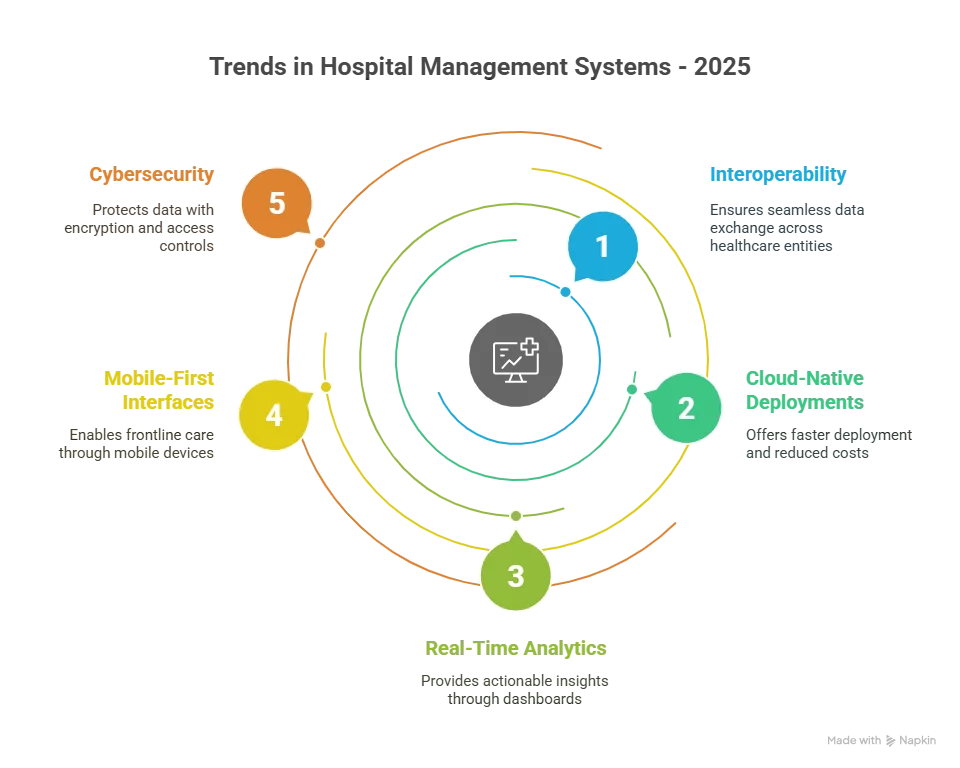
Interoperability as a Baseline, Not a Bonus
With national mandates like NPHIES in Saudi Arabia and NHIS in Ghana, interoperability is now non-negotiable.
Adoption of HL7 and open APIs ensures seamless data exchange across insurers, labs, pharmacies, and government platforms.
Hospitals are prioritizing systems that support real-time claim validations, cross-platform referrals, and standards-based data sharing reducing duplication and improving care coordination.
Cloud-Native, Scalable Deployments
Hospitals are shifting from legacy on-premise installations to cloud-first HMS models that offer:
Faster deployment and updates
Reduced capital expenditure
Business continuity through disaster recovery and remote access
Cloud-ready systems are gaining preference for their lower maintenance burdens and multi-location operability.
Real-Time Analytics and Executive Dashboards
The demand for actionable, role-based dashboards has increased.
C-level executives need financial and operational KPIs at a glance
Department heads require productivity metrics and inventory burn rates
Quality teams use real-time surveillance tools to monitor compliance and safety
HMS vendors are responding with modular BI engines and plug-and-play dashboard builders integrated directly into the core platform.
Mobile-First Interfaces for Frontline Care
In 2026, mobile-enabled HMS features are not limited to patient apps they extend to staff as well.
Doctors use handheld devices to review labs, approve discharges, and place orders during rounds
Nurses log vitals and administer medication bedside
Technicians receive and close maintenance tasks via mobile tickets
Mobility is no longer an add-on it’s a workflow imperative for time-critical roles.
Embedded Cybersecurity and Role-Based Governance
As digital touchpoints multiply, so do security risks.
HMS platforms now include built-in encryption, zero-trust architecture, and privilege-based access controls
Integrated activity logs trails and real-time anomaly detection are fast becoming standard, especially in markets with strong data protection laws (e.g.,NPHIES, CCHI)
How to Choose a Hospital Management System
Selecting an HMS is a long-term decision, since switching systems later is disruptive. A few factors are worth evaluating carefully:
- Hospital size and requirements: a small clinic and a multi-specialty hospital have very different needs; match the system’s scope to your actual operations.
- Required modules identify which modules are essential from day one versus which can be added later.
- Scalability considers whether the system can handle growth without a costly overhaul.
- Interoperability checks whether the system can exchange data with labs, insurers, or external platforms already in use.
- Security looks for role-based access, audit trails, and data protection appropriate for healthcare data.
- Reporting and analytics evaluate whether the tools answer the questions administrators actually need answered.
- Implementation support asks how the vendor handles setup, data migration, and configuration.
- Total cost of ownership looks beyond license or subscription fees to implementation, training, and future upgrade costs.
When choosing a hospital management system vendor, it’s critical to assess implementation track record. Medinous, for instance, offers hands-on deployment support, localized training, and change management frameworks field-tested in over 10 countries across Asia, the Middle East, and Africa.
How to implement HMS : From Evaluation to Go-Live

The success of HMS implementation hinges not just on product selection, but on change management, cross-functional coordination, and execution discipline. Below is a structured roadmap hospital can follow to reduce disruption and accelerate time-to-value.
Internal Needs Assessment and Stakeholder Alignment
Before shortlisting vendors, hospitals must define their baseline:
What existing systems are in use and where are the gaps?
What departments need immediate digitization?
What compliance standards must be met (e.g., NPHIES, ICD-10)?
Cross-functional discovery workshops with clinical, financial, IT, and admin teams help uncover true pain points and prioritize modules.
Vendor Evaluation and Demo Analysis
A well-run evaluation process includes:
Live sandbox demos across workflows (not just pre-recorded tours)
Checklists based on real hospital use cases, such as OT scheduling, claims rejection management, and discharge billing
Reference checks with hospitals of similar size and specialty
Key criteria to assess: uptime SLAs, localization capabilities, deployment models (cloud vs on-premise), integration readiness, and support quality.
Staff Training and Change Management
Resistance to change is natural especially in clinical settings where time pressure is high.
Best practices include:
Role-based training programs (physicians, nurses, coders, IT, billing)
On-floor superusers or HMS champions to support peers
Feedback loops via helpdesks and in-system prompts
Go-Live and Stabilization
A full go-live typically involves all clinical, operational, and financial modules switching over from legacy systems.
During this phase:
Live ticketing and support escalation mechanisms must be in place
A command center approach helps centralize incident resolution
Critical reports and dashboards should be validated daily to ensure system reliability
Vendor Evaluation: Top Considerations Before You Commit
When choosing a hospital management system vendor, it is critical to assess implementation track record. For instance, Medinous offers hands-on deployment support, localized training, and change management frameworks that have been field-tested in over 10 countries across Asia, the Middle East, and Africa. Below are the top considerations that help your evaluation process.
Before and After HMS: A Realistic Hospital Scenario
To understand the tangible impact of an HMS, let’s walk through a simplified comparison of a mid-sized, multi-specialty hospital before and after HMS implementation.
| Function | Before HMS | After HMS Implementation |
| Patient Registration | Manual forms, redundant data entry, frequent spelling errors. | Digital onboarding with verified patient ID, auto-filled recurring data. |
| Consultation & Orders | Doctors write prescriptions on paper; tests requested separately. | Orders placed via CPOE; e-prescriptions sync with pharmacy and diagnostics. |
| Billing & Insurance | Fragmented systems lead to missed charges, claim denials. | Integrated billing with mapped charge masters and real-time claim validation. |
| Diagnostics | Tests duplicated due to lost or delayed lab orders. | Single-click order routing; LIS/RIS modules eliminate redundancy. |
| Inventory Tracking | Overstocking and expiry losses from spreadsheet-based tracking. | Real-time inventory levels, auto-reorder alerts, and batch-level tracking. |
| Compliance Reporting | Manual audits, inconsistent logs, and regulatory lapses. | Auto-generated reports aligned to CCHI/NPHIES, with complete activity logs. |
| Decision-Making | Department heads rely on Excel or manual counts for KPIs. | Executive dashboards show real-time performance metrics and resource use. |
Frequent Asked Question
What is the difference between an HMS, EMR, and EHR?
An HMS is a comprehensive software platform that manages all clinical, financial, operational, and administrative processes in a hospital. An EMRstores patient records within a single practice, while an EHR allows sharing of patient data across multiple healthcare providers.
Is a Hospital Management System necessary for smaller hospitals or clinics?
Yes. Even small or mid-sized hospitals benefit from HMS platforms through reduced paperwork, faster billing, fewer errors, and improved compliance. Scalable, modular systems let facilities start small and add functionality over time.
Can an HMS integrate with insurance platforms and government health systems?
A modern HMS supports HL7 and open APIs allowing it to integrate with insurance portals, e-claims systems, and national health networks like NPHIES (Saudi Arabia) or NHIS (Ghana) for real-time data exchange and regulatory alignment.
Is a cloud-based HMS more secure than an on-premise solution?
Cloud-based HMS platforms offer robust encryption, role-based access, and disaster recovery protocols, often outperforming legacy on-premise setups in uptime, scalability, and data backup.
How does a Hospital Management System improve clinical decision-making?
A Hospital Management System improves clinical decision-making by delivering real-time access to integrated patient data, lab results, and EMR alerts enabling faster, safer, and more coordinated care.
How does an HMS support multi-specialty or group hospital networks?
An HMS supports multi-specialty and group hospitals by centralizing data, standardizing workflows, and enabling cross-branch coordination through a unified, configurable platform.
Aligning Hospital Operations with Systemic Clarity
Operational inefficiencies in hospitals are seldom the result of inadequate effort they are more often a consequence of disjointed systems and fragmented data flows. When core functions such as admissions, diagnostics, billing, and discharge operate in silos, delays become systemic, and institutional visibility suffers.
A modern Hospital Management System addresses this not through digitization alone, but through structured interoperability. It facilitates alignment across departments, reduces administrative burden, and offers real-time oversight for clinical, operational, and financial processes.
At Medinous, we have partnered with healthcare institutions across Saudi Arabia, Africa, and Asia to streamline complex workflows without requiring a complete infrastructural overhaul. The results have included faster discharge cycles, improved insurance claim approval rates, and more coordinated multi-departmental operations all within regulatory frameworks.
Explore our detailed case studies for real-world insights into how hospitals have implemented Medinous HMS to address operational bottlenecks and compliance challenges:
Considering an HMS Transition?
We invite you to request a personalized demo focused not on software features, but on how Medinous can support your hospital’s current structure, strategic goals, and compliance.