

Patient histories, diagnoses, billing details, and personal identifiers are sensitive healthcare data. While authorised staff need access to perform their roles, unrestricted access can put patient privacy at risk.
Role-based access control (RBAC) solves this by giving employees access only to the information required for their role or department. This helps healthcare organisations maintain both data security and usability.
At Medinous, we build access management into our platform to support secure and efficient healthcare operations. This blog explains what RBAC is, why it matters, and how to implement it.
What Is Role-Based Access Control in Healthcare?
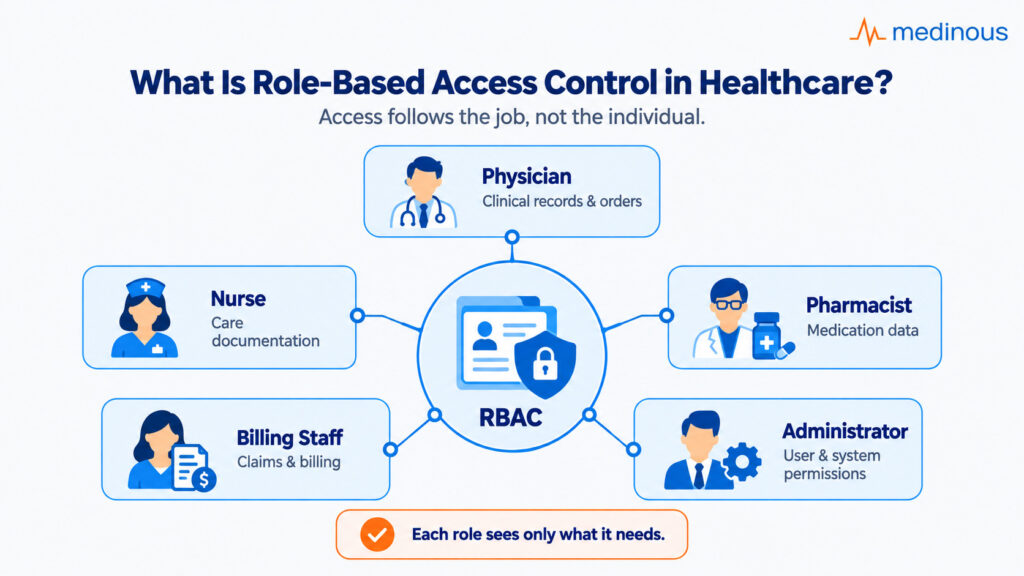
Instead of granting every user complete access to a system, RBAC assigns access levels according to a person’s job function. Hence, employees only reach the specific data and tools required to perform their duties.
In a hospital setting, roles typically include physicians, nurses, pharmacists, billing staff, and administrators, and each role carries a defined set of permissions attached to it. Define role-based access control simply as this: access follows the job, not the individual, which makes managing large and constantly changing staff rosters far more practical.
Why EMR Access Must Be Managed Carefully?
Here are a couple of reasons to manage EMR access carefully:
Protecting Sensitive Patient Information
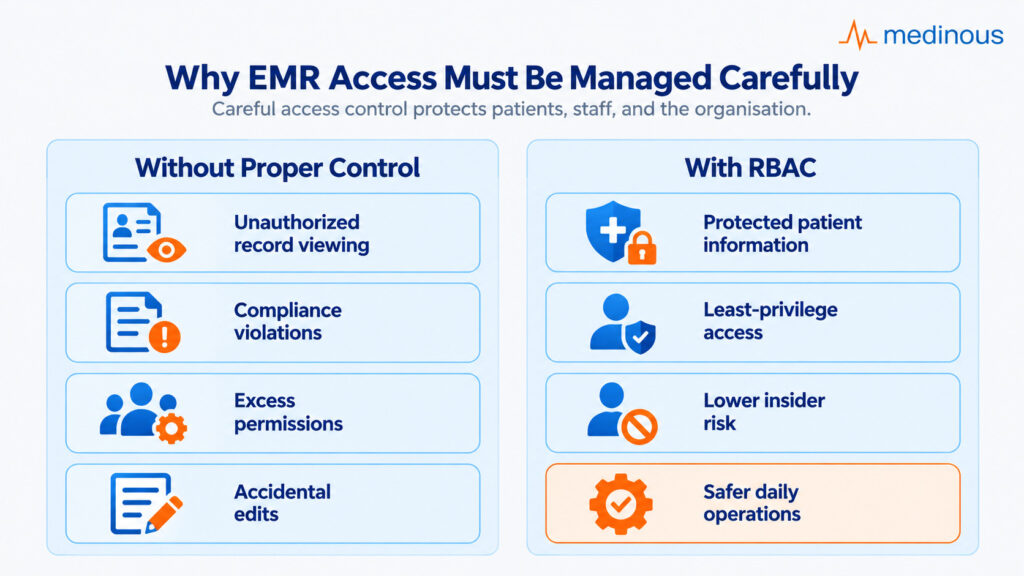
Without proper controls, healthcare organisations become vulnerable to data breaches, unauthorised viewing of records, and compliance violations, all of which carry serious consequences for both the institution and the patient.
A receptionist does not need to see a patient’s full clinical history, and a lab technician does not need access to billing codes. Careful access management keeps electronic medical records visible only to the people who genuinely need them for care or operations.
Reducing Unnecessary Access and Security Risks
Every extra permission granted is another potential point of failure. Limiting each user to the minimum access needed to do the job, often called the principle of least privilege, narrows the attack surface, reduces insider risk, and strengthens overall healthcare data security across EHRs, billing systems, and lab platforms.
Fewer unnecessary permissions also means fewer opportunities for accidental errors, such as a staff member editing a record they were never meant to touch.
How Does Role-Based Access Control Work in an EMR?
Role-based access control allows you to work in a much more efficient way, as mentioned below:
Defining Roles and Access Permissions
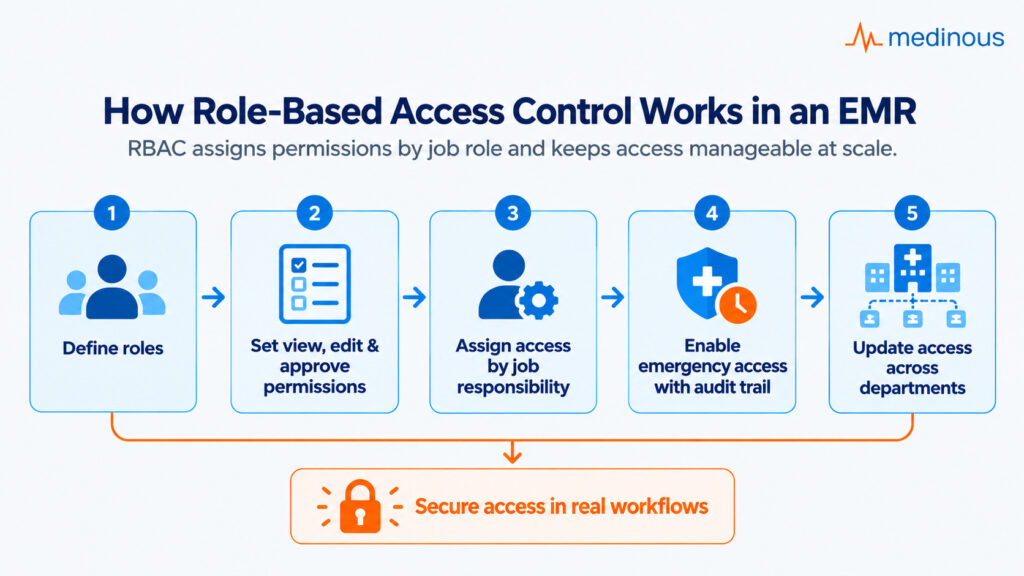
The first step is mapping out every role in the organisation and deciding exactly what each one should be able to view, edit, or approve. This might mean a physician can document a SOAP note, while administrative staff can only manage scheduling and billing information. Clear role definitions remove ambiguity and make onboarding new staff far simpler.
Assigning Access Based on Job Responsibilities
Once roles are defined, access is assigned automatically based on a staff member’s position rather than negotiated individually each time someone joins the team. This structure also makes emergency access, sometimes called break-glass access, possible under strict justification and full auditing, so clinicians can reach critical information quickly in urgent situations without weakening everyday security.
Managing Access Across Departments
Large hospitals often have overlapping departments and staff who move between units. RBAC allows administrators to update permissions quickly when someone changes roles or departments, without having to rebuild their access profile from scratch. This flexibility is especially valuable in busy hospital environments where staff schedules and assignments shift often.
Implementing Role-Based Access Control in Healthcare
After having a look at how role-based access control works in healthcare, it is now time to look into the implementation of the same:
Identifying User Roles and Access Requirements
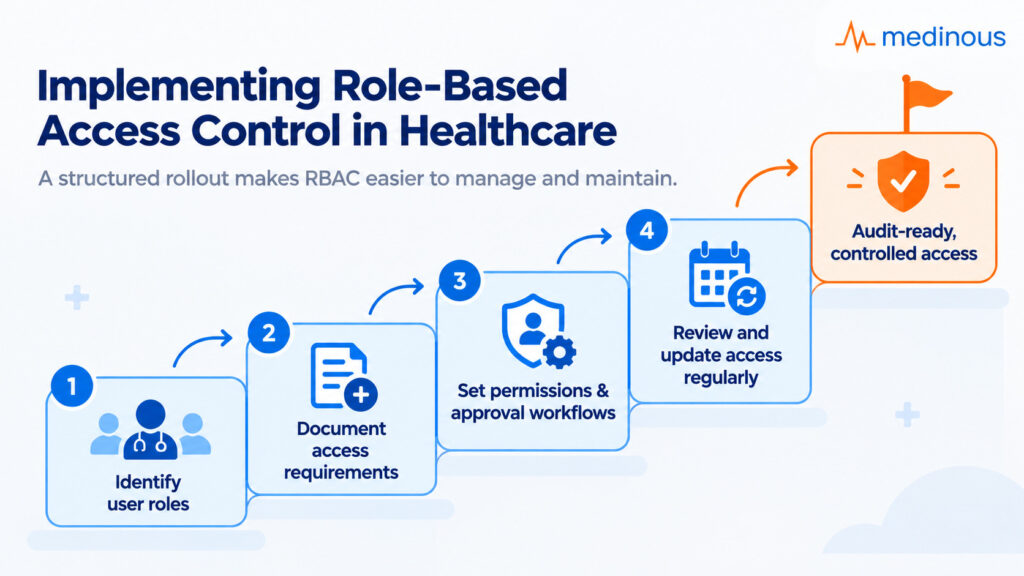
Start by cataloguing every distinct role across clinical and administrative teams, along with the specific systems and data each one touches during a normal day. This groundwork is what makes the rest of implementing RBAC manageable, since vague or overlapping role definitions tend to create confusion later.
Setting Up Permissions and Approval Workflows
With roles defined, configure the system so that access requests, exceptions, and role changes go through a clear approval workflow. This keeps a record of who approved what and when, which becomes invaluable for audits and compliance reviews. It also prevents permissions from expanding over time as staff pick up extra duties without a formal review.
Reviewing and Updating Access Regularly
Access should never be a set it and forget it exercise. Regular reviews help identify accounts that still have access from a previous role, staff who have left the organisation, or permissions that were granted temporarily but never removed. Scheduled audits also support faster incident response, since administrators always know exactly who can reach what information.
Key Benefits of Role-Based Access Control
Role-based access control has the following benefits. Let us look into them in detail:
- Simplifies onboarding and offboarding: New hires can be assigned access based on their roles, while departing employees can have their access revoked quickly without lengthy manual processes.
- Supports regulatory compliance: RBAC provides clear visibility into who accessed specific data and when, making audits and compliance reporting easier.
- Reduces clinical delays: Standardised role-based permissions ensure staff have the access they need, reducing delays caused by waiting for permissions during busy shifts.
- Helps control costs: Rightsizing access prevents organisations from paying for unnecessary licenses or access levels. Temporary and contract staff can also lose access automatically when their assignments end.
- Builds patient trust: Clearly defined access controls help healthcare organisations explain who can view patient information, strengthening confidence in how sensitive data is handled.
- Protects staff: Clearly scoped permissions and access logs help ensure employees are accountable only for activities within their assigned roles.
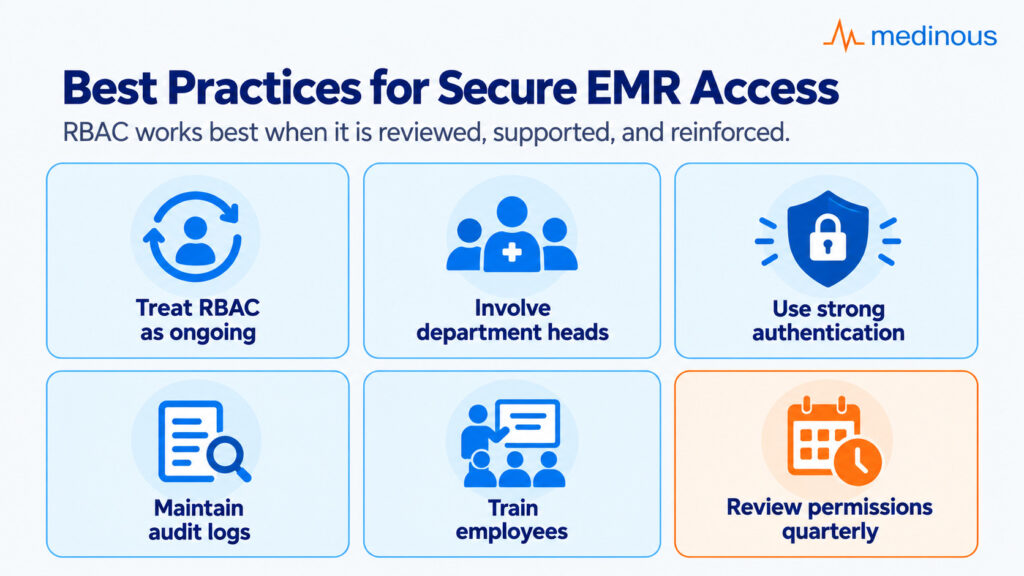
Best Practices for Secure EMR Access
Here are the best practices for secure EMR access that you should follow to maintain the security of data and still work in a more efficient and time-saving manner:
- Treat RBAC as an ongoing process: Keep roles aligned with changing organisational needs rather than treating access control as a one-time setup.
- Involve department heads: Work with department leaders when defining roles to ensure permissions reflect real-world workflows.
- Use strong authentication and audit logs: Combine RBAC with secure authentication and detailed logs to track and monitor access events.
- Train employees: Explain why access is restricted and how these controls protect patients and colleagues. This encourages staff to follow policies, report unusual requests, and avoid risky practices such as sharing login credentials.
- Review permissions regularly: Set a review cycle, such as quarterly, to update roles and permissions as your organisation and systems evolve.
At Medinous, our hospital management system is built with granular, role-based permissions at its core, giving healthcare organisations the confidence that sensitive patient data stays in the right hands. At the same time, staff can still work efficiently across every department.