

A hospital signs a seven-figure contract for what the proposal calls a complete digital records platform. Eighteen months later, the referral letters are still being printed, the second branch is running its own patient numbering, and the finance team is reconciling theatre consumables by hand. Nobody was lied to. The hospital bought an EMR and needed an HIS.These systems form part of the wider digital environment supported by a modern hospital management system complete guide
That mistake is common, expensive, and almost entirely avoidable and it starts with three acronyms that get used as though they were interchangeable.
KEY TAKEAWAYS
EMR, EHR and HIS are not competing products they are three levels of ambition. An EMR is a record kept inside one practice, an EHR is a record that travels with the patient across providers, and an HIS is the system that runs the entire hospital, usually with one of the other two inside it. The costly error is not picking the wrong acronym; it is buying for the hospital you run today rather than the one you will be running in five years.
Three Acronyms, Three Levels of Scope
EMR
A record kept inside a single practice
EHR
A record that follows the patient across providers
HIS
The operating engine for an entire hospital
The confusion is understandable. All three store patient data. All three replace paper. All three are often sold by the same vendors and bundled into a single contract, so the boundaries blur before anyone signs anything.
Once you stop treating them as three competing products and start seeing them as three different levels of ambition, the picture gets much clearer.
Electronic Medical Records (EMR)
An EMR is the digital version of the paper chart that once sat in a filing cabinet. It holds the notes, diagnoses, medications, allergies and test results gathered by clinicians inside one organisation.Within an HMS environment, electronic medical records in HMS can form an important part of the hospital’s clinical information workflow
What an EMR Does Well
The Office of the National Coordinator for Health Information Technology describes an EMR as containing primarily the notes and information collected by and for the clinicians in that single office. Within those walls, it works beautifully. Doctors can track a patient over time, spot who is due for a screening, and monitor quality of care far better than paper ever allowed.
Where an EMR Stops
The limitation is movement. The data does not travel well. When a patient is referred elsewhere, the record often has to be printed or faxed, and the receiving team types everything in again.
Structured EMRs solve the documentation problem elegantly. They were never built to solve the sharing problem.
For a single specialty clinic, that may be perfectly acceptable. For a hospital group planning to grow, it becomes a bottleneck quickly.
Electronic Health Records (EHR)
An EHR does everything an EMR does and adds the one thing an EMR cannot: reach. It is designed from the start to be shared.
How an EHR Improves Care Coordination
An EHR is a patient-centred record that makes information available immediately and securely to authorised users, bringing together data from past and present clinicians, emergency facilities, pharmacies, laboratories and imaging centres. That is why regulators and payers keep pushing hospitals toward EHR rather than EMR.
The practical benefit is concrete:
- The cardiologist can see what the emergency physician ordered last night.
- The pharmacist can see the allergy the nurse recorded this morning.
- Duplicate tests fall away and medication errors fall away with them.
THE QUESTION TO ASK VENDORS
Not “how many fields does the system capture?” but “how cleanly does the data move when a patient crosses a departmental or organisational boundary?”
Field counts are easy to demonstrate in a sales demo. Clean handoffs are not which is exactly why you should insist on seeing one.
Hospital Information Systems (HIS)
The hospital information system is wider still. It is not only about the clinical record. It is about running the hospital as a business and as a care provider at the same time.
Clinical and Administrative Operations in One Place
An HIS ties together registration, appointments, admissions, laboratory, radiology, pharmacy, theatre scheduling, billing, insurance claims, inventory and finance. These distinctions become clearer when the different types of hospital software systems are considered together Evaluating one properly means looking across human, technological, informational, organisational, legal and outcome factors not judging it on a technical feature list.
A hospital does not fail because a screen looks dated. It fails when the pharmacy cannot see the prescription and billing cannot see the procedure.
Revenue leakage discovered months after the fact is not a reporting problem. It is a systems architecture problem.
EMR vs EHR vs HIS: Side by Side
The shortest honest answer: EMR is a record. EHR is a shared record. HIS is a system that runs the hospital and it usually contains an EMR or an EHR inside it.
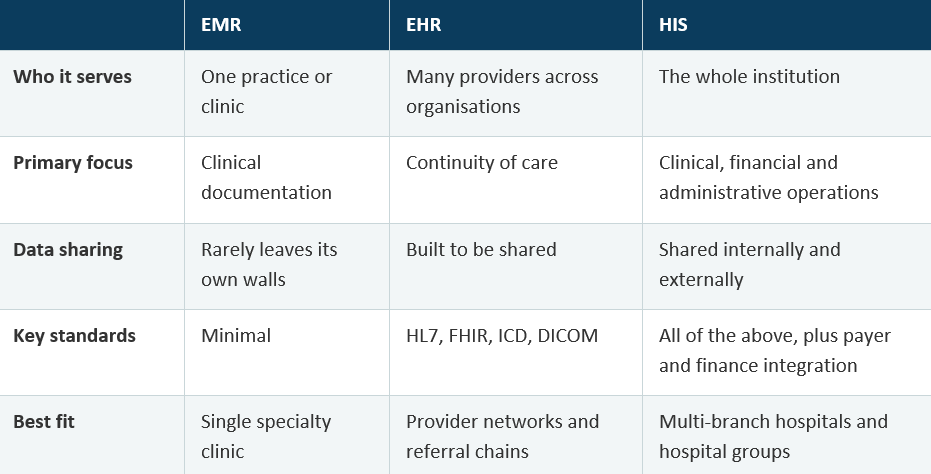
A small dental clinic may genuinely need only an EMR. A referral hospital with three branches, a laboratory network and multiple insurance payers needs considerably more.
The mistake decision makers make is buying for the hospital they have today rather than the one they will be running in five years.
Where Healthcare ERP Fits
Healthcare ERP handles the parts of a hospital that patients never see but always feel procurement, human resources, payroll, asset management, the general ledger and budgeting.
Clinical systems tell you what care was delivered. ERP tells you what that care costs and whether the institution can afford to keep delivering it. Understanding the difference between EMR vs EHR vs HIS helps clarify where electronic medical records fit within hospital technology
When these two worlds stay separate, hospitals reconcile spreadsheets at month-end and guess at margins. When they connect, a consumable used in theatre reduces stock, triggers a reorder, posts to the ledger and appears on the patient bill without a single manual entry. That is the quiet operational advantage most boards underestimate.
How to Choose: A Practical Sequence
Start with your actual pain, not the feature list.
First, name the problem:
- Are claims being rejected?
- Are discharges slow?
- Are departments working from different versions of the truth?
Then ask the harder questions:
- Does the platform integrate with laboratory analysers, PACS, drug databases and payer portals?
- Does it support your compliance regime NPHIES in Saudi Arabia, CBAHI accreditation, JCI standards?
- Can it run several facilities under one login without splitting your patient records in two?
The single best test: good hospital management software reduces the number of systems your staff log into. If a proposal increases that number, it is solving the vendor’s problem rather than yours. And confirm local insurance and tax compliance early retrofitting it later is expensive.
The Direction of Travel
Saudi Arabia’s Health Sector Transformation Program under Vision 2030 places digital transformation and improved access at the centre of national healthcare reform. The EMR works alongside the 5 must-have modules in hospital software that support the wider operational needs of a hospitalHospitals still running disconnected departmental tools will struggle to keep pace with national health information exchange, unified records and value-based care models.
The winners will be the institutions that treat their platform as one connected nervous system rather than a collection of separate organs. An integrated healthcare system removes the seams between clinical, financial and administrative work and that is where the real return lives.
Frequently Asked Questions :
Is an EHR just an EMR with more features?
No the difference is architectural, not cosmetic. An EMR is built to document care inside one organisation; an EHR is built from the start to share that record safely across organisations. Adding fields to an EMR does not make it an EHR.
Can a hospital run an HIS without an EMR or EHR?
Not meaningfully. An HIS is the wider operating system, and the clinical record sits inside it. The practical question is which type of record your HIS contains and how well it travels.
Do we need healthcare ERP as well as an HIS?
Many HIS platforms include ERP functions such as inventory, procurement and finance. If yours does not, the two need to be genuinely integrated otherwise you are back to reconciling spreadsheets at month-end.
What is NPHIES and why does it matter to this decision?
NPHIES is Saudi Arabia’s national platform for health insurance claims and health information exchange. Any system you buy must be able to exchange data with it, so confirm compliance before signing rather than after.
We only have one facility today. Should we still consider an HIS?
If growth, a second branch or payer complexity is anywhere in your five-year plan, yes. Migrating records and rebuilding integrations later costs far more than choosing a platform with room to grow.
EMR, EHR and HIS are not rivals. They are three layers. Your job as a decision maker is to know which layer your hospital actually needs next and to choose a partner who can carry you to the layer after that.
NOT SURE WHICH LAYER YOU NEED?
Most hospitals discover the gap only after the contract is signed. Medinous can map your current systems against where your organisation is heading, and tell you plainly whether an EMR, an EHR or a full HIS is the right next step even if that answer is smaller than what you expected to buy.
Request a demo – no obligation, and you keep the findings either way.