

A nurse in Riyadh copies a blood pressure reading onto a chart. Two floors down, the same patient’s lab results sit in a system the ward cannot see. By the time the two pieces of information meet, four hours have passed and a bed that should have been freed this morning stays occupied until evening.
Multiply that by every ward, every day, across a Kingdom whose healthcare system is being rebuilt around data, and you have the single biggest problem Saudi hospitals are solving right now.
KEY TAKEAWAYS
Vision 2030’s Health Sector Transformation Program has moved Saudi healthcare from building hospitals to connecting them. AI is already live in triage, imaging and claims processing but it only works on clean, connected data, which is why the hospitals that win the next decade will be the ones fixing interoperability now, rather than the ones buying the flashiest tool
The Numbers Behind the Shift
79.7
Years – life expectancy in the Kingdom
97.5%
Primary healthcare coverage across population clusters
31M+
Users who have benefited from the programme
Source: Health Sector Transformation Program annual report, 2025
These are outcomes, not ambitions and they were delivered by a system that decided to compete on data rather than on buildings.
The Health Sector Transformation Program under Vision 2030 set out to improve access and quality by strengthening primary care, hospital services, emergency response, and digital transformation. This is a health system rebuilding its foundations around data, and every hospital operating within it is now expected to plug into that foundation.
The Rise of Smart Hospitals
A smart hospital is not simply a hospital with tablets. It is a facility where information moves on its own, equipment talks to the record, and the system flags a problem before a human notices it.
Monitors feed vital signs straight into the patient record instead of a nurse copying them onto a chart. Laboratory analysers post results the moment they are ready. Beds, theatres, and imaging slots are scheduled against live demand rather than historical averages.
What That Actually Buys You
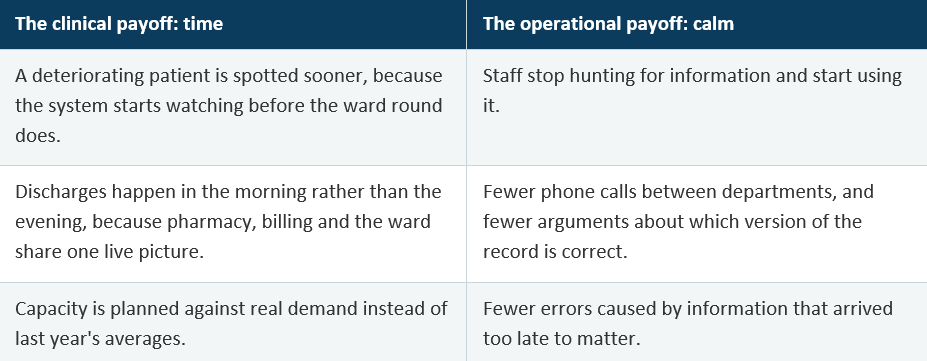
Every hour saved is a bed freed – and in a growing population, every bed matters
The Growing Role of AI in Modern Healthcare
Artificial intelligence has moved from conference panels into clinical corridors. In Saudi Arabia it is already visible in triage, imaging, chronic disease monitoring, and virtual consultation.
On the clinical side, AI supports radiologists by highlighting suspicious findings, flags patients at risk of deterioration, and assists with early detection in screening programmes. It does not replace the clinician. It narrows the search so the clinician can focus.
On the operational side less discussed, equally real predictive models forecast admission volumes so rosters match demand. Algorithms identify which insurance claims are likely to be rejected before submission. Systems anticipate pharmacy stockouts before shelves are empty.
BEFORE YOU DEPLOY ANY MODEL, ANSWER THESE THREE QUESTIONS
- 1. How was this model validated, and on whose data?
- 2. Where does the data physically sit?
- 3. Who is accountable when the model is wrong?
Connected Systems: The Foundation of Integrated Care
Smart hospitals built on isolated databases are simply expensive hospitals.
How Silos Happen
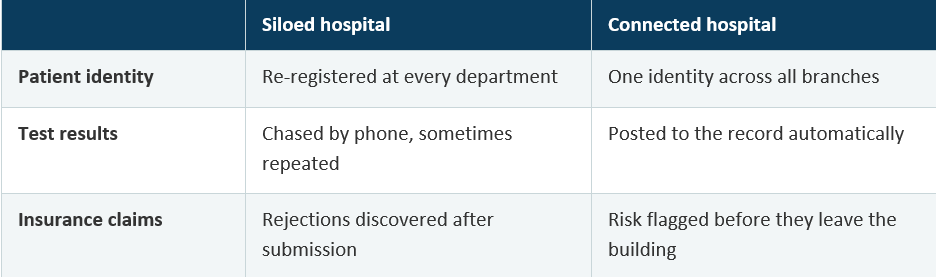
Most hospitals did not set out to build silos. They grew into them. A laboratory system bought in one year, a billing package in another, a radiology tool from a third vendor. Each was a sensible purchase in isolation.
The patient pays for that fragmentation with repeated tests, repeated questions, and repeated waiting. The hospital pays for it with duplicated effort and losses that never appear on any single line of the P&L.
Siloed vs. Connected: The Same Hospital, Two Realities
Why Interoperability Matters
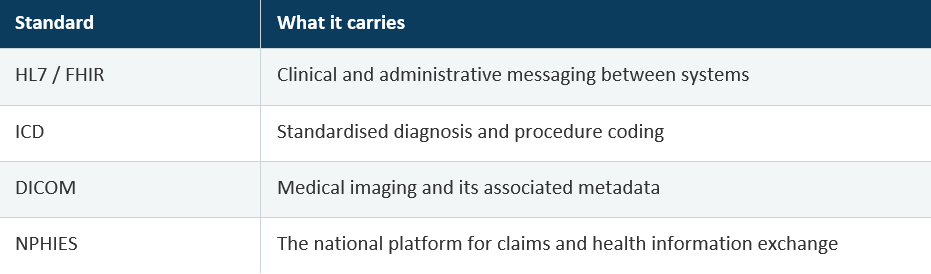
Interoperability is what turns connection into care. Standards allow a record created in one system to be understood correctly by another.
THE ONE-QUESTION AUDIT
Can your systems exchange data with a payer, a national platform, and another facility-without a manual export?
If the answer is no, your digital transformation has not really started, however modern the software looks.
Cloud-Based HIS and Healthcare Analytics
Cloud architecture changed what a hospital system can be. Multiple branches share one patient identity. New departments come online in weeks rather than quarters. Disaster recovery becomes a design feature rather than a prayer.
But data alone changes nothing. A hospital can drown in dashboards and still miss the fact that its emergency turnaround time has slipped for three straight months.
A capable analytics layer answers the questions leadership actually asks:
- Which specialty is losing money, and why?
- Where do claim rejections cluster?
- Which ward has the slowest discharge cycle?
- Which physician’s schedule leaves capacity unused every Tuesday?
Paired with a cloud-based HIS, those insights arrive while they are still useful-rather than in a report that lands after the quarter has already closed.
Virtual Care and the New Patient Baseline
Saudi Arabia has gone further on virtual care than almost anyone, and that model reshapes expectations permanently.
- A specialist in Riyadh can assess a stroke case in a remote hospital within minutes.
- Chronic disease patients are monitored at home instead of occupying a bed.
- Follow-up consultations no longer require a four-hour drive.
Convenience, once tasted, becomes the baseline against which every provider is judged.
Patients who experience that once will expect it everywhere – including from your hospital.
Preparing for the Next Era: A Practical Checklist
So what should hospital leaders actually do now? Start with the foundation, not the headline. AI and virtual care sit on top of clean, connected, well-governed data.
- Audit your integrations honestly. Map every point where data crosses a system boundary.
- Find the retyping. Anywhere staff still re-enter information is a broken integration wearing a human costume.
- Confirm compliance first. NPHIES, ZATCA, and accreditation requirements come before anything experimental.
- Establish a single patient identity across every department and branch.
- Check your analytics latency. If your reports arrive after the quarter closes, they are history, not intelligence.
- Choose a platform built to grow. One you can extend for a decade, not replace in three years.
Where Medinous Fits
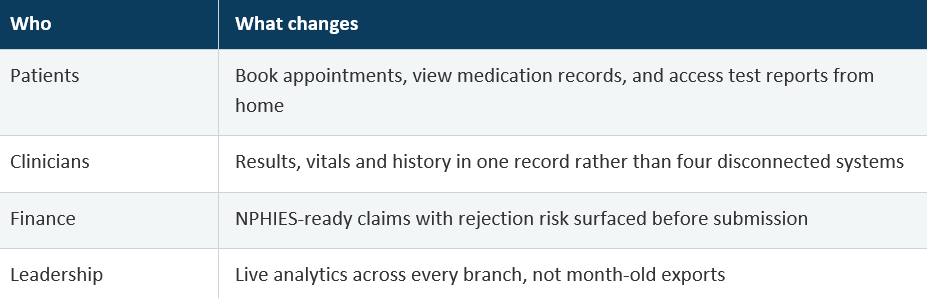
Medinous is an integrated healthcare system that unifies clinical, diagnostic, financial, and administrative workflows in a single platform. In practice, that means:
Frequently Asked Questions
What is a smart hospital?
A facility where clinical data moves automatically between devices, records and departments – so information reaches the people who need it without anyone re-entering or chasing it.
What is NPHIES?
Saudi Arabia’s national platform for health insurance claims and health information exchange. Compliance is a prerequisite for operating with payers in the Kingdom.
What is the difference between connected and interoperable?
Connected means two systems can pass data to each other. Interoperable means the receiving system actually understands what it received. Standards such as HL7, FHIR, ICD and DICOM are what close that gap.
Do we need AI to be a smart hospital?
No – and starting there is usually a mistake. AI is a layer that sits on top of clean, connected data. Fix the foundation first.
The Kingdom has already decided where healthcare is going. The only real question left for each hospital is whether it arrives prepared, or arrives late.
SEE WHERE YOUR HOSPITAL STANDS
Most hospitals do not know how many manual handoffs sit inside their daily workflow until someone maps them. Medinous can walk your team through that audit and show you exactly where data stops moving – department by department, in your own systems.
Book a free demo – no obligation, and you keep the findings either way.