Healthcare AI Shouldn’t Stop at Discharge: The Opportunity in Post-Visit Care
The Missing Mile of Healthcare
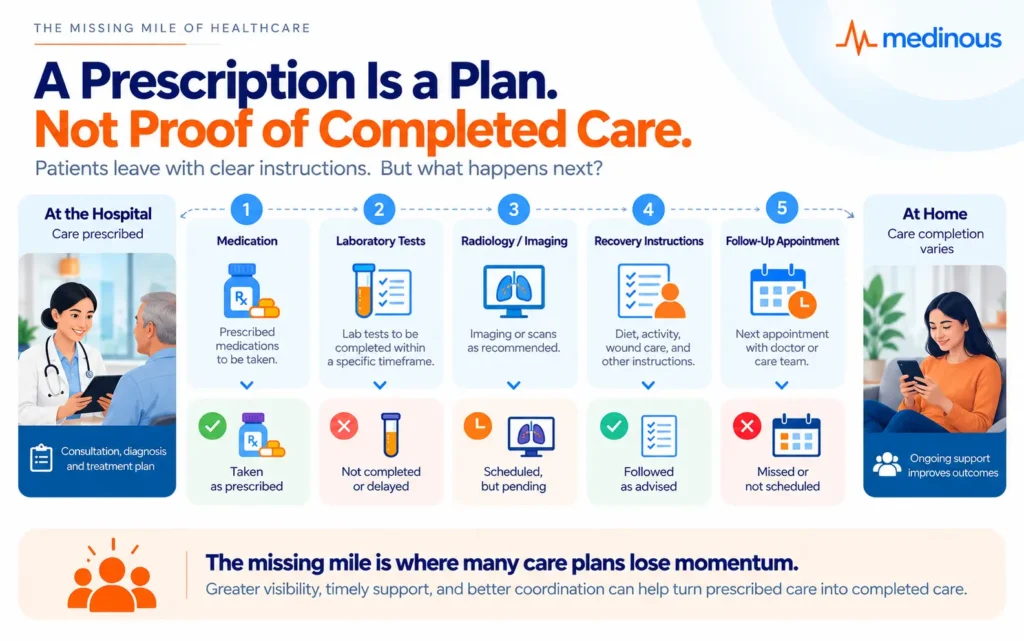
A hospital can confirm that a consultation took place. It can document a diagnosis, record the medication prescribed, generate laboratory orders, and schedule the next appointment. But can it confirm that the patient completed the care plan?
Consider a patient leaving a consultation with two medications, a laboratory test, dietary instructions, and a follow-up appointment. The encounter is closed and the electronic medical record is updated. Three days later, the patient may have purchased only one medicine. The test remains incomplete. The next appointment is not booked. And the patient is unsure whether a symptom needs attention.
This is the missing mile of healthcare: the distance between care prescribed and care completed.
Many healthcare systems excel at recording what happens within the hospital, yet treatment continues after patients return home. Responsibility for organizing the next steps often shifts to the patient or caregiver. The opportunity for healthcare AI is not merely to send more reminders, but to help connect treatment plans, patient actions, and timely human support.
At a glance
- Continuity of care depends on what happens between encounters, not just at discharge.
- Remote patient monitoring and AI-supported post-visit engagement address different but complementary needs.
- Contextual reminders, care-plan tracking, and prioritized follow-up may help patients overcome barriers.
- Clinical oversight, consent, reliable integration, and evidence-based measures remain essential.
Why Patient Care Needs to Continue Beyond Hospital Discharge
Discharge is a clinical milestone, not necessarily the end of treatment. A surgical patient may need wound care, medication, symptom observation, and review. Someone living with diabetes may require investigations, medication adherence, and ongoing monitoring. Even outpatient consultations generate actions outside the healthcare facility.
The World Health Organization describes medication safety during transitions of care as an important patient-safety concern. Accurate information, structured processes, and patient involvement are central to reducing avoidable medication-related harm [1]. Yet medication is only one part of the wider follow-through challenge.
Patients may miss investigations because they do not understand their importance. Others face transportation, cost, scheduling, or language barriers. Some may experience symptoms without knowing whom to contact. Without a structured approach, the care team may learn of these difficulties only at the next appointment.
Clinical intent is not patient action
| Prescribed activity | What still needs to be understood |
| Medication | Was it obtained? Is the patient able to follow the prescribed regimen? |
| Laboratory or imaging test | Was it scheduled, completed, canceled, or done elsewhere? |
| Follow-up appointment | Is it booked and attended? Is support needed to reschedule? |
| Recovery instructions | Does the patient understand the instructions and report difficulty following them? |
CORE INSIGHT: A prescription proves a clinical decision was made. It does not prove the prescribed care was completed.
What Is Transitional Care and Why Does It Matter?
Transitional care coordinates the movement of patients between settings, providers, and levels of care—for example, from hospital to home or from specialist care to rehabilitation. Continuity of care is broader: it maintains coordinated information, treatment, and relationships over time.
The U.S. Agency for Healthcare Research and Quality includes post-discharge follow-up calls within its Re-Engineered Discharge toolkit. These conversations can surface unanswered questions, medication issues, and misunderstandings after patients leave the facility [2].
At scale, however, effective follow-up is difficult when care coordinators must manually collect information from discharge notes, appointments, pharmacy systems, laboratory records, and telephone logs. AI-supported workflows could help assemble context and indicate which patients may need a human response. The goal should be better-targeted care-team attention, not simply fewer calls.
Why Continuity of Care Matters Beyond the Hospital
WHO’s practice brief on continuity and coordination of care supports integrated, people-centered healthcare across services and settings [3]. Continuity has three related dimensions:
- Informational continuity: relevant clinical information is available to authorized care providers.
- Management continuity: treatment and follow-up remain coordinated across encounters.
- Relational continuity: patients maintain appropriate connections with those responsible for their care.
Electronic medical records have improved informational continuity. Yet the existence of a record does not ensure that a prescribed test was completed or that a patient received help overcoming a barrier. A coordinated model must move from knowing what happened to identifying the next appropriate action.
Imagine a clinician ordering an HbA1c test before a follow-up consultation. If the test is incomplete, the care team needs to know whether it is booked, has been completed at another provider, or remains outstanding because of an access problem. The clinical aim is appropriate completion—not necessarily keeping every service within the original hospital.
A connected record tells you what happened. Connected care helps you act on what has not.
How AI Can Support Post-Discharge Patient Monitoring
AI can help organize care plans, support consent-based conversations, identify outstanding activities, and bring relevant information to authorized staff. Its effectiveness depends on accurate clinical records and clear boundaries: AI should not independently alter a prescription, change medication doses, or make unsupervised clinical decisions.
Translate a treatment plan into trackable actions
A prescription may include medication twice a day, imaging within a week, physiotherapy on alternate days, and a follow-up appointment. Each activity needs its own timeframe and completion signal. A structured care plan could make these steps visible to patients and coordinators while retaining clinician-authored instructions.
Replace generic reminders with contextual support
A patient with a confirmed MRI booking needs preparation information, not another booking alert. A patient reporting a possible adverse effect needs an appropriate clinical route, not an ordinary dose reminder. A patient who completed a test elsewhere should not be inaccurately labeled non-adherent.
Identify barriers and escalation needs
Missed appointments, overdue investigations, unfilled prescriptions, or patient-reported concerns may indicate a need for follow-up. Explainable and validated prioritization tools could help coordinators understand what is outstanding and why action is warranted. Clinical red flags must follow established emergency and escalation protocols.
Using AI to Improve Patient Follow-Up and Engagement
The value of patient engagement should not be counted solely in messages sent or calls completed. It should be assessed by whether an interaction helps a patient understand, access, or complete clinically appropriate care.
Research on mobile text reminders among adults with type 2 diabetes has found potential improvements in medication adherence, although effects vary between studies [4]. Digital reminders therefore have a role, but they cannot independently resolve every practical or clinical barrier.
An illustrative post-visit journey
- After the encounter: the patient receives a consent-based, plain-language summary of prescribed actions.
- During treatment: reminders reflect authorized medication and activity schedules; the patient can report difficulties.
- Before testing: the patient receives appropriate scheduling or preparation information.
- If an activity remains incomplete: relevant context is made available for care-team follow-up.
- Before the next appointment: the patient receives an accurate reminder and help with scheduling where available.
Care coordinators remain central. Their role is to resolve practical obstacles, arrange clinician follow-up, and respond to concerns beyond the scope of automated assistance. The opportunity is to give each person a clearer view of what the patient needs.
Your system knows what was prescribed. How much does it know about what happened next?
Care continuity starts with connected clinical, diagnostic, pharmacy, scheduling, and patient-facing workflows. Explore how Medinous helps bring essential hospital operations together.
Request a DemoThe Role of Remote Patient Monitoring in Continuity of Care
Remote patient monitoring (RPM) provides a way to collect selected physiological measurements outside a hospital or clinic. CMS describes the use of connected medical devices to transmit readings such as blood pressure, weight, or glucose for review by healthcare professionals [5]. For appropriate patients, this can add valuable clinical information between scheduled appointments.
Remote monitoring is more than a device
A hypertension program might use connected blood-pressure readings. A diabetes pathway may incorporate glucose measurements. However, the usefulness of these data depends on validated devices, defined review responsibilities, clinical thresholds, escalation procedures, and the capacity to act on findings.
Where AI patient monitoring may add value
Validated analytical systems may help organize trends, surface measurements outside predetermined parameters, and prioritize review. Such alerts are decision-support signals, not diagnoses. Missing readings, false alerts, device limitations, and algorithmic bias require ongoing governance.
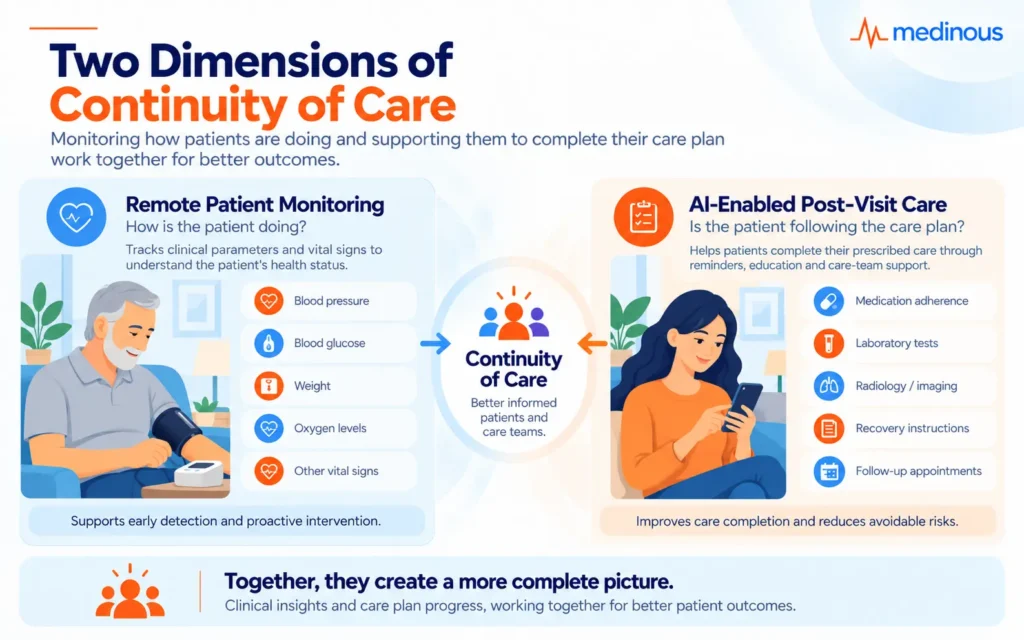
RPM and care-plan follow-through solve different problems
| Remote patient monitoring | AI-enabled post-visit engagement |
| Measures selected physiological data via devices | Follows progress against prescribed care activities |
| Answers: How is the patient doing? | Answers: What care is still pending or difficult to complete? |
| Supports review of trends and clinical readings | Supports reminders, coordination, and contextual outreach |
| Requires clinical monitoring protocols | Requires care-coordination and escalation workflows |
These approaches can complement each other. For example, a patient with diabetes may benefit from connected glucose readings as well as support with medication, laboratory tests, and follow-up visits. They should not be described as the same service or automatically as capabilities within the same product.
From Monitoring to Meaningful Intervention
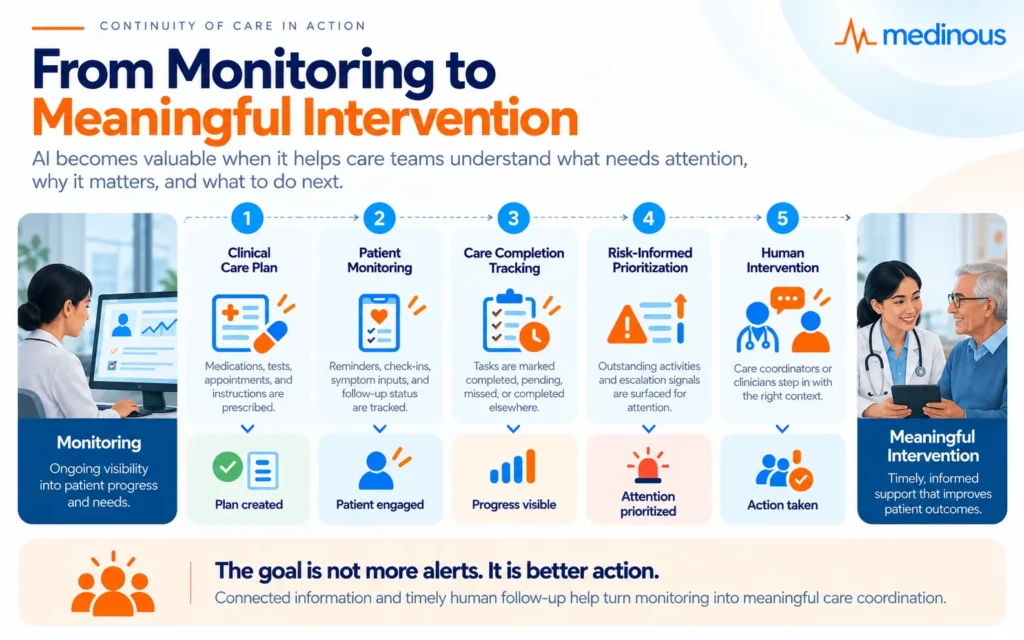
Consider three patients after a consultation: one has completed the planned activities; another missed a routine appointment because of a work conflict; a third reports feeling unwell alongside an overdue investigation. Identical reminders are unlikely to serve them equally well.
Care teams need to understand the individual outstanding action, its clinical significance, timing, prior communication, and reported barriers. A structured worklist can help coordinators start conversations with the right context. Where a situation requires clinical judgment, escalation must remain with qualified professionals.
Connecting Clinical, Operational, and Patient Workflows
The clinical and operational foundation matters. An electronic medical record captures treatment plans and orders. A hospital management system coordinates appointments, diagnostics, pharmacy, and related workflows. A patient portal makes selected information and services available to the patient.
Disconnected reminders can become misleading. If a laboratory result is recorded but not reflected in patient communication, the person may continue receiving unnecessary prompts. If an appointment is rescheduled, the communication must be updated as well.
A more trustworthy approach distinguishes between system-confirmed actions, patient-reported completion, activities completed elsewhere, and unknown outcomes. Medicine dispensing, for instance, does not prove every dose was taken. Accurate status definitions are essential for meaningful care-completion reporting.
Measuring What Happens After Discharge
Hospitals routinely measure encounters, appointments, procedures, and resource utilization. Continuity of care also requires attention to what happens between visits. Five useful measures are:
- Care-plan completion: proportion of prescribed activities completed within an appropriate timeframe.
- Medication adherence: measured or reported ability to follow prescribed treatment, with source clearly distinguished.
- Diagnostics and follow-up: completion of tests, services, and appointments.
- Response time: how promptly appropriate staff address meaningful concerns or outstanding actions.
- Patient experience: understanding, barriers resolved, and perceived usefulness of follow-up.
Before investing in additional AI engagement, hospital leaders should ask: Can we connect prescriptions to completion records? Are patient-facing messages updated when orders or appointments change? Who owns clinical escalations? Are consent and communications governed? Are we measuring completed care instead of message volume?
The Medinous Perspective: Extending Connected Healthcare
Medinous believes healthcare technology should do more than manage individual encounters. Connected clinical records, appointments, diagnostics, pharmacy, and patient-facing workflows can form a foundation for stronger continuity beyond the visit.
The opportunity for AI-enabled post-visit care is to make outstanding prescribed activities more visible, provide contextual patient assistance, and give care teams useful information for follow-up. This is a direction of product development, not a statement that every described capability is already live.
For patients, the value is clearer next steps and relevant support. For clinicians, it is better visibility into follow-through. For coordinators, it is actionable context. For hospital leaders, it is an opportunity to evaluate continuity through care-plan progress and patient engagement.
This reflects the Medinous vision of connected, intelligent, healthcare-native technology.
The Next Frontier of Healthcare AI Is Continuity of Care
Healthcare AI is expanding into documentation, analytics, and decision support. But treatment continues after the electronic record is closed. The patient still needs medicines, investigations, recovery support, and timely review.
Remote patient monitoring can contribute physiological information between visits. AI-enabled post-visit engagement can help maintain a connection to the prescribed plan. Together, they point toward healthcare that is more coordinated across settings and moments of care.
A completed consultation is not always completed care. Healthcare AI should help support what happens next.
Build a stronger foundation for connected healthcare.
Discover how Medinous connects clinical, operational, and patient-facing workflows to support more coordinated healthcare delivery.
FAQs
What is continuity of care in healthcare?
Continuity of care is coordinated healthcare over time and across providers, services, and settings. It includes shared information, consistent treatment planning, and appropriate follow-up.
How can AI improve continuity of care?
AI can help structure treatment plans, personalize consent-based communication, identify outstanding activities, and assist teams in prioritizing follow-up. Appropriate clinical oversight remains essential.
What is remote patient monitoring?
Remote patient monitoring uses connected devices to collect and transmit selected physiological measurements, such as blood pressure, weight, or glucose, for review by healthcare professionals.
What is the difference between RPM and AI patient monitoring?
RPM concerns collection and transmission of device measurements. AI patient monitoring describes analytical applications that may organize or prioritize patient information. The two can complement each other.
How does AI support post-discharge follow-up?
AI can organize approved instructions, support reminders, collect patient-reported concerns, and make outstanding care activities easier for authorized teams to identify.
Can AI improve medication adherence?
Digital reminders can help some patients, and contextual engagement may address practical barriers. Effectiveness varies by patient population and implementation and should be measured.
How do hospitals measure post-visit care effectiveness?
Useful measures include care-plan completion, medication adherence, diagnostic and follow-up completion, intervention response time, and patient experience.
Can AI replace human care coordinators?
AI can support routine engagement and information organization, but clinical assessment, treatment decisions, and escalations remain the responsibility of qualified healthcare professionals.