A hospital introduces an AI-powered clinical documentation assistant. Physicians spend less time preparing notes, an executive intelligence tool makes performance data easier to explore, and a patient communication assistant automates responses to routine questions. Each implementation addresses a genuine problem, and each may deliver measurable improvements within its immediate area.
Yet the hospital’s daily operations may remain largely unchanged. Clinicians still navigate multiple screens to gather patient information, laboratory and pharmacy departments still manage incomplete handoffs, administrative teams reconcile reports from different systems, and executives still depend on follow-up meetings to understand why operational performance has changed. The organization has introduced AI, but the way work moves across the hospital has not necessarily improved.
This is becoming one of the central challenges in healthcare digital transformation. Electronic medical records have made clinical documentation more accessible, hospital management systems have improved coordination, and analytics platforms have strengthened operational visibility. Artificial intelligence creates another opportunity, but its value depends on how effectively it becomes part of these existing processes. The next stage is not simply about making individual applications more intelligent; it is about designing workflows in which information, intelligence, decisions, and appropriate actions work together, with healthcare professionals retaining the oversight required by their roles.
The strategic question is shifting from “Where can we add AI?” to “Which workflows should operate differently because AI is now available?”
Key takeaways
- AI adoption does not automatically create transformation: individual tools can improve tasks while broader processes remain fragmented.
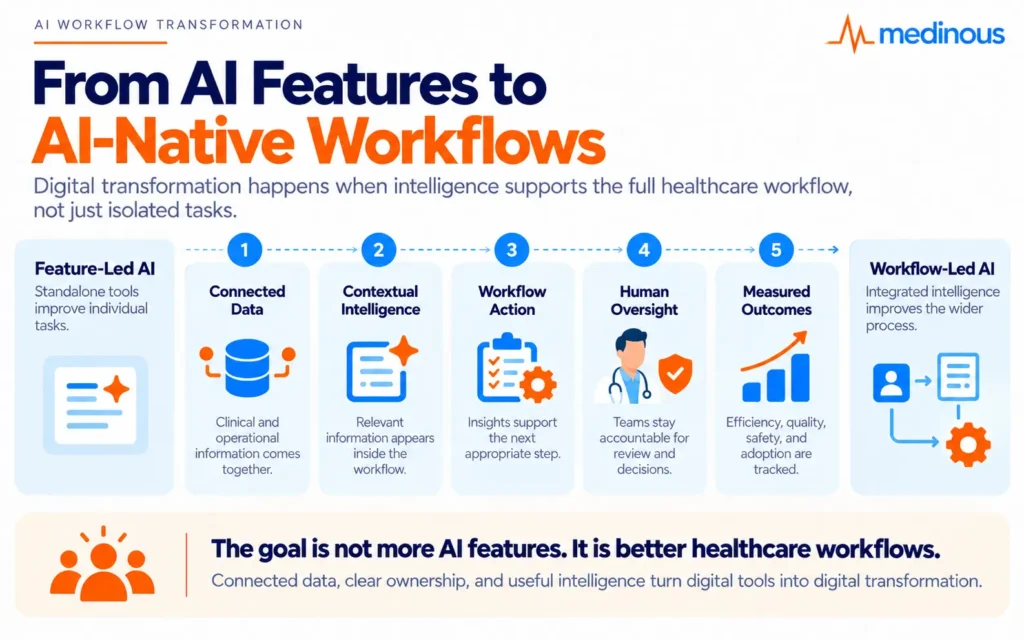
- AI-native workflows connect reliable information, contextual assistance, automation, accountability, and measurement.
- Healthcare automation should address real friction in information retrieval, coordination, administration, and follow-up.
- Integrated hospital management systems and EMRs create the trusted foundation for useful AI workflows.
- Performance should be assessed through efficiency, reliability, safety, staff experience, and financial value.
Why Healthcare Needs to Move Beyond Standalone AI Features
The first phase of AI adoption often begins with individual productivity problems. A physician wants faster documentation, a billing executive needs help classifying rejected claims, and a department head wants to understand performance without waiting for a customized report. These are practical starting points, but the limitation emerges when AI operates separately from the activities that come before and after a task. A documentation assistant may produce a note while the clinician still transfers information between applications. A reporting assistant may explain a trend while managers still manually retrieve supporting records and coordinate action.
A hospital does not function as a collection of independent tasks. Outpatient consultations generate prescriptions, investigations, follow-up appointments, and billing activities; discharge involves clinical clearance, documentation, pharmacy, insurance, billing, and bed management; revenue-cycle processes depend on accurate information flowing between clinical and administrative teams. The problem with isolated AI is not that individual tools are ineffective, but that their impact may stop at the boundary of the task they improve.
The World Health Organization’s Global Strategy on Digital Health 2020–2027 emphasizes coordinated organizational, financial, human, and technological resources rather than technology-only initiatives. The same principle applies to healthcare AI: sustainable transformation requires changes in how people, systems, and processes work together.
From task-level improvement to workflow-level value
Consider laboratory operations. An AI feature might summarize a report or identify an administrative exception, while a broader AI-native workflow examines how an investigation was ordered, prepared, processed, validated, reviewed, and followed up. The objective is not autonomous clinical interpretation; it is reducing avoidable gaps between stages while making information easier for responsible professionals to use. An integrated workflow can therefore generate value beyond the sum of its individual task improvements.
| Standalone AI feature | AI-native workflow opportunity |
| Generates a patient summary | Makes relevant patient information available within the clinical workflow |
| Produces an operational report | Supports investigation of trends using connected hospital data |
| Classifies a rejected claim | Helps route the issue to an accountable team and track resolution |
| Answers a routine patient question | Connects approved responses to relevant service processes |
| Identifies a pending task | Supports prioritization, accountability, and appropriate follow-through |
A hospital can deploy ten AI tools and still have the same ten operational bottlenecks.
What Makes a Healthcare Workflow AI-Native?
An AI-native healthcare workflow makes intelligence available within the normal sequence of work instead of introducing another disconnected activity. Information is retrieved from authorized sources, interpreted in context, used to support a defined action or decision, and monitored to determine whether the intended outcome occurred. AI-native does not mean fully autonomous: some activities are better managed through business rules or conventional automation, while clinical decisions require professional judgment and carefully validated systems.
Requirements for an AI-native workflow
1. Reliable and connected information
A clinician needs the correct patient history, medications, and investigations; an administrator needs the current status of operational tasks. Data quality, interoperability, matching, access controls, and information freshness are therefore essential.
2. Contextual intelligence
Information should appear where an authorized user needs it, whether at the point of care or while investigating operational performance. Outputs should be traceable to source records and communicate limitations.
3. Defined actions and ownership
An unresolved task needs an owner, an appropriate next step, and a way to record completion. Otherwise AI creates another queue of observations rather than improving the process.
4. Human oversight and safety
Routine administrative routing may be automated within established rules; medication changes, clinical interpretations, and patient safety concerns demand stronger controls and professional responsibility.
5. Continuous measurement
Hospitals should assess time, rework, output accuracy, user overrides, failures, escalation, and adoption rather than counting generated summaries or prompts.
How AI-Native Workflows Can Improve Hospital Operations
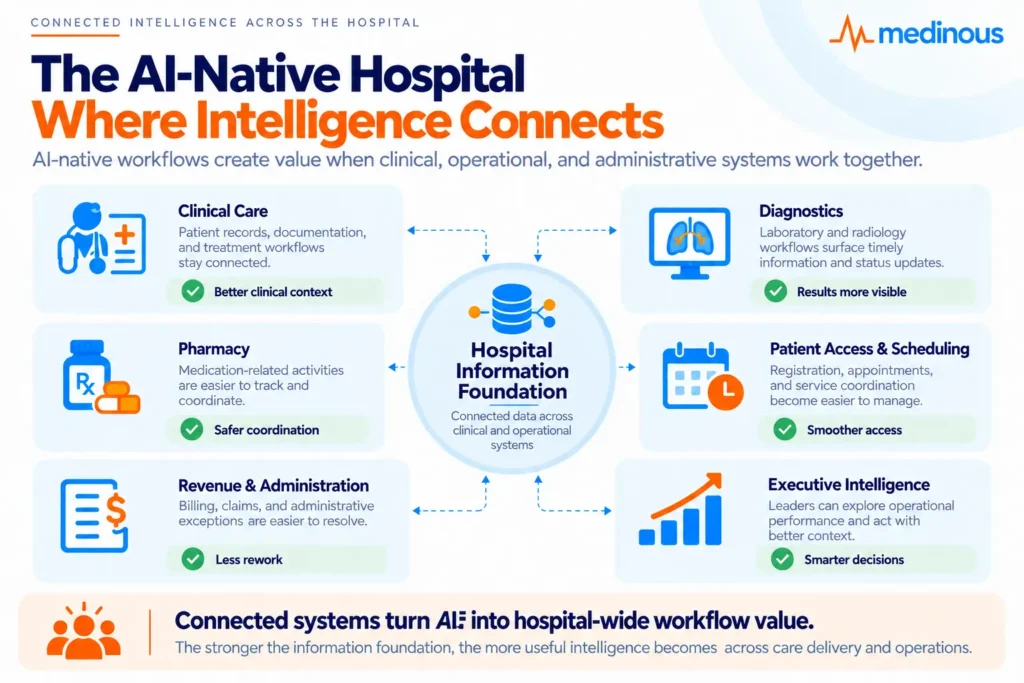
Hospitals are complex operating environments where delays in one department influence others. A patient awaiting an elective procedure may depend on diagnostic clearance, insurance authorization, operating room availability, medication preparation, and administrative coordination. Even when every department uses digital software, the entire process can remain inefficient if staff must reconcile information or chase handoffs manually. Healthcare workflow automation becomes more useful when it addresses these interdependencies rather than a single repetitive task.
Patient registration and appointment management
Patient access workflows involve scheduling, registration, demographic verification, insurance-related activities, and coordination with clinical departments. AI-supported processes could classify routine requests, flag missing administrative information, or route inquiries to relevant teams. Predictive analytics may help investigate demand and appointment cancellations, but their value depends on connecting findings to actual scheduling capacity, staffing, and patient communication.
Laboratory and radiology coordination
Diagnostic workflows involve order entry, preparation, specimen collection or imaging, processing, results, clinical review, and follow-up. AI may help organize pending activities, retrieve order information, and bring administrative exceptions to attention, while the clinical interpretation of results remains separately governed. A reliable workflow must distinguish between results being available and a qualified clinician reviewing or acting on them.
Pharmacy and medication workflows
Medication activities span prescribing, verification, dispensing, administration, reconciliation, and follow-up. AI-assisted retrieval may help authorized professionals review medication histories and documented changes, while predefined automation can handle appropriate administrative checks. AI must not independently invent dosage instructions or modify clinical prescriptions.
Revenue cycle and insurance management
Claims processing combines structured transactions with documentation requirements, payer rules, rejected claims, and repeated administrative follow-up. AI may help categorize rejection reasons, organize supporting information, highlight recurring administrative issues, and prepare material for staff review. The potential benefit is reduced rework and more consistent resolution, but payer standards and applicable regulatory obligations remain authoritative.
Patient discharge and bed management
Discharge may depend on clinical clearance, documentation, pharmacy, insurance, billing, patient instructions, and bed-status updates. An AI-supported view could consolidate current task status and surface outstanding administrative dependencies for responsible coordinators. The aim is not to automate the medical decision to discharge, but to make the supporting process more visible and reduce avoidable delays.
| Workflow | AI-native opportunity | Potential KPI |
| Registration | Identify missing administrative information and route requests | Completion time |
| Scheduling | Study demand and coordinate capacity | Utilization, rescheduling time |
| Diagnostics | Organize order status and administrative exceptions | Turnaround time |
| Pharmacy | Retrieve relevant medication information securely | Review effort |
| Revenue cycle | Classify exceptions and route claims | Resolution time, rework |
| Discharge | Surface cross-department administrative dependencies | Time after clinical clearance |
The smartest hospital workflow is not the one that automates every step; it removes avoidable friction while keeping responsibility clear.
Using AI to Support Clinical and Administrative Decision-Making
Healthcare decisions depend on accurate, timely information. Clinicians need clinical histories, medication records, and investigations, while executives need department performance, staffing, revenue, and utilization data. Both groups benefit from improved information access, but clinical decision support requires especially stringent safeguards because errors can affect patient safety.
Clinical intelligence: reducing information-search burden
A patient with multiple encounters may have relevant history dispersed across the EMR. AI-assisted retrieval can summarize authorized records, locate previous observations, and display trends for professional review. A source-grounded summary can be useful, but clinical teams must assess it for omissions, altered values, or unsupported assertions. AI should make information easier to use without claiming diagnostic authority.
Executive intelligence: moving beyond static dashboards
Hospital leaders may have extensive dashboards yet struggle to investigate why measures changed. Natural-language analytics can help authorized users explore appointment cancellations by department, laboratory turnaround by location, or unresolved insurance activities over time. Such tools should distinguish verified figures and calculations from hypotheses: a correlation between changes does not establish causation.
Why timing matters
An accurate alert delivered to the wrong person or after a decision may add work without improving care. AI-native systems should consider the recipient, timing, relevance, supporting context, and expected action. The goal is to shorten the distance between useful information and informed action, not simply increase the volume of messages.
KEY INSIGHT: The goal is not to generate more information. It is to make relevant information easier to act upon.
KEY INSIGHT: Your hospital has data. How quickly can your teams turn it into decisions?
When clinical and operational information remains fragmented, routine questions can require multiple reports, screens, and departmental follow-ups. Discover how Medinous brings clinical and administrative processes together to support connected operations and more accessible intelligence.
Request a DemoThe Role of Hospital Management Systems in AI-Native Workflows
AI-native workflows need dependable operational foundations. A hospital management system brings together registration, scheduling, inpatient and outpatient activity, pharmacy, laboratory, radiology, billing, insurance, inventory, and reporting. An electronic medical record supplies clinical context through patient histories, orders, and treatment documentation. When these systems share reliable information, healthcare organizations are better positioned to introduce AI at relevant points in the process.
Why better models cannot compensate for fragmented information
An AI application designed to identify administrative causes of delayed discharge needs accurate information from clinical documentation, pharmacy, billing, and bed management. If any source is disconnected or stale, the tool may produce an incomplete view regardless of the sophistication of its model. Interoperability, data definitions, integration monitoring, audit logs, and role-based access are therefore as important as model capabilities.
The Medinous perspective: connected, intelligent, healthcare-native
Medinous supports clinical and administrative workflows across hospitals, including physician and nursing activities, pharmacy, diagnostics, registration, appointments, billing, and reporting. Integrated clinical and operational modules create a foundation for making authorized information accessible throughout care delivery and management. Its AI direction includes clinical information assistance, executive intelligence, and opportunities for more contextual patient engagement, with capabilities requiring appropriate implementation and validation.
The strategic opportunity is to make intelligence useful within the systems healthcare professionals already use rather than requiring them to visit disconnected tools. The objective is connected, intelligent, healthcare-native technology that helps teams work with better context and clearer coordination, without implying that every potential autonomous capability is already deployed.
How to Build an AI-Native Strategy for Healthcare Organisations
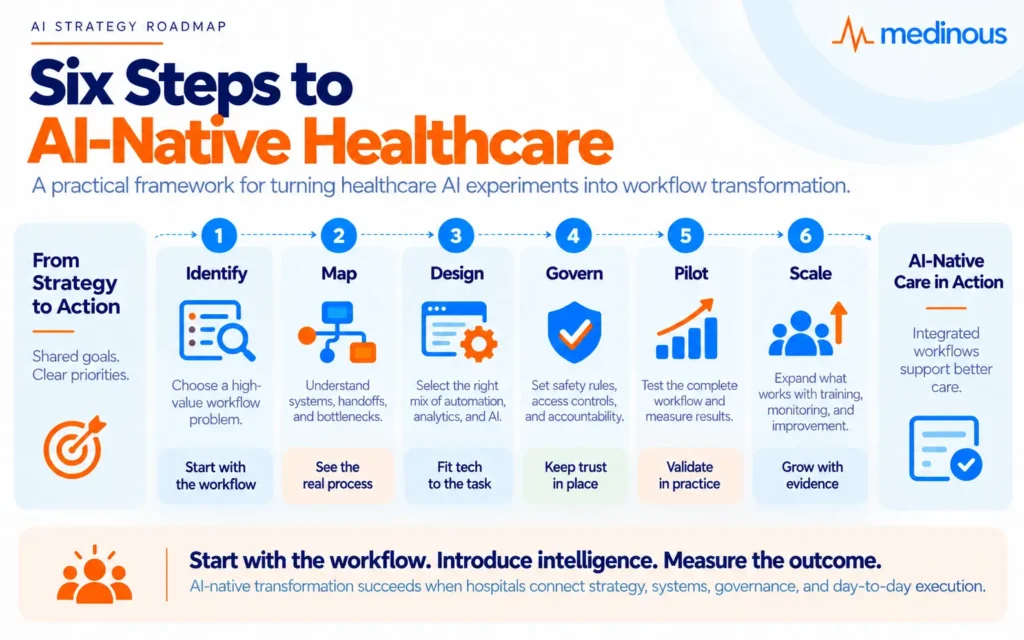
AI strategy should begin with workflow problems, not a list of available tools. Leaders should identify where employees spend time gathering data, where handoffs cause repeated delays, and where decisions require information that is difficult to access. The selected workflow should be important, measurable, and sufficiently supported by reliable data to make improvement feasible.
Step 1 — Identify high-value workflows
Prioritize repeated, measurable problems; consider frequency, impact, quality of available data, process ownership, and realistic success criteria.
Step 2 — Map the current process
Document systems used, responsible teams, approvals, exceptions, rework, and handoffs. Resolve simple integration or process problems before adding AI.
Step 3 — Design the right combination
Use rule-based automation for deterministic activities, analytics for structured questions, and AI where contextual retrieval or interpretation adds distinct value.
Step 4 — Govern the deployment
Set rules for data access, privacy, clinical safety, model validation, accountability, review, and incident response, aligned with applicable regulations.
Step 5 — Pilot the entire workflow
Test in actual operating conditions, including uncertain inputs, data gaps, system outages, error handling, user experience, and baseline comparison.
Step 6 — Scale what demonstrates value
Expand by department or facility only after evaluating performance, safety, adoption, cost, and the operational effort required for ongoing monitoring.
| Period | Priority | Decision output |
| Days 1–30 | Select workflow, map handoffs, baseline metrics, risk review | Approved use case |
| Days 31–60 | Integrate or configure, validate, train pilot group | Controlled pilot |
| Days 61–90 | Assess impact, accuracy, adoption, cost, and safety | Scale / revise / stop |
Measuring the Impact of AI-Native Workflows on Hospital Performance
AI usage metrics are not the same as value metrics. The number of summaries generated, prompts submitted, or accounts enabled can indicate activity, but not whether the hospital delivers work more effectively. Evaluation should begin with baseline workflow performance and consider comparable operating conditions, recognizing that patient volume, staffing, and policy changes can also influence results.
Efficiency, reliability, and safety
Hospitals can compare task completion time, handoffs, duplicate data entry, and rework before and after implementation. Clinical information assistance should also be evaluated for source fidelity, missing critical information, and unsupported output. Administrative tools should be monitored for misrouting, inaccurate classifications, failed retrievals, and user overrides. Faster but unreliable outputs do not represent successful transformation.
User experience, adoption, and financial impact
An application may be technically impressive and still go unused if it adds interruptions or verification work. Sustained adoption, staff feedback, and ease of task completion help show whether intelligence is integrated into everyday work. Financial value must account for software, integration, training, governance, infrastructure, and continuing operational costs. Time saved should not automatically be described as cash savings without evidence that it produces a real financial benefit.
| Dimension | Suggested KPI | Leadership question |
| Efficiency | Time, handoffs, rework | Is the workflow simpler? |
| Reliability | Accuracy, missing information | Is output dependable? |
| Safety | Overrides, escalation incidents | Are boundaries effective? |
| Experience | Staff feedback and interruption burden | Is work easier? |
| Adoption | Sustained use | Are intended users using it? |
| Financial | Validated benefits and full costs | Does value justify investment? |
KEY INSIGHT: The right AI metric is not how often employees interact with a system. It is how much better the workflow performs.
The Future of Healthcare Digital Transformation Is Workflow-Native
Healthcare technology has progressed from electronic records to integrated hospital platforms, business intelligence, and sophisticated AI applications. The next opportunity is not to add a separate intelligent feature to every screen but to make information, responsibilities, and appropriate actions connect more effectively across the organization. A clinical information assistant can help a physician find relevant history; a connected process can make that information available where clinical work already happens. An executive tool can explain a performance trend; a well-designed management workflow can help the responsible team investigate and act.
This evolution does not remove the need for clinical accountability, data governance, interoperability, or organizational change management. It makes those foundations more important because intelligent systems can influence how information is interpreted and work is prioritized. The hospitals that benefit most from AI may be those that redesign their most important workflows around reliable information, useful assistance, and measurable outcomes—not those that merely deploy the most AI features.
Healthcare does not operate one feature at a time. Meaningful digital transformation should not either.
ntelligent healthcare starts with connected workflows. Explore how Medinous brings together clinical, operational, and administrative processes to support more connected, data-driven healthcare management.
FAQs
What is an AI-native workflow in healthcare?
An AI-native workflow integrates relevant AI capabilities into the normal sequence of clinical or operational work. It combines trustworthy information, contextual assistance, appropriate automation, human oversight, and measured outcomes rather than functioning as a standalone tool.
How does healthcare workflow automation differ from AI-native workflows?
Healthcare workflow automation often executes tasks through established rules. AI-native workflows can combine these rules with AI-assisted information retrieval, predictive analysis, and contextual support; many automated processes do not require generative AI.
What are examples of AI in healthcare operations?
Examples include administrative exception classification, appointment-demand analysis, clinical information retrieval, diagnostic workflow coordination, revenue-cycle assistance, and natural-language access to operational performance information.
Why is AI adoption in healthcare challenging?
Fragmented systems, data quality, clinical safety requirements, security, regulation, change management, and difficulty measuring value can impede adoption. Effective programs address workflow redesign and governance alongside technology.
Why is the hospital management system important?
An integrated HMS connects registration, scheduling, EMRs, diagnostics, pharmacy, billing, and reporting, providing operational context that appropriately integrated AI applications can use.
Can AI-native workflows replace clinical judgment?
No. AI-native workflows may support information retrieval and validated decision support, while activities requiring clinical judgment must remain within applicable professional and safety requirements.
How should hospitals measure ROI?
Compare verified gains in time, productivity, quality, and financial outcomes with full implementation and operating costs. Evaluate safety and patient experience independently and avoid treating all time savings as direct cash savings.
Where should a hospital start?
Choose one measurable workflow problem, map it, verify available data, define governance, pilot the entire process, and expand only after demonstrating reliable improvement.