
A super-specialty hospital requires a large workforce to manage its daily operations and repetitive administrative tasks. Even with sufficient staff, managing the growing workload can become challenging. To address this, hospitals are increasingly adopting AI agents to streamline their workflows. AI helps automate manual and repetitive tasks, reducing the workload on hospital staff and allowing them to focus on more critical responsibilities related to patient care and treatment.
This blog explores how AI in healthcare improves operational efficiency, how hospitals can implement AI technology and which areas of hospital operations can benefit from automation. Let us understand these concepts in detail.
What Are AI Agents in Healthcare?
AI agents in healthcare are autonomous software systems that perceive information, reason across data and carry out tasks with minimal prompting. They work inside boundaries that the organization sets.
Here is the key difference. A basic tool waits for a question. An agent can plan steps, use connected systems and adjust as new information arrives. 33% of enterprise software applications are expected to include agentic AI by 2028, up from under 1% in 2024.
Why the shift now? Well, the reasons include rising data volumes, workforce shortages and growing expectations for access and quality. Agents help scale work beyond what people can handle alone, but they also change how teams supervise and trust software.
AI Agents, AI Assistants and Traditional Automation: What Is the Difference?
Hospitals may already use automation, chatbots or AI assistants, so it is useful to distinguish these technologies.
Traditional automation usually follows a predefined rule. If a certain event happens, the system performs a specific action. An AI assistant typically helps a user complete a task by responding to prompts, retrieving information or generating content.
An AI agent can go a step further. It can interpret an objective, determine the steps required, interact with connected systems and continue working until it reaches a defined outcome or requires human intervention.
For example:
- Automation may send an appointment reminder automatically.
- An AI assistant may answer a patient’s question about the appointment.
- An AI agent may identify an unconfirmed appointment, contact the patient, offer an alternative slot and update the scheduling workflow within approved rules.
This distinction matters because the more independently software can act, the more important governance, permissions and auditability become.
How AI Agents Are Used in Healthcare?
Several early uses of AI in healthcare are:
- Care coordination: one agent manages referrals, another tracks test completion and a third prompts staff or patients about next steps.
- Clinical documentation: drafting notes and routing them for review.
- Operational planning: adjusting staffing and spotting bottlenecks.
- Patient engagement: handling intake, reminders and common questions.
- Population monitoring: flagging patients who may be getting worse.
4 in 10 healthcare executives already use AI for inpatient monitoring and early warnings. Agents are used in drug research too, but this blog focuses on daily hospital operations.
Where AI Agents Fit Across the Hospital Journey
The biggest opportunity may not be a single AI agent completing a single task. It is the ability to reduce friction across the complete hospital journey.
Consider the number of operational steps that may surround one patient encounter:
- Appointment discovery and scheduling
- Pre-registration and digital intake
- Insurance eligibility and authorization
- Arrival and registration
- Consultation
- Investigations and diagnostics
- Medication and pharmacy workflows
- Billing and claims
- Discharge
- Follow-up and ongoing engagement
Every handoff creates another opportunity for waiting, repeated data entry or missed information. AI agents can be most useful when they operate within these connected workflows rather than as isolated applications.
The objective should therefore be broader than automating individual tasks. Hospitals should ask whether AI can reduce the number of manual handoffs required to move a patient or process from one stage to the next.
Key Areas Where AI Agents Can Improve Operational Efficiency
There are four priority areas: clinical documentation, value-based care, revenue cycle work and hospital operations. Here are a few practical examples:
- Operating room scheduling and case sequencing
- Staffing alignment and capacity forecasting
- Supply chain forecasting to reduce waste and shortages
- Faster intake and fewer missed appointments
The payments company Zelis runs more than 20 production agents, building proof-of-concept agents in a day and moving them to production two days later. The lesson for hospitals is clear: a strong data foundation makes agents faster to launch.
Operational Use Cases Hospitals Can Prioritise
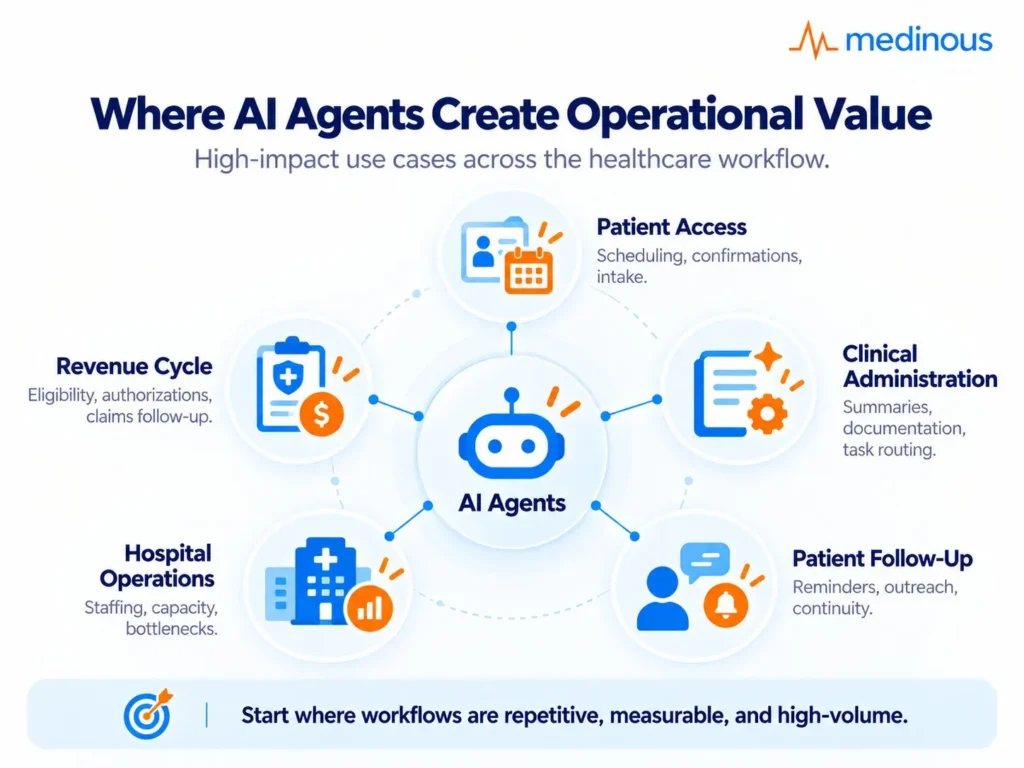
Not every workflow needs an AI agent. The best starting points are usually repetitive processes with clear rules, measurable outcomes and defined escalation paths.
Patient Access
Agents can support appointment discovery, scheduling, confirmations, rescheduling, registration and common patient queries.
Revenue Cycle
Agents can assist with eligibility checks, documentation gathering, claims follow-up, prior authorization workflows and exception handling.
Clinical Administration
Agents can organise patient information, prepare summaries, support documentation and help route follow-up actions for review.
Hospital Operations
AI can help teams monitor capacity, analyse queues, coordinate resources and identify operational bottlenecks.
Patient Follow-Up
Agents can support reminders, follow-up communication and routine post-visit engagement while escalating situations that require staff attention.
This approach allows hospitals to choose AI use cases based on operational value rather than deploying AI simply because the technology is available.
How AI Agents Can Support Administrative Workflows
Paperwork is a heavy load. 87% of healthcare workers stay late each week to finish administrative duties. Agents can summarize patient history, check insurance eligibility and match patients with the right provider.
Money matters too. 34% of healthcare executives said they already apply AI to revenue and budget cycle work, and 67% saw the biggest opportunity in payer and provider coordination and claims integrity. An agent can gather documents, submit a prior authorization request and follow up with the payer.
The ambient note generation and encounter summaries can reduce after-hours charting. Think of agents as extra pairs of hands for insurance checks and follow-ups, and not as a replacement for your billing team.
AI Agents for Patient Scheduling and Communication
Front desk work is repetitive, which makes AI a good fit here. Agents can:
- Offer appointment slots and send reminders
- Guide digital intake
- Predict likely no-shows
- Answer routine questions at any hour
A Chicago academic health system is using agents for around-the-clock non-clinical patient support, which frees staff for complex cases. Pair agents with a patient management system so bookings, registration and messages share one record.
Nursing teams benefit too. Admission guidance, medication reminders, communication after discharge and appointment reminders are the repeated tasks AI agents can handle.
Why Integration Matters More Than the Agent Itself
An AI agent is only as useful as the systems and information it can safely access.
A scheduling agent that cannot see appointment availability still creates work for staff. A billing agent that cannot access the required documentation cannot complete the workflow. A clinical AI tool that sits outside the electronic medical record may force clinicians to switch screens or manually copy information.
This is why hospitals should evaluate the workflow surrounding the AI, not only the AI model.
Before deploying an agent, ask:
- What systems does it need to access?
- What data is it allowed to use?
- What actions is it allowed to perform?
- Where does human approval remain mandatory?
- What happens when the agent is uncertain?
- Can every action be traced and audited?
The strongest AI implementations are usually those where the technology becomes part of the existing workflow rather than another destination employees have to visit.
AI Agents for Clinical and Diagnostic Support
Clinical agents support human judgment instead of replacing it. Some synthesize patient data and review imaging such as MRIs and X-rays, surfacing risks and guidelines. But in AI medical diagnosis, the doctor still decides.
Agents can also listen to a consultation, draft notes and queue follow-ups for review. These notes belong in electronic medical records where the full history sits together. Linking agents to clinical decision support such as order sets keeps suggestions aligned with approved care pathways.
Remember that every suggestion needs review. A simple rule helps: the agent drafts and the clinician decides.
From Clinical AI Assistant to Agentic Workflow
There is also an important distinction between helping a clinician retrieve information and allowing AI to take an action.
For example, an AI-enabled clinical assistant might bring together previous encounters, medications, investigations and trends so that a physician can review the relevant patient context more quickly.
An agentic workflow may then take the next step by preparing follow-up actions, routing approved tasks or coordinating processes across systems.
The level of autonomy should depend on the level of risk. Retrieving information and preparing a draft may require less oversight than changing medication orders, initiating clinical treatment or making decisions that directly affect patient care.
Healthcare organisations therefore need to define clearly what AI can retrieve, what it can recommend, what it can prepare and what it can actually execute.
Benefits of Artificial Intelligence in Healthcare
Here are a few of the benefits of artificial intelligence in healthcare:
- Better coordination across teams and systems
- Less administrative burden and lower burnout risk
- More consistent use of guidelines and policies
- Ongoing patient engagement between visits
- Faster response to change
Staff are open to it. Research found that 70% of healthcare workers want to use agents at work. Another study also reports that 69% of executives expect AI to improve their ability to adapt to changing clinical demands.
A practical way to track benefits is to pick three numbers before you begin, such as minutes spent per task, missed appointments and claim turnaround time. Compare them after three months.
How Hospitals Can Measure the ROI of AI Agents
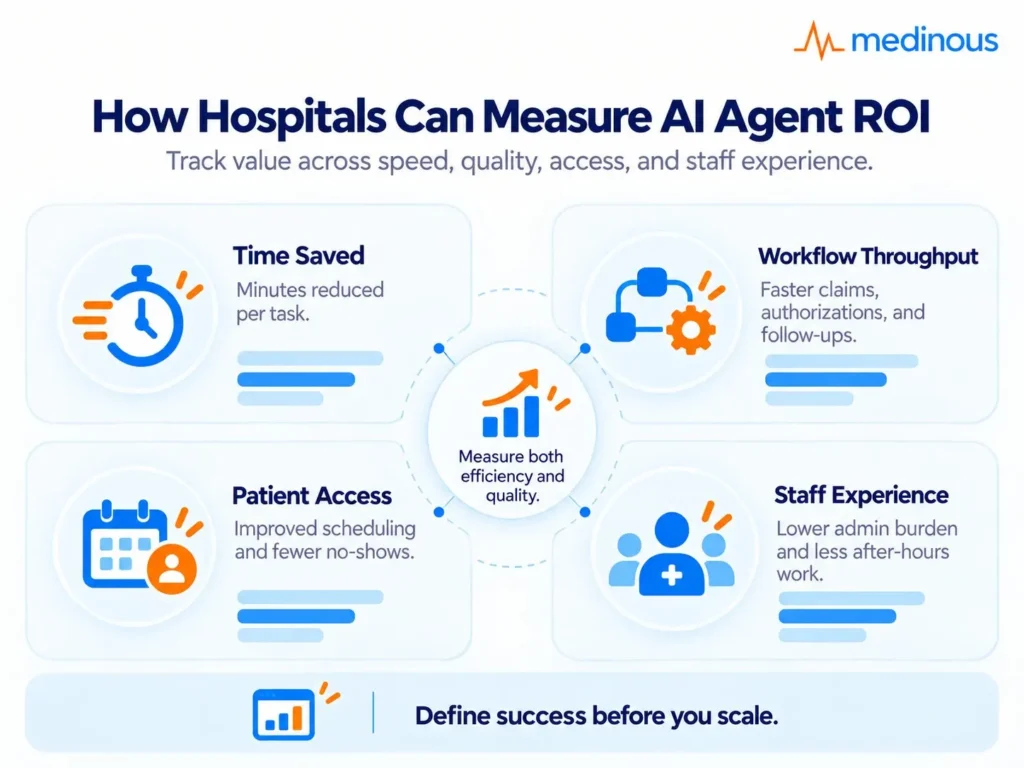
Hospitals should define success before implementation rather than trying to prove value after deployment.
Useful operational measures can include:
- Time saved per administrative task
- Appointment confirmation and no-show rates
- Average registration time
- Prior authorization turnaround time
- Claims processing time
- Number of manual handoffs
- After-hours documentation time
- Patient response time
- Percentage of agent actions requiring human correction
- Staff satisfaction with the workflow
Hospitals should also measure quality, not only speed. An agent that completes a task faster but creates more errors or additional review work has simply moved the burden elsewhere.
A useful question is: What becomes faster, easier, safer or more consistent because this agent exists?
Challenges of Using AI Agents in Healthcare
Although AI is very beneficial in healthcare systems, there are a few challenges associated with this as well:
- Data protection: 53% of healthcare executives call cybersecurity and patient data protection their greatest challenge.
- Accountability: Leaders must decide who supervises an agent and who answers for its actions.
- Integration: The results depend on workflow fit and deep links to health records.
- Trust: The AI agents cannot be trusted every time. It does all the repetitive tasks but needs supervision.
The agents should give explainable, auditable answers with data sources shown. If you cannot see why an agent acted, you cannot trust it in a regulated setting. Staff change is another hurdle. Clinicians and administrators must rethink how they supervise, trust and work with software that acts on its own.
Governance: What Should an AI Agent Be Allowed to Do?
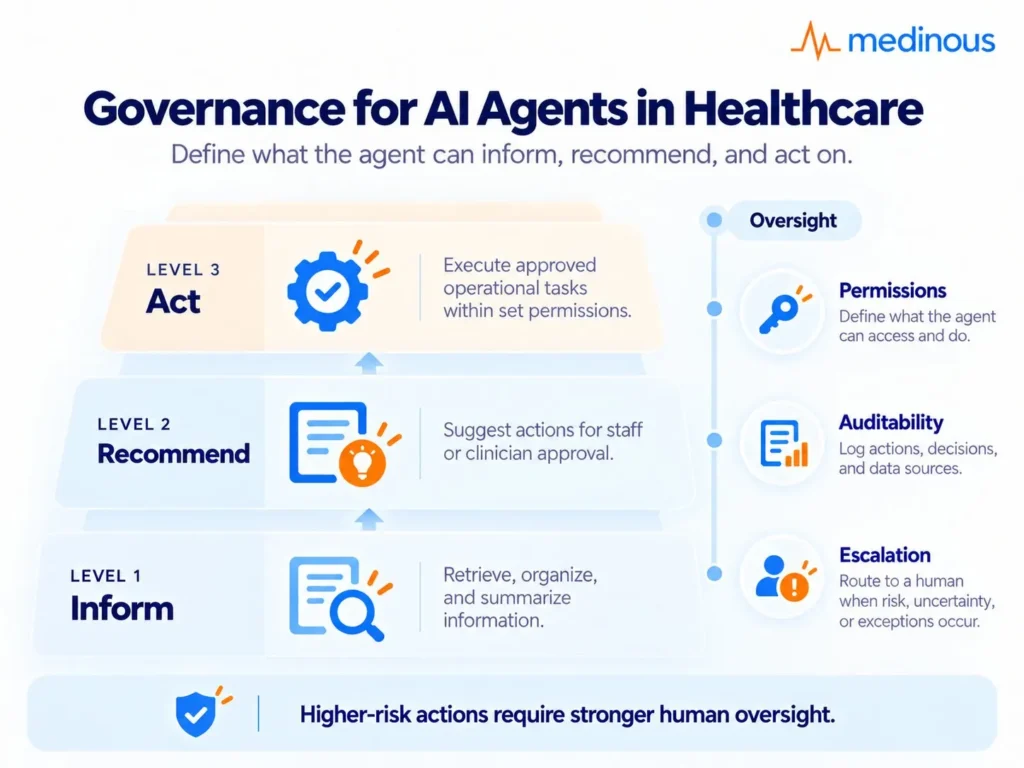
For healthcare organisations, one of the most important design decisions is not simply what an AI agent can do. It is what the organisation will allow it to do.
A practical governance model can divide actions into three levels:
1. Inform
The agent retrieves, organises or summarises information. A person remains responsible for interpreting it.
2. Recommend
The agent proposes an action, but a clinician or authorised staff member must approve it.
3. Act
The agent executes an approved operational task within clearly defined permissions.
The higher the potential impact on patient care, privacy or financial outcomes, the stronger the human oversight should be.
Hospitals should also define escalation rules. When the agent encounters missing information, conflicting data or a situation outside its approved scope, it should stop and route the task to the appropriate person rather than improvise.
Best Practices for Implementing AI Agents in Healthcare
Here are a few of the best practices to follow for implementing AI agents in healthcare:
- Start with low-risk tasks such as scheduling or coding, which can deliver strong returns.
- Keep a human in the loop for clinical decisions.
- Connect agents to your existing systems, such as your hospital software, instead of running them alone.
- Set clear targets, like fewer missed appointments or faster claim turnaround.
- Train staff early and invite their feedback.
- Check compliance rules, such as HIPAA, before launch.
AI should not be treated as a standalone productivity tool. The best results come when agents are woven into existing workflows and operational systems.
A Practical AI Agent Readiness Checklist for Hospitals
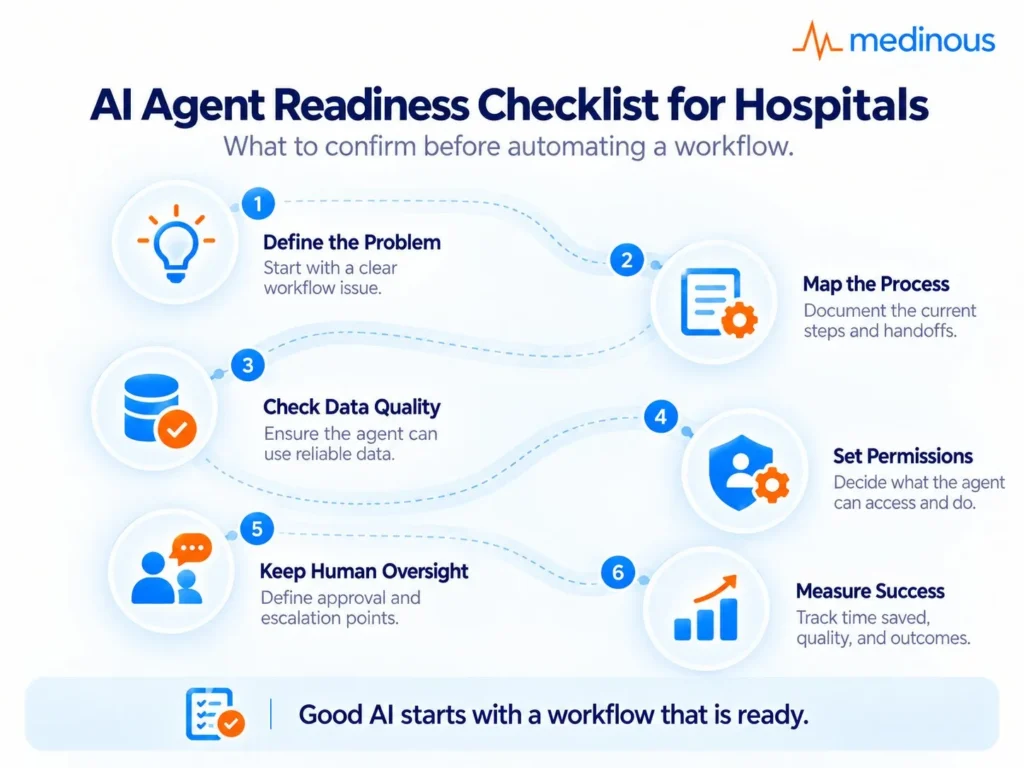
Before selecting an AI agent, hospitals can assess whether the underlying workflow is ready for automation.
Ask these questions:
- Is the problem clearly defined?
- Is the current process documented?
- Does the agent have access to reliable data?
- Can it connect securely to the systems involved?
- Are its permissions clearly defined?
- Is there a named person or team responsible for oversight?
- Is human approval required at the appropriate points?
- Can the agent explain or trace the information behind its output?
- Can every important action be audited?
- Is there a clear escalation process when the agent cannot proceed?
- Have success metrics been defined before implementation?
If these foundations are not in place, adding an AI agent may automate confusion rather than improve the workflow.
Start With the Workflow, Not the AI
Hospitals considering agentic AI should resist the temptation to begin with a list of AI capabilities.
Start instead with an operational problem.
Where are patients waiting unnecessarily? Where are staff entering the same information more than once? Which workflows generate repeated calls and follow-ups? Where do teams spend time finding information rather than acting on it?
Once the friction is clear, hospitals can determine whether the answer is process redesign, conventional automation, an AI assistant, an AI agent or a combination of these.
This also prevents organisations from using autonomous AI for tasks where simpler and more predictable automation would work just as well.
The Future of AI Agents in Healthcare
Expectations for the AI agents are to move from single tasks to constant, system-wide coordination. They will remember long-term context, work across departments, and still stay inside clinical rules and human oversight. Providers that build governance now will scale with less risk. At Medinous, we believe strong digital foundations come first.
Researchers expect future agents to work continuously, anticipate needs and cooperate across organizations.
The longer-term opportunity is therefore not simply an AI agent for scheduling, another for billing and another for clinical documentation. It is coordinated intelligence across the healthcare enterprise.
A patient journey may eventually trigger multiple specialised agents working together — one supporting access, another checking administrative requirements, another organising relevant clinical context and another coordinating follow-up.
For hospitals, this makes interoperability and governance even more important. Agents need trusted information, clearly defined permissions and a common operational foundation if they are expected to work across departments safely.
Building an AI-Ready Foundation with Medinous
AI agents become significantly more useful when the hospital’s underlying clinical, administrative and financial workflows are already connected.
Medinous provides an integrated healthcare platform across areas such as registration and appointments, outpatient and inpatient workflows, electronic medical records, diagnostics, pharmacy, billing, insurance and operational reporting.
This connected foundation can make it easier for healthcare organisations to introduce AI into workflows without creating another isolated system.
Medinous is also extending AI into the clinical workflow through Med Jini, an AI-led Clinical Assistant embedded within the Medinous environment. It helps physicians retrieve and organise relevant patient information using natural-language queries while keeping the clinician responsible for clinical judgement.
As healthcare moves toward more agentic workflows, the principle remains the same: AI should work around the healthcare professional and the patient journey, not force them to work around the AI.
Frequently Asked Questions :
What are AI agents in healthcare?
AI agents in healthcare are autonomous software systems that reason over data and complete tasks within limits set by a provider.
Will AI agents replace clinicians?
No, AI will not replace clinicians. They support human judgment.
Where should hospitals start?
Hospitals should begin with scheduling, intake or billing support, then expand carefully.
What is the biggest risk?
While using AI in healthcare, the biggest risk is protecting patient data, along with clear oversight of what agents do.
What is the difference between an AI agent and an AI assistant in healthcare?
An AI assistant typically responds to a user’s request and helps complete a task, while an AI agent can plan and perform multiple steps toward a defined outcome within approved permissions. The level of human oversight should increase as the potential impact of the agent’s actions increases.
How can hospitals measure whether an AI agent is successful?
Hospitals can track metrics such as time saved, turnaround time, missed appointments, manual handoffs, claims processing time and staff workload. They should also measure accuracy and the number of agent actions that require correction or human intervention.
Should AI agents connect directly with hospital management systems and EMRs?
In many workflows, integration is essential. Agents need access to the right information and systems to complete useful tasks. However, access should be role-based, governed and limited to the information and actions required for the specific workflow.
Can AI agents make clinical decisions independently?
Clinical use requires strong human oversight. AI can retrieve information, organise context and prepare recommendations, but clinicians should remain responsible for decisions that affect diagnosis, treatment and patient care.