
Cybersecurity in hospitals is often treated as an IT responsibility. For healthcare leadership, however, the more important question is what happens clinically and operationally when a digital system is disrupted.
A physician may need access to previous encounters, medications, laboratory results, imaging, or clinical notes. A pharmacy may depend on electronic medication orders. A billing team may rely on connected insurance workflows. An administrator may need real-time visibility into admissions, appointments, or hospital activity.
When those systems become unavailable, the impact is no longer limited to technology.
These are questions of clinical continuity, patient data protection, operational resilience, governance, and trust.
As hospitals become more connected, cybersecurity needs to protect more than individual applications. It needs to protect the wider digital environment through which clinical, operational, and financial workflows move.
A secure digital hospital should protect information without disrupting the workflows that depend on it.
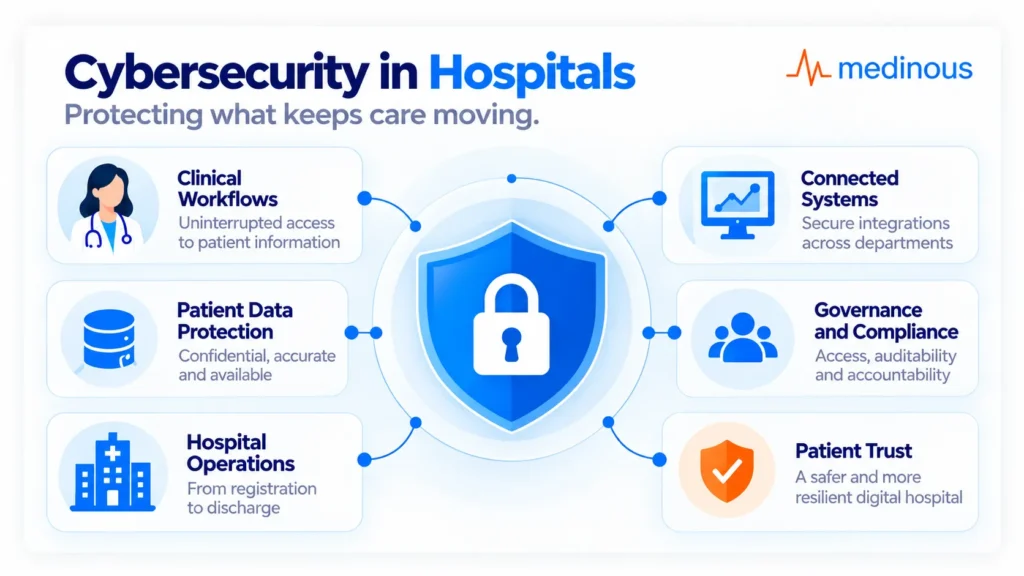
What Is Cybersecurity in a Hospital?
Hospital cybersecurity is the protection of healthcare systems, patient information, connected applications, digital infrastructure, and workflows from unauthorized access, misuse, disruption, alteration, or loss.
Key Principles
Confidentiality
Sensitive information should be accessible only to authorized users.
Integrity
Information should remain accurate and protected from unauthorized changes.
Availability
Systems and information should remain accessible when clinicians and hospital teams need them.
Protecting patient information is important. But if the systems containing that information become unavailable during care delivery, the organization still faces a clinical and operational problem.
Cybersecurity therefore needs to be evaluated not only by whether information is protected, but also by whether hospital workflows can continue when disruption occurs.
Why Is Cybersecurity Important for Hospitals and Clinics?
Patients experience healthcare as a sequence of connected interactions.
They register, attend consultations, undergo investigations, receive medications, make payments, and return for follow-up.
These workflows may involve:
- Patient identity
- Registration
- Clinical documentation
- Laboratory
- Radiology
- Pharmacy
- Billing
- Insurance
- Payments
- Inventory
- Finance
- Follow-up care
Patient Context → Clinical Workflow → Connected Systems → Operational Continuity
The value of cybersecurity lies not only in preventing unauthorized access, but also in ensuring that clinicians and hospital teams can continue using the systems they depend on.
Protecting Patient Information
- Clinical history
- Diagnoses
- Medications
- Investigations
- Personal information
- Financial information
- Role-based access
- Context-specific permissions
Protecting Clinical and Operational Continuity
- Information retrieval
- Clinical documentation
- Diagnostic workflows
- Medication workflows
- Registration
- Billing
- Claims
- Reporting
Cyber resilience creates operational value when the organization can maintain critical workflows rather than waiting for technology to return.
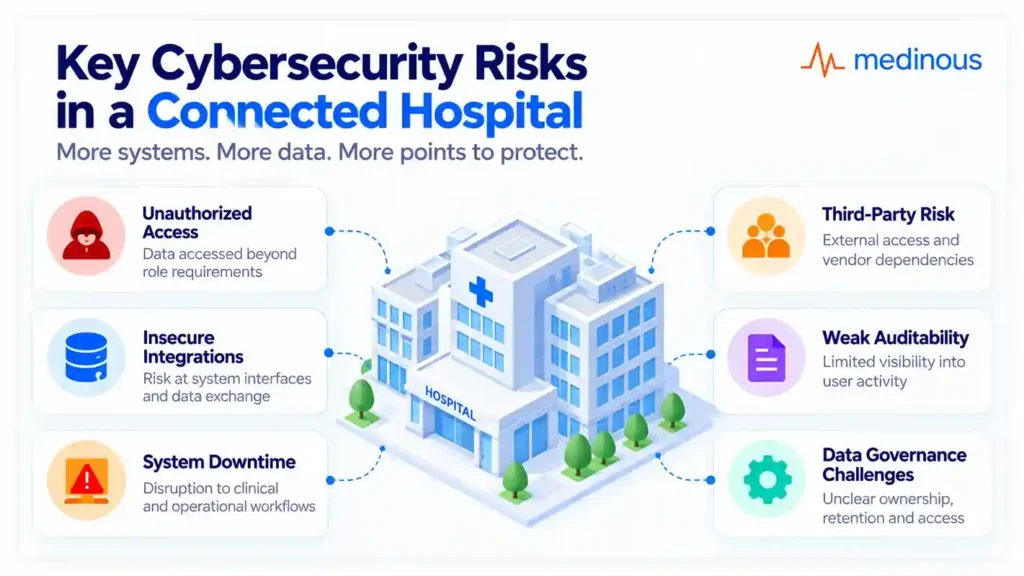
How Can Cybersecurity Affect Clinical Workflows?
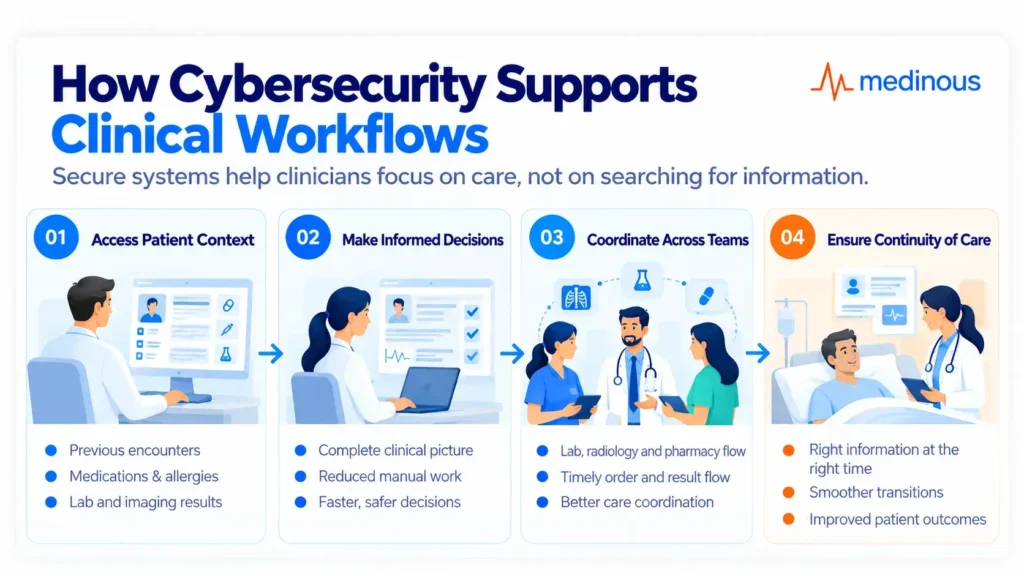
For CIOs and hospital IT teams, the question is not simply whether infrastructure is protected.
It is whether the hospital can preserve:
Patient Context | Workflow Continuity | System Availability
Explain how disruption can force teams to:
- Gather information manually
- Reconfirm patient details
- Use alternate documentation processes
- Delay non-critical activity
- Coordinate differently across departments
Cybersecurity becomes an operational issue when it affects how care is delivered.
Why Does System Availability Matter in Healthcare?
Patient → Consultation → Investigation → Result → Clinical Decision
Hospital leaders should understand:
- Which systems are critical
- Which processes can tolerate downtime
- Which workflows require immediate alternatives
- Which systems should be restored first
- How long teams can operate manually
How Do Hospital Integrations Affect Cybersecurity?
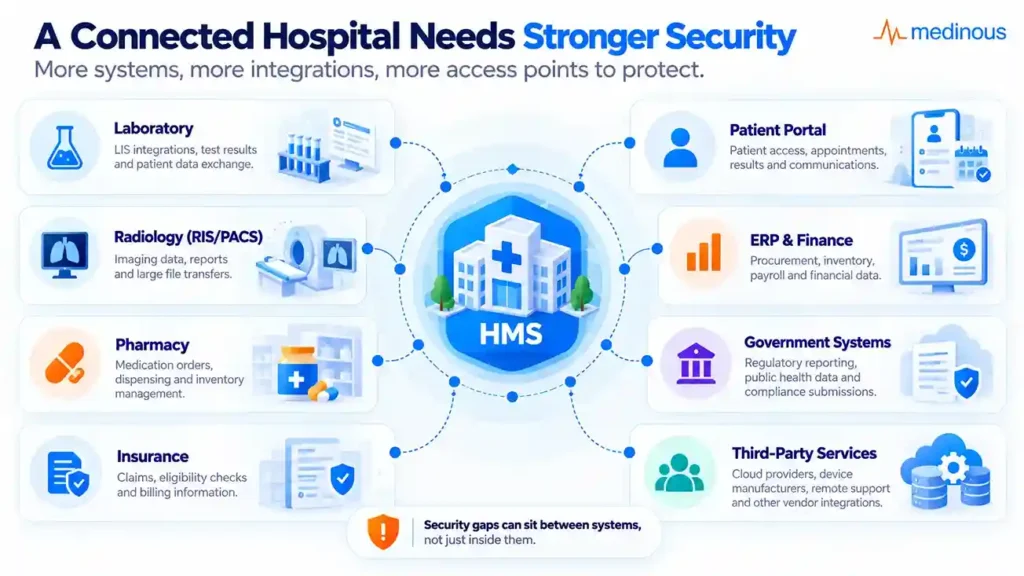
A modern HMS rarely works alone.
It may connect with:
- Laboratory systems
- RIS and PACS
- Pharmacy
- ERP
- Insurance platforms
- Payment systems
- Patient applications
- Government systems
- External service providers
Connected System → Authentication → Data Exchange → Hospital Workflow
Security gaps do not always sit inside individual applications. They can sit between them.
Secure Data Exchange
- Which system initiates the connection?
- How is it authenticated?
- What information is exchanged?
- Which users or services can initiate actions?
- Is interface activity monitored?
- What happens if the external system becomes unavailable?
Why Does Role-Based Access Matter in Hospital Systems?
Different hospital users need different levels of access.
Examples:
- Physicians
- Nurses
- Pharmacists
- Laboratory staff
- Front-office teams
- Billing users
- Finance users
- System administrators
- External support teams
Hospitals should understand:
- What each role can view
- What each role can change
- Who can export information
- Which users have elevated privileges
- How permissions change when roles change
- How quickly access is removed when employment ends
Key question:
Not simply: Can users log in securely?
But:
Once authenticated, what can each user see and do?
Why Are Audit Trails Important in Healthcare Systems?
Access controls determine what users are allowed to do.
Audit trails show what actually happened.
Relevant actions may include:
- Opening a patient record
- Changing clinical information
- Entering or reviewing orders
- Updating administrative data
- Exporting information
- Changing user permissions
- Performing system administration
User → Action → Record → Timestamp
Audit trails should help answer:
- Who performed the action?
- What changed?
- When did it happen?
A hospital cannot investigate what it cannot see.
How Does Third-Party Access Affect Hospital Cybersecurity?
Third parties may include:
- Cloud providers
- Software vendors
- Integration partners
- Support providers
- Analytics platforms
- Medical technology vendors
Hospitals need to distinguish between:
- Internal users
- External users
- Temporary access
- Privileged access
- Support access
- Vendor access
Key governance questions:
- Why was access granted?
- Which systems can be reached?
- How long should access remain active?
- How is access removed?
How Are Cybersecurity, Privacy and Data Governance Connected?
Cybersecurity
Protects systems and information from unauthorized access, disruption, alteration, or loss.
Privacy
Defines how personal information should be collected, accessed, used, and shared.
Data Governance
Defines who owns information, where it is stored, how it is classified, who can access it, and how long it is retained.
Good governance connects policy with system behavior.
Key Benefits of a Strong Hospital Cybersecurity Approach
Greater Clinical Continuity
Critical information remains available to support patient-care workflows.
Better Control of Patient Information
Access, authentication and governance reduce unnecessary exposure.
Greater Visibility Into System Activity
Auditability improves governance and investigation.
More Controlled Integrations
Hospitals understand which systems exchange information and how.
Better Operational Preparedness
Recovery planning clarifies what happens before, during and after disruption.
Stronger Third-Party Governance
External access remains tied to purpose, scope and duration.
What Should Hospitals Look for in a Secure HMS?
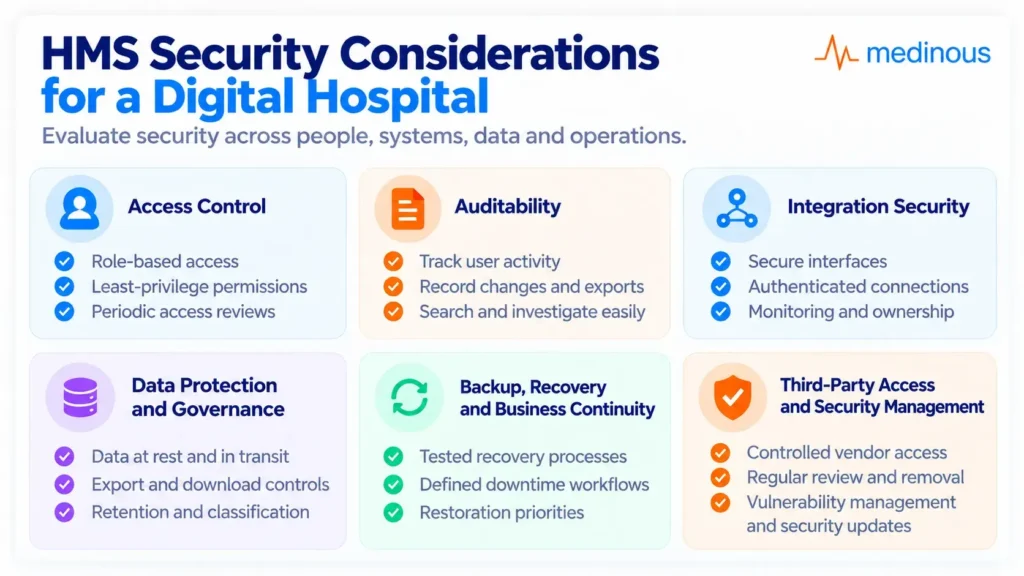
Patient Data and Access
- Is access based on roles and responsibilities?
- Can permissions be restricted by workflow or function?
- Can privileged accounts be managed separately?
- Can user access be reviewed regularly?
- Can access be removed quickly?
Auditability
- Can the hospital see who accessed a patient record?
- Are important changes recorded?
- Are administrative actions logged?
- Can activity be searched during an investigation?
- Is each action associated with a user and timestamp?
Integrations
- Is there an inventory of systems connected to the HMS?
- How are applications authenticated?
- What data can each integration exchange?
- Are interfaces monitored?
- What happens if a connected system becomes unavailable?
Data Protection and Governance
- How is sensitive information protected while stored?
- How is it protected while exchanged?
- Are exports and downloads controlled?
- Can retention policies be supported?
- How is access to sensitive data governed?
Business Continuity
- Which systems are considered critical?
- What happens if the HMS becomes unavailable?
- Are downtime workflows documented?
- Are backup and recovery processes tested?
- Are recovery priorities clearly defined?
Third-Party Access
- Which vendors can access hospital systems?
- Is vendor access limited?
- Is remote access monitored?
- Can temporary access expire?
- Is access removed when no longer required?
Security Management
- How are vulnerabilities managed?
- How are updates applied?
- How are incidents escalated?
- Who owns security responsibilities after go-live?
- How does the platform adapt as security requirements change?
Do not ask only whether a security control exists. Ask what happens in the actual hospital workflow when that control is used.
The Better Measure of Hospital Cybersecurity
Healthcare organizations should not assess cybersecurity only by the number of tools, controls or policies implemented.
The more important question is:
Can the hospital remain secure, governed and operational when something changes or goes wrong?
If patient information remains protected, user activity remains visible, integrations remain controlled and critical workflows can continue during disruption, cybersecurity is becoming part of the hospital’s operating model.
Building a More Secure Digital Hospital With Medinous
Medinous brings clinical, patient-care, ancillary and back-office workflows together within an integrated hospital platform.
For healthcare organizations evaluating their digital environment, cybersecurity should be reviewed across complete workflows — from patient identity and access to integrations, data governance, auditability and continuity planning.
The next step is not simply to ask whether individual security capabilities exist.
It is to examine how security operates across the connected hospital environment.
Request a Medinous Walkthrough
Frequently Asked Questions
Why is cybersecurity important in hospitals?
Cybersecurity is important because hospitals depend on digital systems for clinical, operational and financial workflows. A cybersecurity incident can affect patient information, system availability, workflow continuity and hospital operations.
How can cybersecurity affect patient care?
Cybersecurity can affect patient care when clinicians lose access to systems or information needed during diagnosis, treatment, medication management or other clinical workflows.
What is cyber resilience in healthcare?
Cyber resilience is the ability of a healthcare organization to prepare for disruption, continue critical operations, respond effectively and recover systems and workflows.
Why is role-based access important in hospitals?
Role-based access helps ensure users can access only the information and functions required for their responsibilities.
Why are audit trails important in healthcare?
Audit trails help hospitals understand who accessed information, what actions were taken and when those actions occurred.
How do integrations create cybersecurity risk?
Every integration creates another connection through which systems exchange information. Hospitals need to understand authentication, data exchange and monitoring.
What should hospitals ask an HMS vendor about cybersecurity?
Hospitals should ask about access controls, authentication, audit trails, integration security, data protection, backup and recovery, downtime workflows, third-party access, vulnerability management and ongoing security responsibilities.