
The AI medical scribe has become one of the most recognizable applications of artificial intelligence in healthcare.
Its value is easy to understand. Instead of spending a significant part of the consultation typing or completing notes later, a physician can conduct the conversation more naturally while AI helps capture and structure the documentation.
That solves an important problem. But documentation is only one part of the clinical workload.
Long before a physician begins writing a note, there is often substantial work involved in understanding the patient. Previous visits may need to be reviewed, laboratory and radiology results checked, medication changes understood, specialist notes read, and important events reconstructed from months or even years of medical history.
During the consultation, the physician may need to retrieve a particular result or understand how something has changed over time. After the consultation, there may still be documentation, referrals, orders, handovers, patient communication, and follow-up.
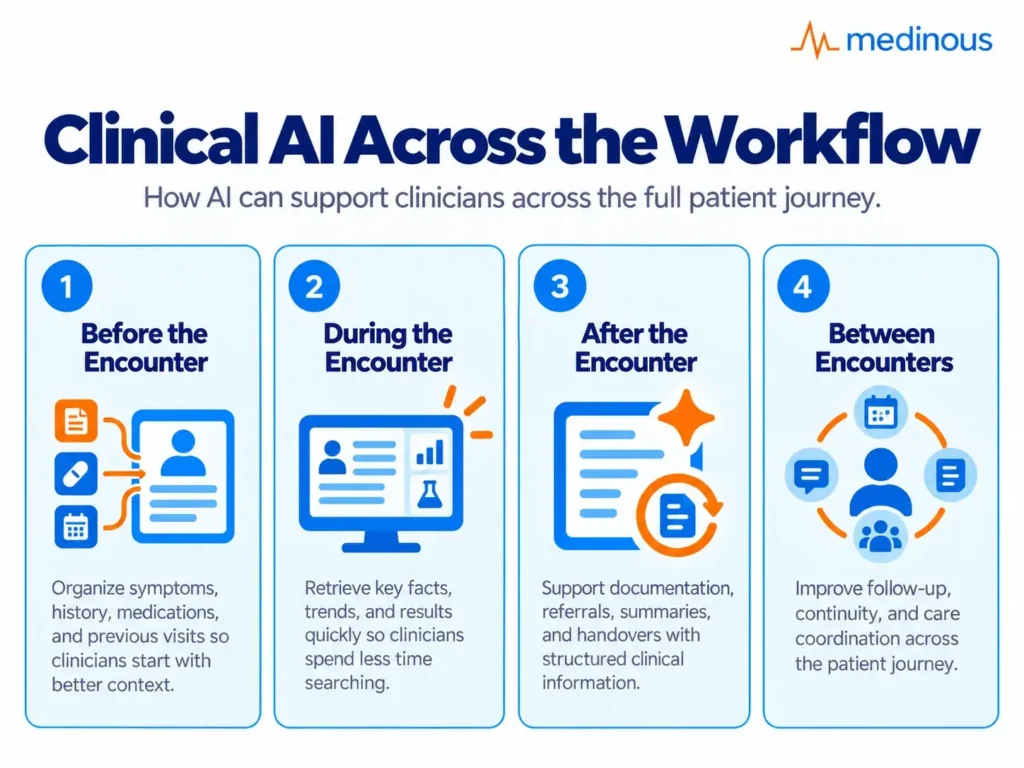
The bigger opportunity for clinical AI is therefore not simply to automate what the physician writes. It is to reduce the effort required to find, understand, and use clinical information throughout the patient journey.
Why AI Scribes Are Only the Beginning of Clinical AI
An AI scribe in healthcare is primarily designed around the encounter itself. It listens to the physician-patient conversation and helps convert that conversation into structured clinical documentation. For clinicians dealing with significant documentation burden, that can create immediate value.
The broader information problem, however, often begins before the conversation starts.
Consider a physician preparing to see a patient with several years of medical history. Relevant information may be spread across outpatient encounters, inpatient admissions, emergency visits, laboratory systems, radiology reports, medication records, diagnoses, allergies, procedures, and specialist notes. The information may already be there. The challenge is finding what matters quickly.
A broader AI clinical assistant can potentially help clinicians:
- Bring together relevant information from previous encounters.
- Surface recent laboratory and investigation results.
- Highlight documented diagnoses, medications, and allergies.
- Present important changes across the patient’s history.
- Summarize relevant patient context before the consultation.
- Retrieve specific clinical information during the encounter.
This represents an important shift. The AI medical scribe helps document what happens during the current encounter. Clinical AI can help clinicians understand what happened before the encounter, retrieve information while it is taking place, and support the activities that follow.
You might be interested in: 7 Clinical Moments Where an AI Clinical Assistant Can Help
How AI Can Support Patient Intake and Clinical Preparation
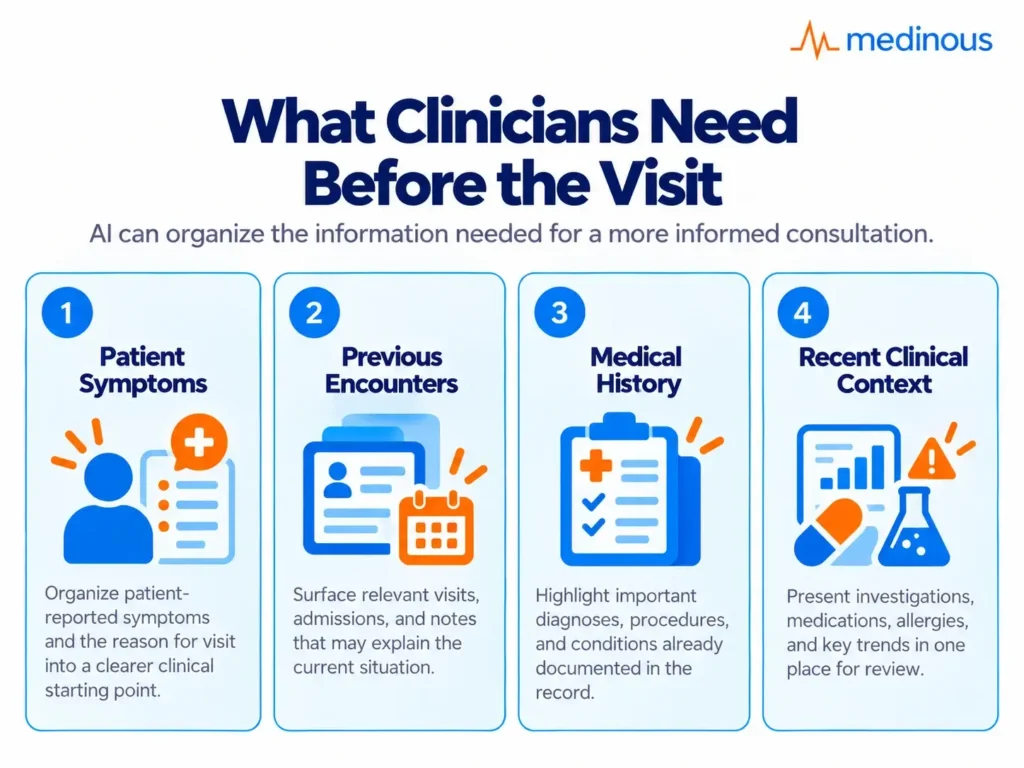
Clinical work begins before the physician sees the patient. Information may already have been gathered through a patient portal, nursing assessment, reception process, referral letter, or previous medical record. The challenge is turning all of that information into something the clinician can review efficiently.
AI can help organize patient-reported symptoms while also bringing forward relevant historical information. Recent investigations can be viewed alongside important diagnoses, medications, allergies, and previous encounters, giving the clinician a more complete starting point.
This becomes particularly valuable for patients with long or complex histories. A clinician seeing a patient with diabetes, hypertension, and cardiovascular disease may need to understand several years of laboratory trends, medication adjustments, specialist consultations, and admissions before the current symptoms can be interpreted properly.
The ability to assemble that context quickly can reduce time spent searching while leaving the interpretation where it belongs – with the clinician. The purpose is not for AI to make the clinical decision. The purpose is to improve the quality and accessibility of the information available when that decision is being made.
Using AI to Improve Clinical Information Retrieval and Decision Support
Clinical decision support is not new. Hospitals have used alerts, rules, order sets, drug-interaction warnings, and clinical pathways for years. Generative AI introduces a different type of interaction because it allows clinicians to ask questions about available information using natural language.
A physician may want to know the patient’s latest HbA1c value, how that value has changed over the past two years, when a particular medication was first introduced, or what changed after a previous admission. Traditionally, finding those answers may involve opening several screens and reviewing multiple records. AI can potentially reduce that search process by retrieving relevant information and presenting it in a more usable form.
For example, a clinician might ask:
- “What was this patient’s latest HbA1c?”
- “Show me the HbA1c trend over the last two years.”
- “What medication changes were made after the last admission?”
- “When was this medication first prescribed?”
- “What were the major findings from the previous visit?”
The distinction between retrieval and recommendation is important. Asking AI to locate a laboratory result, display a trend, or summarize previous treatment is very different from asking the system to make the clinical decision itself.
In many hospital workflows, the immediate value of AI may come from helping clinicians access evidence faster rather than attempting to replace clinical reasoning. For this to work safely, important outputs should remain verifiable. A clinician who receives an AI-generated answer should still be able to understand where the information came from and inspect the underlying record when required.
Read more: How Role-Based Access Control Protects Patient Records
How AI Can Support Diagnostics and Care Planning
Some of the most discussed applications of AI in healthcare involve diagnosis, imaging, pathology, and prediction. Yet there is another role for AI that may be immediately relevant to everyday clinical practice: organizing the information that contributes to diagnostic thinking and care planning.
A patient with a chronic condition may have years of observations, results, medication changes, consultations, and interventions recorded across the hospital’s systems. The physician’s challenge is to understand which parts of that history matter to the current situation.
AI can help create a longitudinal view of that information. Instead of requiring clinicians to manually compare laboratory reports from different dates or search through a series of previous encounters, the system can help surface changes over time and bring together the relevant parts of the patient’s history.
This can be particularly useful in areas such as diabetes and chronic disease management, oncology, cardiology, antenatal care, pediatrics, and ophthalmology. In each of these specialties, a single encounter rarely tells the full clinical story. The value of AI lies in helping clinicians see that story more clearly.
Related resources: AI in Hospital Management: Real Use Cases for Saudi Arabia
AI for Care Coordination and Clinical Communication
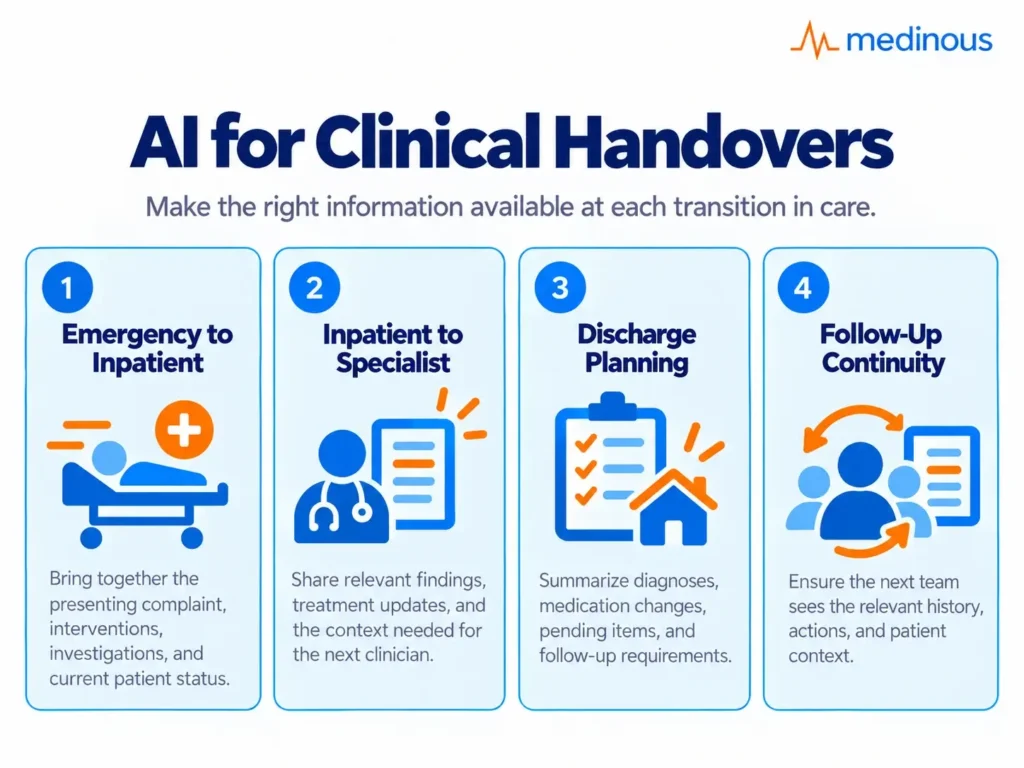
Clinical care rarely occurs within a single interaction or department. A patient may move from the emergency department to inpatient care, from inpatient care to a specialist, and eventually from the hospital to outpatient follow-up.
Every transition creates a handover, and every handover depends on the accurate transfer of relevant information. AI can help organize these transitions by bringing together the information required for the next stage of care.
For example:
- Emergency to inpatient care: presenting complaint, investigations, interventions, medications, and current status.
- Inpatient to specialist: relevant findings, treatment updates, and the clinical context needed for the next clinician.
- Discharge planning: diagnoses, medication changes, pending items, and follow-up requirements.
- Follow-up continuity: relevant history, actions already taken, and the context required for the next interaction.
The goal should not be to create more documentation simply because AI can generate it. The objective is to make the relevant information easier for the next care team to understand.
Moving Beyond AI Medical Documentation to Workflow Automation
AI medical documentation is often discussed as if documentation were a single task. In reality, clinicians and care teams may need to create referral letters, discharge summaries, encounter summaries, patient instructions, clinical correspondence, follow-up documentation, and information required for administrative or coding processes.
AI can potentially assist with many of these activities because much of the underlying information already exists elsewhere in the patient’s record. Rather than repeatedly searching, copying, and restructuring information, clinical AI can help convert available data into the format needed for the next task.
Potential applications include:
- Drafting referral letters and clinical correspondence.
- Preparing discharge information and encounter summaries.
- Creating patient instructions and follow-up documentation.
- Summarizing information for multidisciplinary reviews.
- Organizing relevant information for administrative workflows.
However, workflow integration is critical. An AI application that requires physicians to leave the EMR, log into another platform, locate the patient again, and manually move information between systems may simply replace one form of work with another.
The strongest clinical AI experiences are therefore likely to be those that operate within the environment clinicians already use. Even technically capable AI can fail if it creates additional screens and steps rather than removing them.
Explore: Medinous Hospital Management System
Read: What Is a Hospital Management System? A Complete Guide
How AI Can Support Patient Follow-Up and Continuity of Care
The clinical workflow does not end when the consultation is complete. Patients may need follow-up visits, repeat investigations, specialist referrals, medication monitoring, rehabilitation, chronic disease reviews, or additional education.
Managing this continuity becomes increasingly difficult when hospitals are dealing with large patient populations and multiple care pathways. AI can help care teams understand where a patient is within a longer care journey by bringing together previous appointments, laboratory trends, treatment changes, outstanding investigations, referral activity, and follow-up status.
This is particularly relevant for patients with chronic conditions. Instead of treating every encounter as an isolated event, clinical teams can gain a more longitudinal view of the patient’s journey. This may ultimately be one of the most important applications of AI in clinical workflows: not simply supporting individual tasks, but preserving clinical context across encounters.
What Hospitals Should Consider Before Expanding AI Across the Clinical Workflow
As hospitals move beyond the AI medical scribe, evaluating clinical AI requires a broader perspective. The starting point should be the problem the hospital is trying to solve, not the sophistication of the technology.
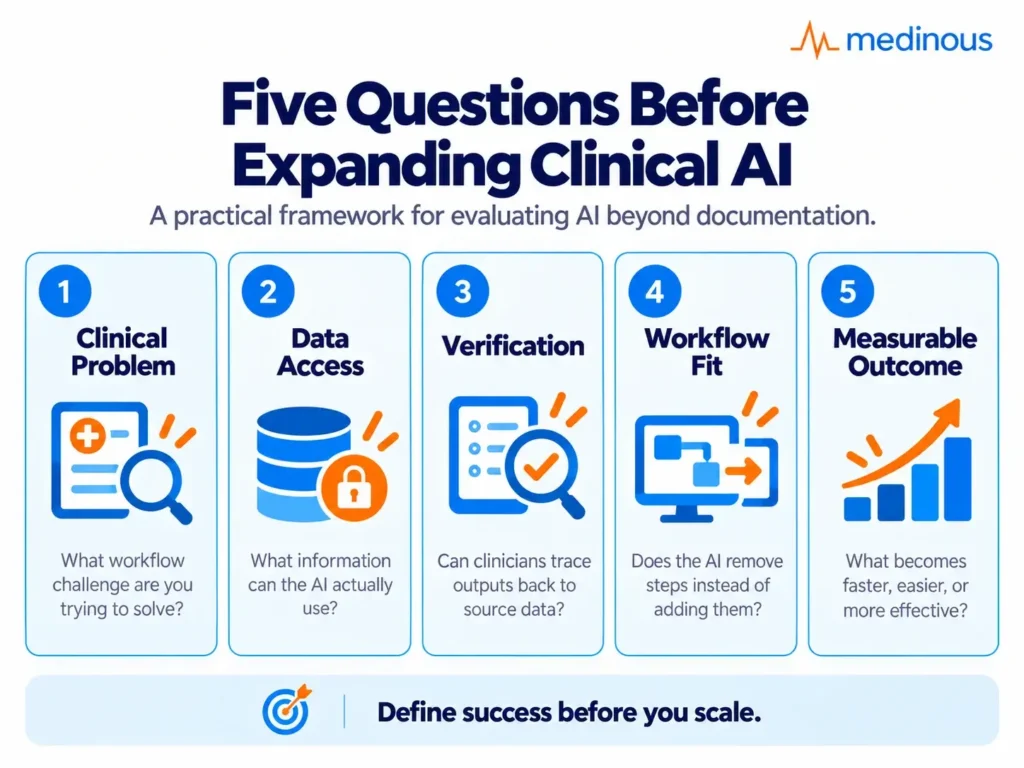
Hospitals should consider five areas:
- Clinical problem: What workflow challenge are we trying to solve?
- Data access: What information can the AI actually use?
- Verification: Can clinicians trace important outputs back to source data?
- Workflow fit: Does the AI remove steps rather than add them?
- Measurable outcome: What becomes faster, easier, or more effective?
Data access is particularly important. An AI system that cannot see the relevant laboratory, radiology, medication, or encounter information cannot provide complete clinical context, regardless of how advanced the underlying model may be.
Hospitals should therefore evaluate the system around the AI rather than focusing only on the model itself. The same principle applies to security and governance: access controls, data handling, integration, monitoring, and workflow fit are part of the AI system, not separate considerations.
The Future of Clinical AI Goes Beyond the Scribe
AI medical scribes have given healthcare organizations a clear and understandable entry point into generative AI. They address a visible burden and demonstrate how AI can operate within the everyday clinical environment.
The larger opportunity, however, lies across the full clinical workflow. Before the encounter, AI can help bring relevant patient history together. During the encounter, it can make clinical information easier to retrieve and understand. After the encounter, it can assist with documentation, handovers, and communication. Between encounters, it can help preserve the context required for follow-up and continuity of care.
The evolution is therefore from AI that primarily records the clinical moment to AI that helps clinicians navigate the clinical journey.
For hospital leaders, the more useful question may no longer be whether they should implement an AI scribe. It may be where clinicians are still spending unnecessary time searching for, reconstructing, documenting, and coordinating information – and whether AI can remove some of that burden while keeping clinical judgment firmly in the hands of the care team.
Bring AI Into the Clinical Workflow With Medinous
Medinous is taking clinical AI beyond the standalone assistant by bringing AI capabilities closer to the patient information and workflows clinicians already use.
With Medinous AI, clinicians can access relevant patient context, retrieve information using natural-language queries, review longitudinal clinical information, and understand trends without having to manually reconstruct the patient’s history across multiple screens.
Discover how Medinous AI can support clinicians across the patient journey. Request a Medinous demo.