
As the quality and number of hospitals in Saudi Arabia continue to grow, patient experience has become a crucial factor. Patient waiting time stands at the forefront of this experience. Many healthcare providers in Saudi Arabia are already working to reduce this wasted time and maintain a smooth workflow, ensuring that no patient has to wait for an unknown duration.
One of the easiest ways to improve patient experience is by integrating a hospital management system into the workflow. It can help hospitals manage their day-to-day operations more efficiently while making the patient journey smoother. Before exploring how it can help, let us understand what patient experience means and why improving it matters.
What Is Patient Experience in Healthcare?
The Agency for Healthcare Research and Quality (AHRQ) describes patient experience as the full range of interactions patients have with the healthcare system. That includes care from doctors, nurses, staff and health plans. It covers what patients value most, such as timely appointments, easy access to information and clear communication.
Many teams treat patient experience and patient satisfaction as twins. But they are not.
- Patient satisfaction asks whether a patient’s expectations were met.
- Patient experience asks whether, and how often, certain things happened, such as a doctor explaining the plan clearly.
As expectations differ from person to person, two patients can receive the same care but rate it differently. Experience is easier to track and compare, which makes it a stronger base for improvement.
Why Patient Experience Matters in Hospitals
A good experience is a worthy goal on its own, and it also links to better results. Research points to evidence connecting strong communication between clinicians and patients with fewer unnecessary services, better adherence to medical advice and lower infection rates.
Here is what else hospitals gain:
- Stronger trust: Satisfied patients are more likely to trust their provider again.
- Safer care: Patient comments about cleanliness, communication and responsiveness can reveal safety risks early.
- Better staff morale: Improved morale and retention as a benefit of focusing on experience.
- A competitive edge: Patients make use of the experiences when they have to make a choice to receive care.
There are five benefits of focusing on experience: better health outcomes, higher satisfaction, safer care, lower costs through fewer repeat tests and readmissions, and better staff retention.
In short, a patient who feels respected is more likely to follow advice, and that shows up in results. It is a general understanding that if patients cannot get the desired care, they look for other options.
Key Factors That Affect Patient Satisfaction
Hospital patient satisfaction rarely depends on one thing. It is the sum of many small moments mentioned below:
- Waiting time: A report says 26% of patients wait two months or more for an appointment, and over half give up on care when waits feel unreasonable.
- Clear communication: Without clear communication, patients often misunderstand common medical terms.
- Staff attitude: Polite and empathetic reception and nursing teams ease anxiety.
- Clean facilities: Tidy waiting areas and examination rooms help patients feel safe.
- Discharge and follow-up: About 49% of patients experience at least one medical error after discharge, which hurts trust.
- Cultural fit: Translation help and culturally aware staff make patients feel understood.
Notice that most of these points are about people and process, not buildings. That is good news, because process changes cost far less than renovations.
How to Improve Patient Satisfaction and Experience
Want to improve patient satisfaction? Start small and stay consistent.
- Make booking simple. Offer online and phone options with clear confirmations.
- Cut waiting time. Find where queues build up and fix those points first.
- Speak plainly. Swap jargon for everyday words and ask patients to repeat the plan in their own words.
- Follow up. Call or message patients after discharge to check the changes.
- Train every team. Reception, billing and housekeeping shape the experience as much as nursing does.
- Support language needs. Arrange translation help when patients need it.
- Close the loop. Tell patients what changed because of their feedback.
Here is a quick idea to try this month. Ask a manager to follow one patient from the entrance to discharge and write down every pause, repeated question and confusing sign. You will often find three easy fixes in a single morning.
How Healthcare Technology Can Improve Patient Experience
Patients now expect the digital ease they enjoy with banking. Portals linked to health records already allow scheduling, online bill payment, messaging and test result access. About 60% of patients want digital-first care. This works in the favour of the patients as it reduces the commute stress and time.
The right software helps you make this concept practical:
- A hospital management system connects departments so patients do not repeat the same details at every desk.
- Electronic medical records give doctors the full history at the point of care.
- A patient management system handles registration and appointment scheduling smoothly.
- Strong outpatient management tools reduce queues in busy clinics.
Healthcare can learn from banking, where people now manage their money securely from their phones. Hospitals can take a similar approach by putting patients at the centre of their digital experience, using chatbots and AI to improve convenience and personalisation without losing the human touch.
Medinous also offers a patient portal module so that patients can stay connected beyond the visit.
How Hospitals Can Measure Patient Experience
You cannot improve what you do not measure. Here are several ways to gather patient experience data:
- CAHPS surveys, which are standardised and tested
- Rapid cycle surveys
- Focus groups
- Direct observation
- Journey mapping
- Patient and family advisory councils
Traditional paper questionnaires often receive fewer responses and take longer to produce useful results. Experts recommend using digital surveys to gather feedback at key touchpoints before and after a patient’s visit, then sharing the findings quickly with care teams. It is also important to measure staff experience, as engaged teams are better positioned to deliver attentive and high-quality care.
It is useful to read open comments and not just scores. Patients’ own words can reveal safety problems, such as unclear discharge instructions or care teams that failed to share information. Treat these comments as early warnings. Track a few simple numbers each month too, such as waiting times, complaints and survey scores.
Best Practices for Creating a Patient-Centered Healthcare Experience
Here is a simple checklist to follow for creating a patient-centered healthcare experience:
- Culturally appropriate care
- Care coordination
- Courtesy and respect
- Access to care
- Communication with clinicians
- Getting information
- Shared decision-making
- Self-management support
Also make sure you add these three habits:
- Review patient comments every week and share wins with staff.
- Pick one fix per month and finish it before you start the next one.
- Finally, remember that experience reaches beyond the bedside. It starts before the patient arrives, when they search for you or book online, and it continues after they go home. Hence, plan for the full journey, not only the visit.
Patient Experience Is Built Across the Entire Hospital Journey
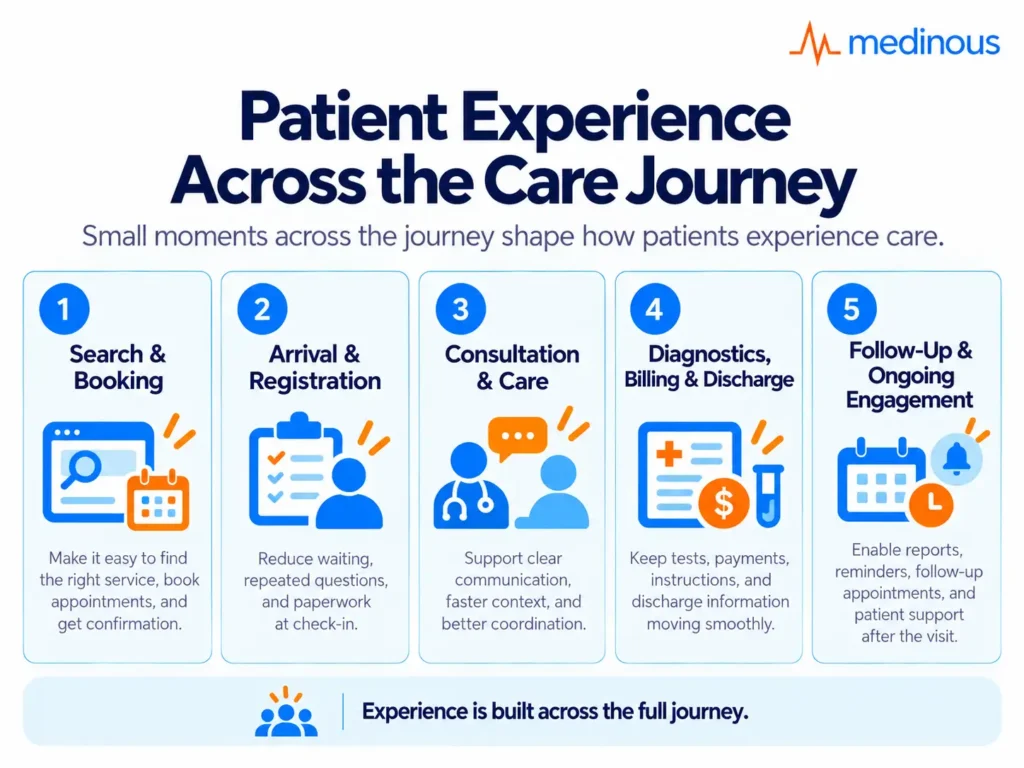
Improving patient experience is not only about making individual interactions more pleasant. Hospitals need to look at the entire journey and identify where patients experience delays, uncertainty or unnecessary effort.
A typical patient journey may include:
- Searching for the right doctor or speciality
- Booking an appointment
- Receiving appointment confirmation
- Arriving and registering
- Completing insurance or payment processes
- Waiting for consultation
- Meeting the physician
- Completing laboratory, radiology or pharmacy requirements
- Receiving discharge instructions
- Accessing reports and prescriptions
- Making payments
- Booking follow-up appointments
- Staying connected with the hospital after the visit
A problem at any one of these points can affect how patients perceive the entire experience.
For example, an excellent consultation may still be followed by dissatisfaction if the patient spends a long time waiting for billing, has to repeat information at another department or cannot easily access a laboratory report later.
This is why hospitals should look beyond individual departments and ask a broader question: How easy is it for a patient to move through our healthcare system from beginning to end?
The Five Layers Behind a Better Digital Patient Experience
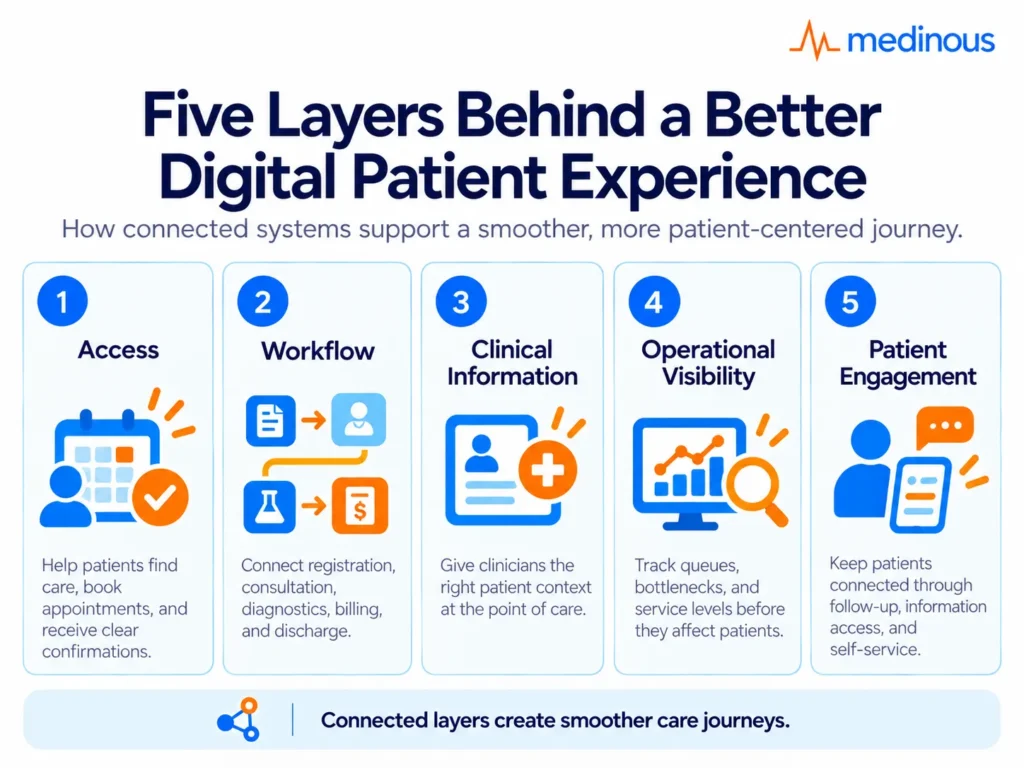
Patient experience can be viewed as a series of connected layers. What patients eventually see and feel depends on how effectively the underlying hospital systems work together.
1. Access
The experience begins before a patient enters the hospital.
Can patients easily find doctors, check availability, book appointments and receive confirmations? Can they access services digitally without making unnecessary calls or visits?
Reducing friction at this stage makes healthcare easier to access from the start.
2. Workflow
Once the patient arrives, hospital workflows determine how smoothly the visit progresses.
Registration, insurance, consultation, diagnostics, pharmacy, billing and discharge should work as connected processes rather than isolated departmental activities.
When information moves with the patient, staff spend less time searching, confirming and entering the same information repeatedly.
3. Clinical Information
Doctors and nurses need the right patient information at the right moment.
A connected electronic medical record can bring together previous consultations, medications, allergies, investigations and other relevant clinical information. This helps clinicians spend less time reconstructing the patient story and more time engaging with the patient.
4. Operational Visibility
Hospital administrators also need visibility into what is happening across the facility.
Waiting times, appointment volumes, bed utilisation, department workloads and service bottlenecks can provide useful signals about where patient experience may be breaking down.
Better operational visibility allows teams to address issues before they become recurring patient complaints.
5. Patient Engagement
The relationship should not end when the patient leaves the hospital.
Digital patient services can allow patients to book future appointments, access medical information, check reports and stay connected with their healthcare provider.
When these layers work together, patient experience becomes part of the hospital’s operating model rather than a separate initiative.
How a Patient Portal Can Extend the Experience Beyond the Hospital
For many patients, some of the most frustrating parts of healthcare happen outside the consultation itself.
They may need to call the hospital to check an appointment, travel back simply to collect information or contact different departments for reports and follow-up.
A patient portal can provide patients with a digital connection to the hospital beyond the physical visit.
Depending on the services enabled by the healthcare provider, patients can use a portal to perform tasks such as:
- Search for doctors
- Book appointments
- View existing appointments
- Access medication information
- View laboratory and radiology results
- Review relevant medical information
- Make online payments
Patient self-service does not remove the need for human interaction. Instead, it gives patients another convenient way to manage routine interactions while allowing hospital teams to focus their attention where personal support is most valuable.
Reducing Waiting Time Requires More Than Appointment Scheduling
Waiting time is often treated as a front-desk problem, but delays can originate almost anywhere in the hospital.
A patient may arrive on time and still experience delays because:
- Registration takes longer than expected
- Insurance approval is pending
- Previous patient information cannot be found quickly
- Consultation schedules have slipped
- Diagnostics are not coordinated with appointments
- Billing creates another queue at the end of the visit
- Staff cannot see where bottlenecks are forming
Reducing waiting time therefore requires hospitals to examine the connected workflow, not only appointment duration.
An integrated hospital management system can help different departments work from connected information and give hospital teams greater visibility across the patient journey.
What Hospitals Should Look for in Technology That Supports Patient Experience
Technology alone cannot create a good patient experience. Poorly implemented technology can simply replace one form of friction with another.
When hospitals evaluate digital systems, they should consider whether the technology makes everyday healthcare processes easier for patients, clinicians and staff.
Useful questions include:
- Does the system connect clinical, administrative and financial workflows?
- Can information move between departments without unnecessary duplicate entry?
- Can patients access relevant services digitally?
- Can physicians access patient information within their normal workflow?
- Can hospital leaders identify queues and operational bottlenecks?
- Does the system support secure, role-based access to patient information?
- Can the solution scale across departments, facilities or hospital groups?
- Can it integrate with other systems used by the organisation?
- Does it support the regulatory and operational requirements of the market?
The best measure of healthcare technology is therefore not simply how many features it provides. It is whether those capabilities reduce friction in the everyday experience of receiving and delivering care.
Where AI Can Add Value to Patient Experience
AI introduces another opportunity for hospitals, but its greatest value may not come from creating another standalone application.
It can be more useful when embedded into existing clinical and operational workflows.
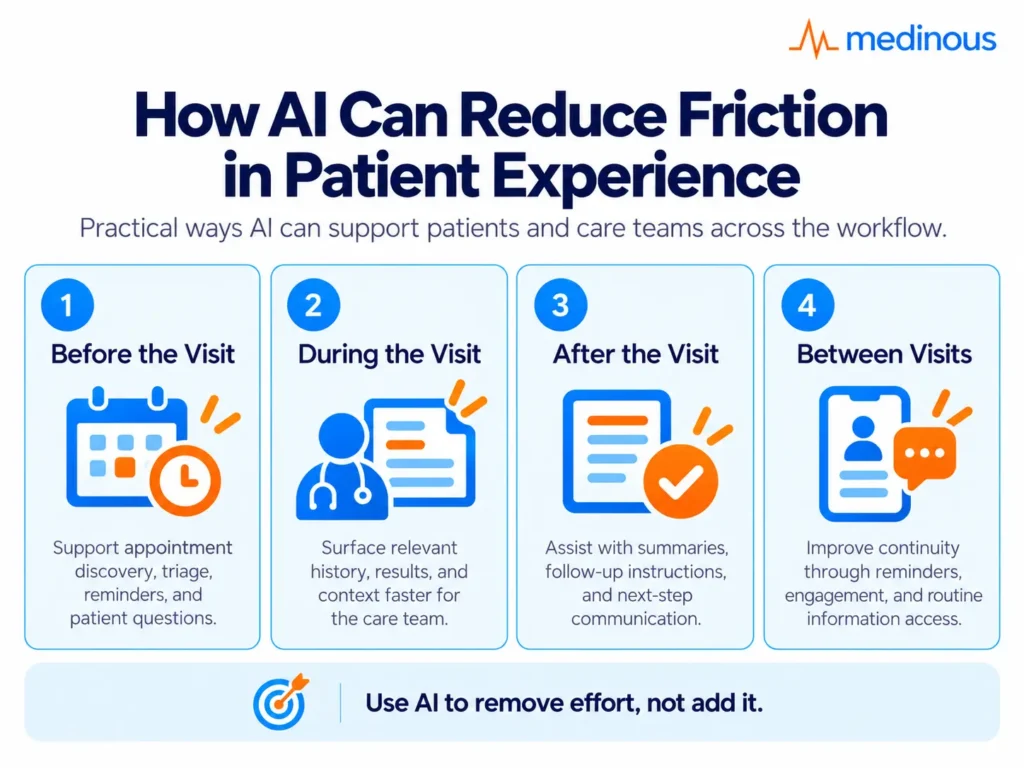
For example, AI can help make large amounts of information easier to navigate, support faster retrieval of relevant context, assist with routine interactions and help teams identify patterns in operational data.
In the clinical setting, the objective should not be to replace professional judgement. It should be to reduce the effort required to find and organise information so clinicians can devote more attention to the patient.
For patients, AI-enabled services may also make routine interactions more convenient through conversational interfaces, guided self-service and faster access to information.
As hospitals introduce these capabilities, security, privacy, clinical governance and appropriate human oversight remain essential.
A Practical Patient Experience Improvement Framework for Hospitals
Hospitals do not need to transform every part of the patient journey at once.
A practical approach is to work through five steps:
Step 1: Map the journey
Follow patients from booking through follow-up and document the major interactions between patients and the hospital.
Step 2: Identify friction
Look for waiting, repeated data entry, unclear communication, unnecessary handoffs and processes that require patients to make additional calls or visits.
Step 3: Prioritise high-impact problems
Focus first on issues that affect large numbers of patients or regularly result in delays, complaints or additional staff work.
Step 4: Connect the workflow
Determine whether the problem requires a process change, training, better information flow, technology or a combination of these.
Step 5: Measure the result
Track waiting time, turnaround time, complaints, patient feedback and other relevant indicators before and after the change.
Patient experience improvement then becomes a continuous operational discipline rather than an occasional survey exercise.
How Medinous Helps Hospitals Build a More Connected Patient Experience
Patient experience is influenced by what happens across the hospital — from registration and appointments to clinical care, diagnostics, billing and follow-up.
Medinous brings clinical, patient care, ancillary, administrative and back-office processes together within an integrated healthcare platform.
This can help hospitals create a more connected journey across areas such as:
- Registration and appointment scheduling
- Outpatient and inpatient management
- Electronic medical records
- Doctor and nursing workflows
- Laboratory and radiology
- Pharmacy
- Billing and insurance
- Patient portal services
- Operational reporting and analytics
By connecting these workflows, hospitals can reduce unnecessary fragmentation and give staff access to the information required to serve patients more effectively.
For patients, capabilities such as the Medinous Patient Portal extend this experience beyond the hospital by supporting convenient access to appointments and relevant care information.
Ultimately, the goal is not digitisation for its own sake. It is to make healthcare easier to navigate for patients and easier to deliver for the people caring for them.
Frequently Asked Questions :
How is patient experience different from patient satisfaction?
Patient satisfaction checks whether the expectations were met, while patient experience checks whether specific parts of care happened.
How do hospitals measure patient experience?
Hospitals use CAHPS surveys, rapid cycle surveys, focus groups, observation, journey mapping and advisory councils.
Why does patient experience matter?
Patient experience matters because it is linked to trust, safer care and better outcomes.
How can technology improve patient experience in hospitals?
Technology can improve patient experience by making appointments, registration, billing, access to reports and follow-up more convenient. Integrated hospital systems can also reduce repeated data entry, improve information flow between departments and help staff respond to patients more efficiently.
What role does a patient portal play in patient experience?
A patient portal gives patients a convenient way to stay connected with the hospital beyond the physical visit. Depending on the services available, patients may be able to book appointments, view reports, access medication information, make payments and manage follow-up activities online.
How can hospitals reduce patient waiting time?
Hospitals can reduce waiting time by identifying bottlenecks across the complete patient journey, not only at appointment scheduling. Better coordination between registration, insurance, consultation, diagnostics, pharmacy and billing can help reduce delays and create a smoother experience for patients.