

A physician may have 30 minutes with a patient. The patient’s medical record may represent years of care.
Somewhere within that record could be a medication changed three months ago, an abnormal laboratory result from the previous year, a specialist’s observation, or an earlier episode with similar symptoms.
The information may already exist. The challenge is finding what matters while the patient is sitting in front of you.
Research highlighted by the American Medical Association found that primary care physicians in one study spent a median 36.2 minutes working in the EHR per patient visit, even though visits were scheduled for 30 minutes.
For physicians, the challenge is therefore not simply capturing more clinical information. It is being able to retrieve the right patient context at the right point in the clinical workflow.
That is where an AI clinical assistant can help.
Not by replacing clinical judgement. Not by making decisions for the physician. But by helping clinicians find, review and understand relevant information already available within the patient record.
Median EHR time per patient visit reported in a primary care study highlighted by the American Medical Association.
1. Understand the Patient Before the Consultation
The clinical question: What do I need to know before I see this patient?
A returning patient may have years of consultations, diagnoses, prescriptions, investigations, procedures and specialist notes. Reviewing all of that information manually can take valuable time before the consultation has even begun.
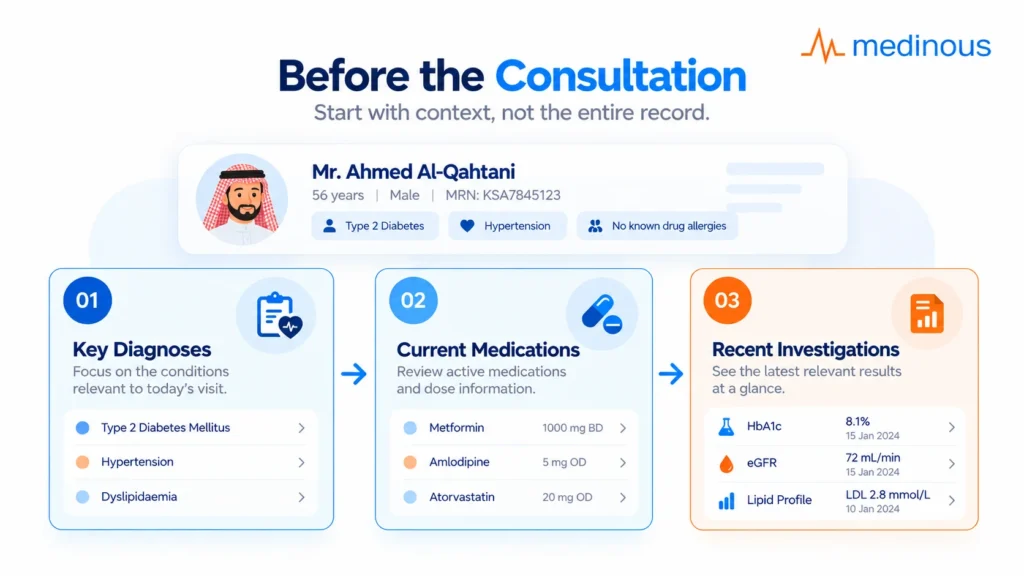
An AI clinical assistant can help bring relevant patient context together, including key diagnoses, current medications, recent investigations, previous consultations and important changes in clinical history.
Instead of starting with the entire electronic medical record, the physician starts with relevant context. That can make pre-consultation review more focused and leave more of the encounter available for the patient.
Start with context, not the entire record.
2. Identify What Has Changed Since the Last Visit
The clinical question: What is different since I last saw this patient?
During follow-up care, physicians may not need to review everything that has happened in the patient’s history. Often, the more useful question is simply: What changed?
- New diagnoses
- Medication changes
- Recent admissions
- New investigations
- Specialist consultations
- Procedures
- Significant changes in an existing condition
An AI clinical assistant can help surface these developments so the physician can focus on what is new rather than rereading information that is already known.
Sometimes the most useful information is not everything in the record. It is the delta.
3. Retrieve Patient Information Without Searching Multiple Screens
The clinical question: Where is the information I need right now?
During a consultation, physicians often need an answer to one specific question: When was the patient’s last HbA1c? What medication changed during the previous visit? Has the patient presented with this symptom before? What did the previous cardiology consultation report?
The answers may already exist within the patient record. Finding them, however, may mean moving between laboratory results, previous encounters, prescriptions, discharge summaries and specialist notes.
An AI clinical assistant changes the interaction. Instead of navigating according to where information is stored, the physician can ask according to what they need to know.
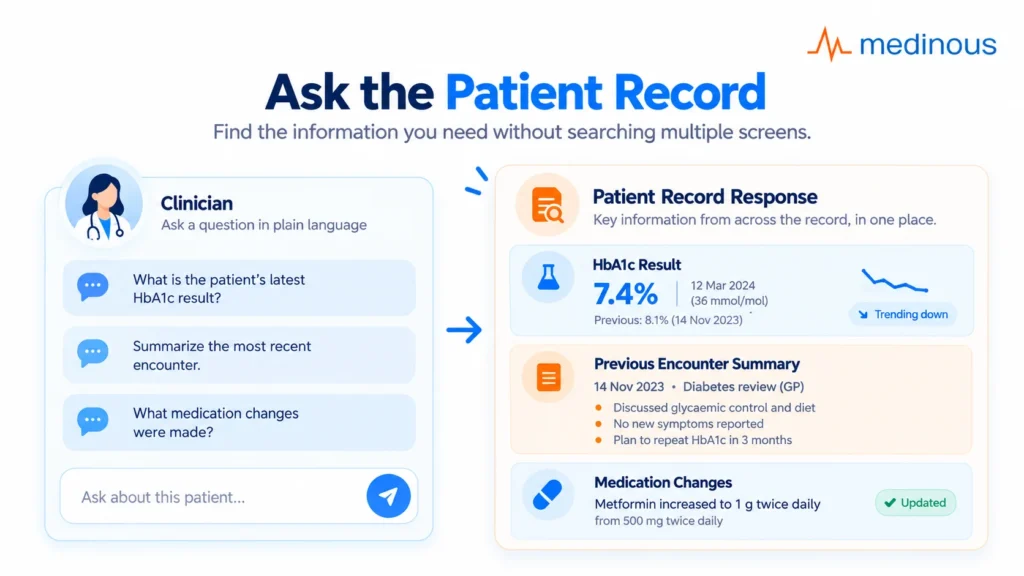
It can reduce the effort required to retrieve knowledge the healthcare organization already has.
4. Bring Relevant Clinical Information Together
The clinical question: What information should I consider together?
Clinical decisions rarely depend on one piece of information. A physician may need to consider diagnoses, medications, laboratory results, previous encounters, procedures, allergies, specialist notes and other relevant clinical observations.
Each piece may be available separately. The challenge is bringing the relevant information together quickly enough to be useful during the consultation.
For example: “Show me the patient’s diabetes-related history, medication changes and HbA1c results over the last 12 months.”
An AI clinical assistant can help retrieve that context from the longitudinal patient record and present it for review. The physician still interprets the information; the technology helps bring the relevant context together.
AI should reduce the information-retrieval work surrounding clinical reasoning, not replace clinical reasoning.
5. See the Trend Behind the Result
The clinical question: Is this result isolated, or is it part of a pattern?
A laboratory result can tell a clinician what is happening today. A longitudinal trend can add another layer of context.
- HbA1c
- Creatinine
- Haemoglobin
- Cholesterol
- Liver function measures
- Other longitudinal clinical observations
Instead of opening several historical reports individually, a physician could ask: “How has this patient’s HbA1c changed over the last 12 months?” or “Compare this creatinine result with the previous three investigations.”
An AI clinical assistant can make longitudinal patient information easier to retrieve and review. That means less time locating individual results and more time understanding the pattern those results may represent.
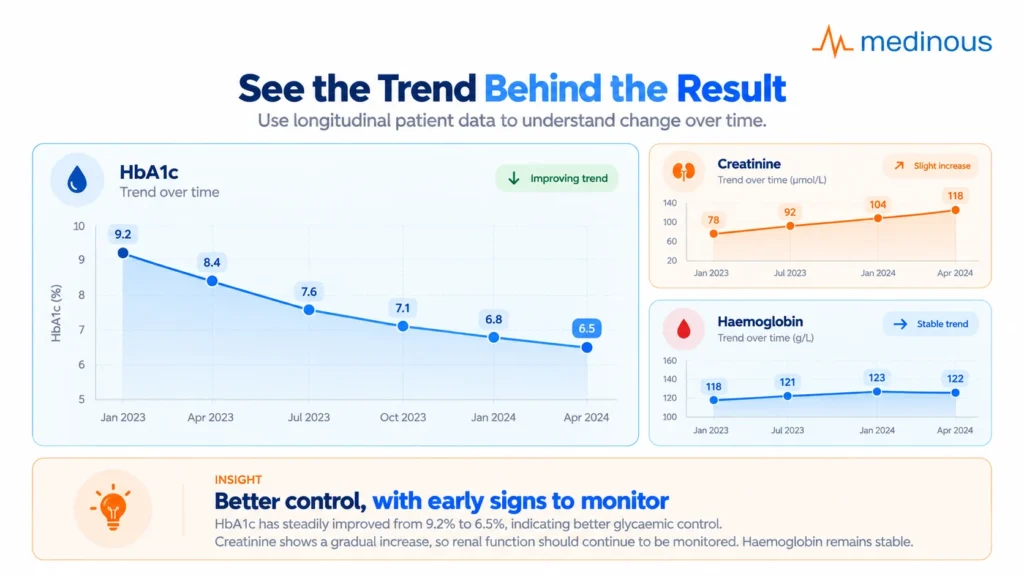
The latest result tells you where the patient is. The trend helps show how they got there.
6. Review Patient Context Before Closing the Encounter
The clinical question: Have I reviewed the information that matters?
- Talking to the patient
- Reviewing medical history
- Checking medications
- Examining investigation results
- Documenting new information
- Planning the next step
Before completing the encounter, there may be value in quickly bringing the relevant clinical context together again. An AI clinical assistant can help surface key information such as recent results, current medications, relevant patient history and significant changes for physician review.
But there is an important boundary. Clinical AI should help clinicians access information. It should not make them less involved in interpreting it. The World Health Organization’s guidance on AI for health emphasizes human autonomy alongside safety, transparency and accountability.
Clinical AI should support the physician, not become the physician.
The physician remains responsible for reviewing the information and making clinical decisions.
7. Make Today’s Consultation Easier to Understand Tomorrow
The clinical question: What will the next clinician need to know?
Today’s consultation becomes part of tomorrow’s longitudinal patient record. Months later, another physician may need to understand why a medication was changed, when a symptom first appeared, what treatment has already been tried, what the previous investigation showed, or how the patient’s condition has changed over time.
As patient records become longer, manually reconstructing that history becomes increasingly difficult. An AI clinical assistant can make previous encounters easier to navigate by allowing clinicians to query information across the longitudinal record.
From searching the patient record to asking the patient record.
AI in Clinical Workflows Is About More Than the AI Scribe
Much of the current discussion around AI in healthcare focuses on ambient documentation and AI scribes. That focus is understandable. Documentation is an important part of physician workload, but it is only one part of the clinical workflow.
Before documentation begins, the physician still needs to understand the patient. During the consultation, they need to retrieve information. During assessment, they need to connect different parts of the patient’s history. While reviewing investigations, they need to understand changes over time. And at a future encounter, someone may need to reconstruct that clinical story again.
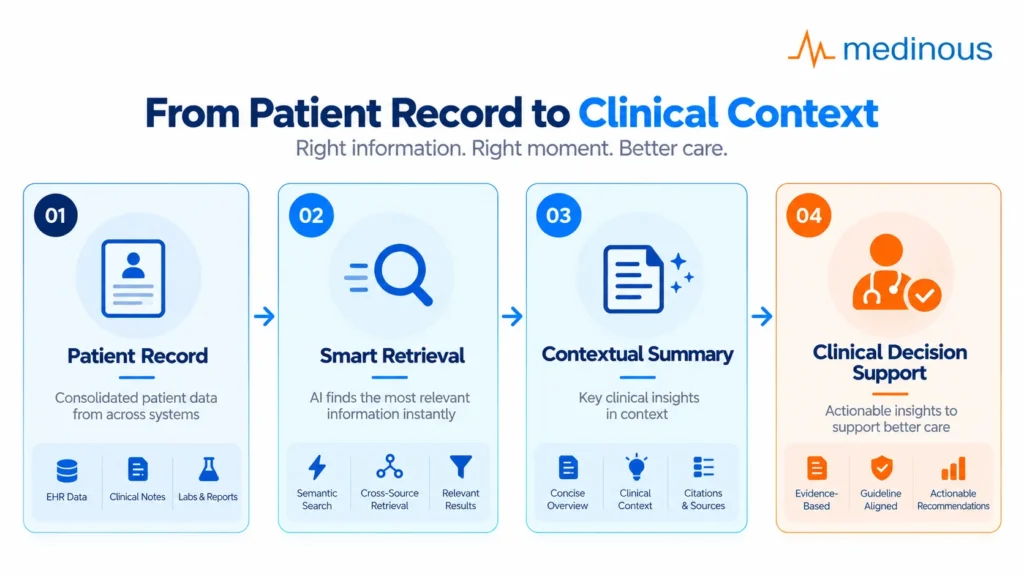
Clinical AI should not begin when documentation starts and end when the note is complete.
What Should Hospitals Look for in an AI Clinical Assistant?
The most useful AI clinical assistant may not be the one with the longest feature list. A better question is whether it improves the actual clinical workflow.
Does It Fit the Existing Clinical Workflow?
Every additional application can introduce another screen, login or process for clinicians to manage. Clinical assistance becomes more useful when it works within the environment clinicians already use.
Can Physicians Ask Questions Naturally?
Clinicians think in clinical questions, not database structures. A physician should be able to ask “What were this patient’s last three HbA1c results?” rather than needing to know exactly where each result is stored.
Can It Use the Longitudinal Patient Record?
The value of an AI clinical assistant increases when it can retrieve relevant context from previous encounters rather than only the current visit.
Does the Physician Remain in Control?
Information surfaced by AI should remain available for physician review, interpretation and validation. Clinical judgement stays with the clinician.
Does It Reduce Information-Retrieval Effort?
Hospitals should look beyond whether a solution includes AI. They should evaluate whether it genuinely makes the workflow better, including time spent finding information, number of screens or steps required, speed of retrieval and clinician experience.
5 questions to ask before evaluating an AI clinical assistant
- Fit the workflow
- Natural-language questions
- Longitudinal context
- Physician control
- Less retrieval effort
From Patient Record to Clinical Context
Hospitals have spent decades digitising healthcare information. The next challenge is not simply collecting more of it. It is making the information already available easier for clinicians to use.
Before the consultation, an AI clinical assistant can help establish patient context. During the encounter, it can help physicians retrieve relevant history. When reviewing investigations, it can make longitudinal trends easier to explore. Across future encounters, it can make an increasingly complex patient record easier to navigate.
And when this capability is embedded within a connected Hospital Management System, clinicians can access information without adding another disconnected layer to the workflow.
The real promise of clinical AI may therefore not be giving physicians more information. They already have enormous amounts of it.
The opportunity is helping clinicians reach the right information at the clinical moment when it matters.
See the Medinous AI-Led Clinical Assistant in Action
The Medinous AI-led Clinical Assistant is designed to help physicians access relevant patient history, query longitudinal clinical information and retrieve patient context directly within their existing clinical workflow.
Explore AI at the Point of Care
Frequently Asked Questions About AI Clinical Assistants
What is an AI clinical assistant?
An AI clinical assistant is an AI-enabled capability designed to support clinicians with tasks such as retrieving patient information, reviewing clinical context, navigating longitudinal records and accessing relevant information within clinical workflows.
How can an AI clinical assistant help physicians?
An AI clinical assistant can help physicians retrieve patient history, find previous results, review longitudinal trends and access relevant clinical information with less manual searching.
Is an AI clinical assistant the same as an AI medical scribe?
Not necessarily. An AI medical scribe primarily focuses on documentation. An AI clinical assistant can support a broader range of workflow activities, including patient-record retrieval, longitudinal context review and information navigation.
Can an AI clinical assistant replace physician decision-making?
No. AI clinical tools should support clinicians rather than replace clinical judgement. Information surfaced by AI requires appropriate clinical review, interpretation and validation.
Why is longitudinal patient context important?
Longitudinal patient context allows clinicians to understand how diagnoses, medications, investigations and other clinical information have changed over time rather than viewing each encounter in isolation.