

Artificial Intelligence is the most significant boost of this decade, and like other countries, Saudi Arabia’s hospitals have also been affected by this shift. Major cities like Riyadh and Jeddah have already been using AI to manage hospital workflows, from reading scans to routing patients to specialists and helping administrators plan staff shifts a week prior. For hospital leaders exploring what AI in hospital management actually looks like in practice, the Kingdom offers some of the most concrete examples anywhere in the region.
At Medinous, we see AI not as a replacement for clinical judgment or administrative expertise, but as a tool that strengthens both when applied thoughtfully. This blog explores why AI is becoming increasingly important for Saudi hospitals, the practical use cases already being implemented, and the key factors healthcare organizations should consider before adopting these technologies.
Why AI Matters for Modern Hospitals in Saudi Arabia?
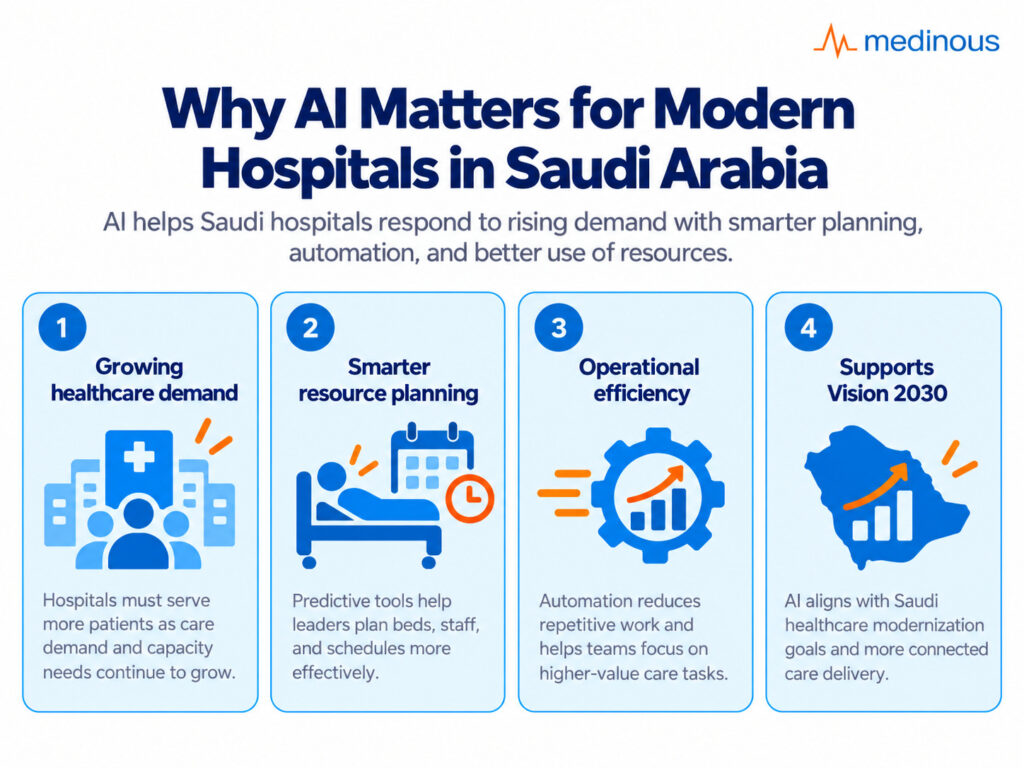
Saudi Arabia’s healthcare demand is growing quickly. Riyadh alone is projected to need thousands of new hospital beds within the next five years, and the shortfall could grow substantially further by 2040 based on global benchmarks.
Meeting that demand with facilities and staff alone is not realistic, which is part of why AI in healthcare administration has become such a central part of the Kingdom’s Vision 2030 healthcare agenda. Predictive tools, automation, and smarter resource planning give hospitals a way to serve more patients without proportionally scaling every cost.
What Is AI in Hospital Management?
AI in hospital management refers to the use of machine learning and automation tools to support both clinical and administrative decisions, from predicting how many patients will arrive on a given day to flagging which patients are at higher risk and need earlier intervention.
Unlike a single software feature, it typically works across many parts of a hospital, including imaging, documentation, scheduling, resource planning, and patient communication. By drawing from the same underlying data, it can provide more accurate and timely insights than manual review alone.
Real-World AI Use Cases in Hospital Management
AI is used extensively in hospital management, and to understand this better, let us look at a few of the real-world AI use cases in hospital management:
Predicting Patient Demand and Managing Capacity
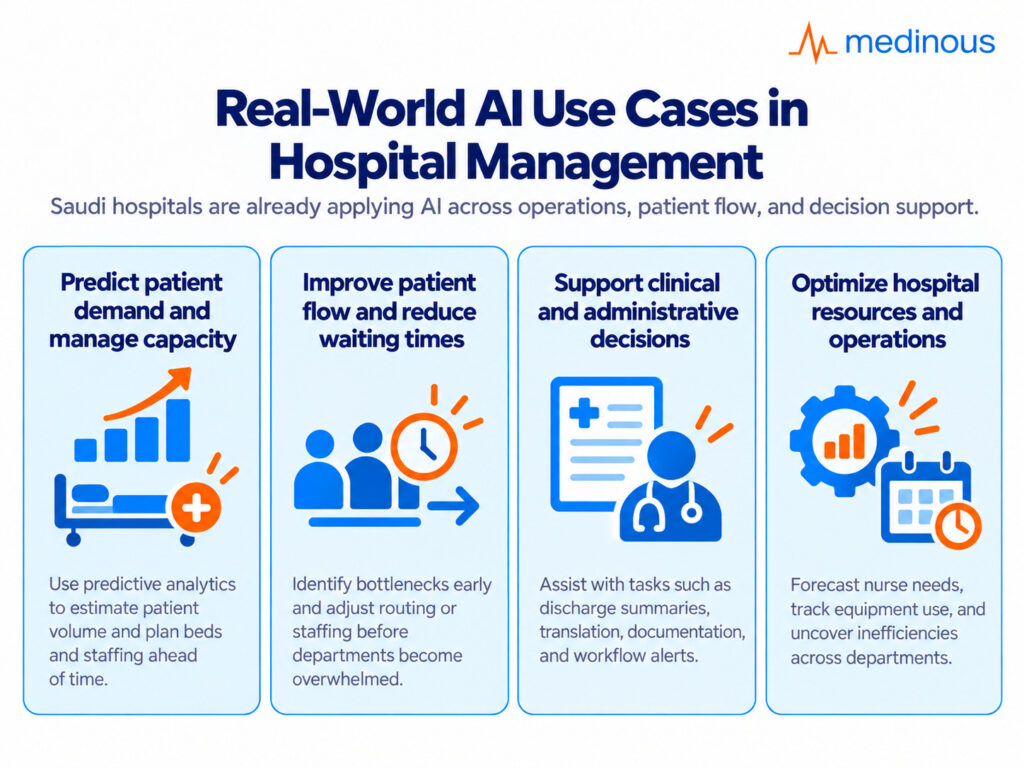
One of the clearest near-term benefits of AI in hospitals is predictive analytics that identifies high-risk patients and supports earlier intervention by analyzing existing patient data. The same predictive approach applies at the operational level, helping administrators anticipate patient volume and plan bed and staff capacity ahead of time.
Improving Patient Flow and Reducing Waiting Times
Image recognition, predictive analytics, and workflow automation are already being used to reduce bottlenecks and balance patient demand across hospital networks in Saudi Arabia. By identifying where patients are likely to bottleneck before it happens, hospitals can adjust staffing or routing proactively instead of scrambling once a department becomes overwhelmed.
Supporting Clinical and Administrative Decisions
Saudi hospitals are already running dozens of in-house AI solutions covering clinical documentation, medical translation, radiology support, and workflow automation. These tools are built to work alongside clinical teams rather than replace their judgment, supporting tasks like generating discharge summaries automatically or flagging bottlenecks in a patient’s journey through the hospital.
Optimizing Hospital Resources and Operations
Beyond direct patient care, AI is increasingly used for operational planning: forecasting how many nurses a ward will need on a given day, tracking equipment usage, and identifying inefficiencies across departments that would be difficult to spot manually.
This kind of behind-the-scenes optimization often delivers savings and efficiency gains that are just as significant as more visible clinical applications.
How AI Can Support Saudi Healthcare Organizations
For hospitals earlier in their AI journey, the lesson from more advanced adopters is to start with narrow, high-value use cases rather than attempting a sweeping transformation all at once.
Experts tracking the sector emphasize that adoption should be co-designed with clinicians and patients from the start, so that AI enhances daily workflows instead of overwhelming staff who are already burned out with a lot of workload.
Hospitals that build AI capabilities gradually, validating each use case against real operational or clinical value, tend to see stronger, more sustainable results than those that adopt tools without a clear governance plan.
Challenges of Implementing AI in Hospitals
AI implementations are boosting in every work sector, and hospitals are one of them. The results are insane, and so are the challenges with AI. Let us look into them in detail:
Data Quality and System Integration
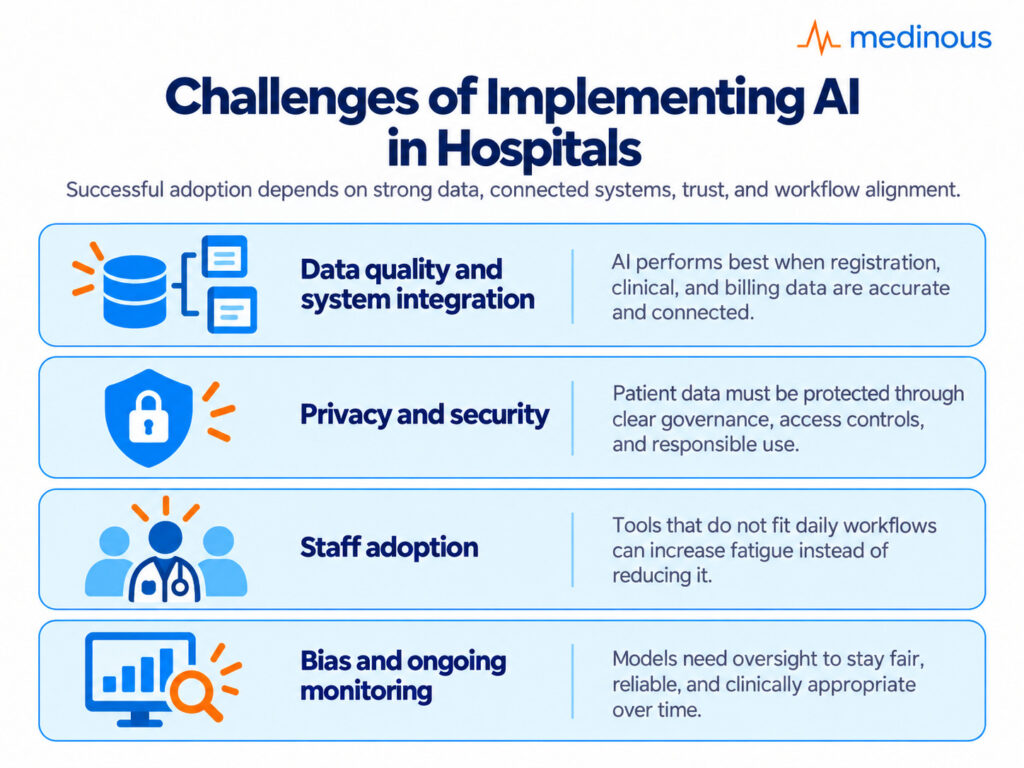
AI tools are only as good as the data feeding them. Hospitals with fragmented systems, where registration, clinical, and billing data all live separately, face a much harder path to reliable AI performance than those with a connected hospital management system in Saudi Arabia already in place. Integration challenges remain one of the most cited barriers to successful AI adoption in the region’s healthcare sector.
Privacy, Security, and Staff Adoption
Patient data protection remains a top priority as AI adoption grows. Saudi Arabia’s regulatory bodies have established frameworks specifically to safeguard patient privacy and address the ethical dimensions of AI use in healthcare.
Beyond regulation, staff adoption is a major challenge. AI models need continuous monitoring for bias and must stay aligned with real clinical workflows. The tools that feel disconnected from daily practice risk causing clinician fatigue rather than relief.
What to Consider Before Adopting AI in Hospital Management?
Here is a list of considerations you need to address before adopting AI in hospital management:
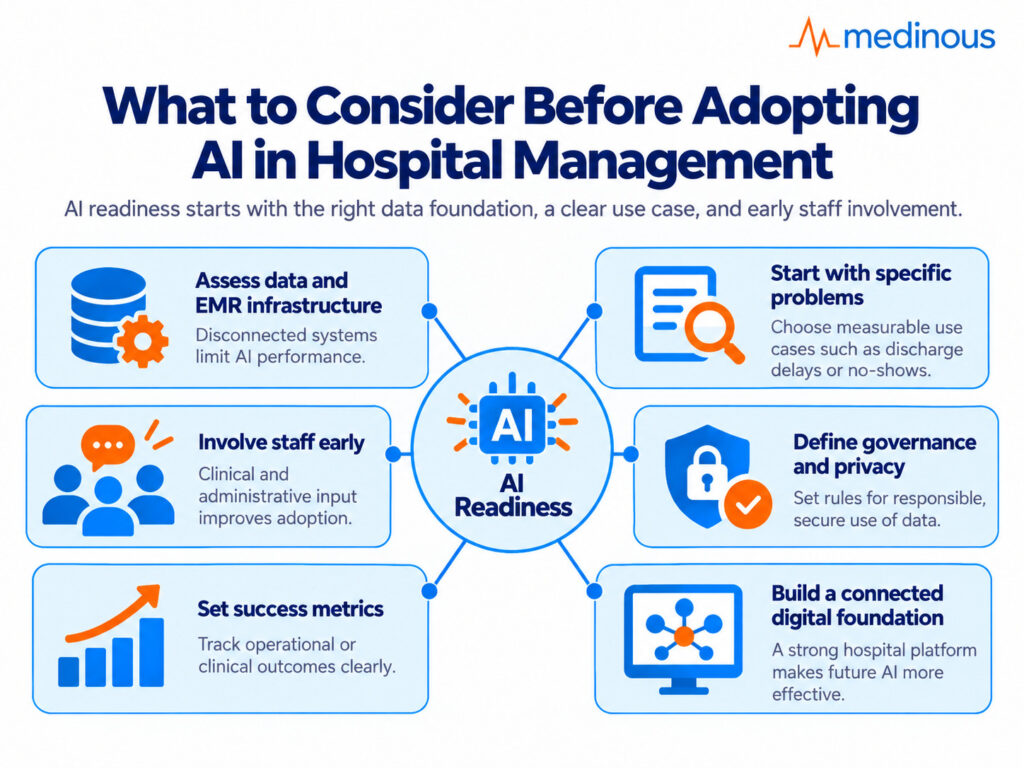
- Assess your data and EMR infrastructure: Before investing in AI, hospitals should evaluate their existing data and EMR infrastructure. Disconnected systems can limit the usefulness of even the most sophisticated AI tools.
- Start with specific problems: Identify one or two measurable challenges, such as predicting patient no-shows or reducing discharge delays, instead of adopting AI as a broad, undefined initiative.
- Involve staff early: Bring clinical and administrative teams into the process from the beginning. Their feedback and support can determine whether an AI pilot becomes part of daily operations or is abandoned after a few months.
The Future of AI in Saudi Healthcare
By 2030, Saudi Arabia’s healthcare system is expected to look meaningfully different, with AI underpinning a shift from reactive treatment toward preventative care, expanding access through digital platforms, and automating routine administrative work so clinicians can focus more directly on patients.
As more hospitals build the connected healthcare technology foundations that AI depends on, the gap between early adopters and the rest of the sector is likely to widen, making it increasingly important for hospital leaders to begin building that foundation now rather than later.
AI in hospital management is not a distant concept for Saudi healthcare organizations. It is already shaping how patients are triaged, how beds are allocated, and how administrators plan their days. Medinous supports this shift with a connected hospital management platform that gives your data the structure it needs to make any future AI investment more effective from day one.